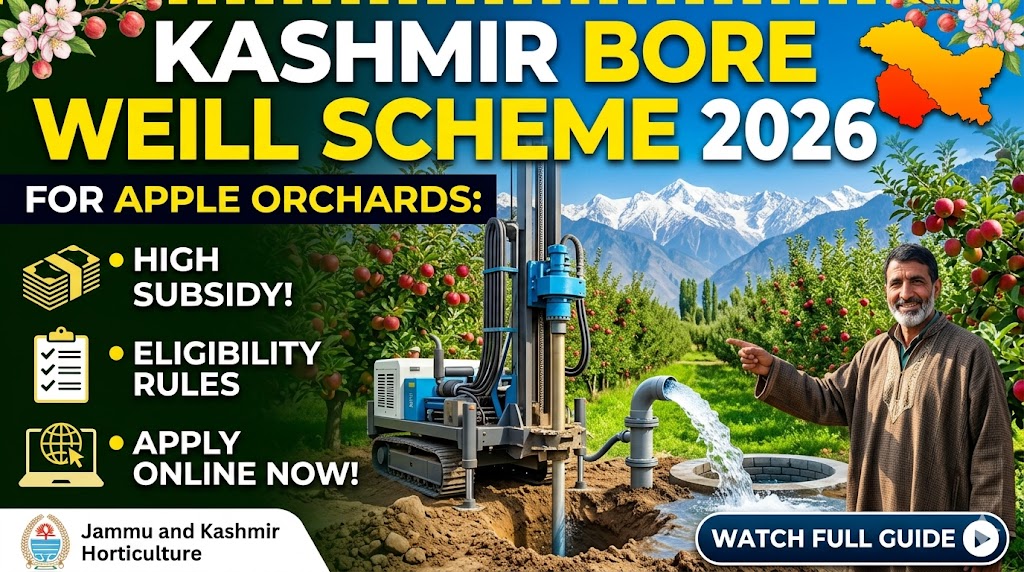
Every apple grower in Kashmir understands one fundamental truth — water is life for an orchard. A single season of water stress during critical growth stages can mean the difference between a bumper crop of premium-grade apples and a heartbreaking harvest of small, color-deficient fruit that barely covers the cost of production. In recent years, as snowfall patterns have become increasingly erratic and the traditional glacial meltwater streams that once reliably fed Kashmir’s orchards have grown uncertain, the need for dependable, controlled irrigation in apple farming has never been more urgent.
This is precisely where the Horticulture Bore Well Scheme for Apple Orchards steps in. Under the umbrella of major central government programs — including the Mission for Integrated Development of Horticulture (MIDH) and the Pradhan Mantri Krishi Sinchayee Yojana (PMKSY) — apple orchardists across Jammu & Kashmir can access substantial financial assistance to create their own reliable, on-farm groundwater source through individual tubewells and borewells.
In 2026, with the J&K Horticulture Department actively pushing water source creation as a priority intervention, thousands of apple growers are applying for bore well subsidies for the first time. This comprehensive guide will walk you through everything you need to know — what the scheme covers, who qualifies, how much subsidy you get, how to apply, and how to integrate a borewell into a high-productivity apple orchard irrigation system.
“An apple tree never asks when the rain will come — it asks only that water be there when it needs it. A borewell in your orchard is the answer to that question.”
1. Why Apple Orchards in Kashmir Need Reliable Irrigation
Kashmir’s apple industry is one of India’s most valuable agricultural assets. With over 7 lakh families directly or indirectly dependent on horticulture, and the sector contributing nearly ₹5,000 crore annually to J&K’s economy, apple farming is far more than a livelihood — it is the economic backbone of the entire valley.
Yet this powerful industry sits on a fragile water foundation. Historically, Kashmir’s apple orchards relied on three primary water sources: seasonal rainfall, snowmelt runoff through kuhls (traditional irrigation channels), and natural spring seepages. For most of the 20th century, this combination was adequate. But in 2026, the situation has changed dramatically:
- 🌡️ Erratic snowfall: Kashmir has witnessed below-normal snowfall in multiple recent winters, significantly reducing spring meltwater availability in orchards across Sopore, Shopian, Pulwama, and Anantnag.
- 💧 Drying kuhls: Many traditional irrigation channels (kuhls) have dried up or carry far less water than they did two decades ago — leaving orchardists dependent on unreliable seasonal rainfall alone.
- 🍎 New varieties need more water: The shift toward high-density apple plantations and modern varieties like Gala, Fuji, Red Delicious clones, and Super Chief has increased per-acre water demand significantly compared to old traditional orchards.
- ☀️ Warmer, drier summers: Rising summer temperatures increase transpiration from apple trees — boosting water demand at the very time when natural water availability is declining.
The result is an increasingly stressed irrigation situation that is directly impacting apple quality, size, and yield across Kashmir. Studies conducted by SKUAST-Kashmir have shown that water-stressed apple trees produce smaller fruit with poor color development — exactly the characteristics that reduce market price and export potential.
A privately-owned borewell in the orchard eliminates this dependency on unreliable external water sources. It places control of irrigation — the single most impactful quality-determining factor in apple farming — directly in the hands of the orchardist.
2. What Is the Horticulture Bore Well Scheme?
The Horticulture Bore Well Scheme is a government-subsidized water source creation program specifically designed to help fruit growers — particularly apple orchardists — establish their own on-farm groundwater extraction infrastructure. Under this scheme, eligible orchardists receive financial assistance toward the drilling, casing, and pump installation costs of an individual tubewell or medium borewell on their orchard land.
The scheme operates through the J&K Horticulture Department under two major centrally-sponsored frameworks:
- 🏛️ Mission for Integrated Development of Horticulture (MIDH) — Component: Creation of Water Sources
- 💧 Pradhan Mantri Krishi Sinchayee Yojana (PMKSY) — Component: Per Drop More Crop (PDMC) — micro irrigation structure creation including tube wells and dug wells
Together, these programs provide a multi-layered support system — funding not just the borewell itself, but also the pipeline distribution system, pump set, and downstream drip or sprinkler irrigation infrastructure. This means an orchardist can, through coordinated scheme benefits, establish a complete end-to-end water delivery system — from underground aquifer to the roots of each apple tree — with government support covering a significant share of the total cost.
3. Schemes That Cover Borewell Assistance in J&K in 2026
Understanding which scheme covers which component is essential for maximizing the total benefit you can access. Here is a clear breakdown of the major programs and what each provides:
| Scheme | Administering Body | Borewell / Water Source Component | Additional Benefits |
|---|---|---|---|
| MIDH (Mission for Integrated Development of Horticulture) | Ministry of Agriculture / J&K Horticulture Dept | Individual Tubewell / Borewell — subsidy up to ₹0.90 lakh per unit | Distribution pipeline up to 600 m; pump set subsidy |
| PMKSY-PDMC (Per Drop More Crop) | Ministry of Jal Shakti / J&K Agriculture/Horticulture | Micro-irrigation structure creation including tube wells & dug wells in groundwater-available areas | Drip and sprinkler system subsidy; water distribution infrastructure |
| HADP (Holistic Agriculture Development Programme) | J&K UT Administration | Water source and micro-irrigation integration for horticultural beneficiaries | Enhanced MIDH norms; integrated orchard development support |
| High-Density Plantation Scheme (NAFED-linked) | J&K Horticulture Dept / NAFED | Water infrastructure as part of integrated HDP package | 50% subsidy on plantation + 40% loan; valid 2021–2026 |
📌 Key Point: These schemes are complementary — not mutually exclusive. A smart orchardist can apply for the MIDH borewell subsidy AND the PMKSY drip irrigation subsidy simultaneously, effectively receiving government support for both the water source creation and the distribution system — dramatically reducing total out-of-pocket investment.
4. Subsidy Amount & What Gets Covered
One of the most common questions orchardists ask is: “Exactly how much will the government pay?” Here is the detailed breakdown of financial assistance available in 2026 under the primary schemes:
| Component | Subsidy / Assistance | Scheme |
|---|---|---|
| Individual Tubewell / Borewell Drilling & Casing | Maximum ₹0.90 lakh per unit | MIDH — Creation of Water Sources |
| Distribution Pipeline (connecting borewell to field) | ₹0.15 lakh per beneficiary; max pipe length 600 metres | MIDH |
| Pump Set (Electric / Diesel) | 50% of cost; maximum ₹0.10 lakh per unit (electric/diesel); maximum ₹0.50 lakh (solar/wind pump) | MIDH — Water Lifting Devices |
| Drip Irrigation System | 50% of cost; limited to maximum 4 hectares per beneficiary | PMKSY-PDMC / MIDH |
| Sprinkler / Rain Gun System | 50% of cost | PMKSY-PDMC / MIDH |
| Secondary Storage Structure (farm pond / water tank) | 100% of cost; maximum ₹20–25 lakh per unit (group/community) | MIDH (group application) |
| High-Density Plantation Package (including water infrastructure) | 50% subsidy + 40% loan on total project cost | HDP Scheme / NAFED (valid till 2026) |
What This Means in Real Numbers
A typical borewell for an apple orchard in Kashmir — including drilling to 150–300 feet depth, casing, pump set installation, and 200 metres of distribution pipe — costs between ₹1.80 lakh and ₹3.50 lakh depending on depth and ground conditions. With combined MIDH subsidy on the borewell (₹0.90 lakh), distribution pipeline (₹0.15 lakh), and pump set (₹0.10 lakh), the government effectively covers ₹1.15–1.20 lakh of your total investment — reducing out-of-pocket cost by 33–65% depending on total project size.
When you add the PMKSY drip irrigation subsidy on top of this for a one-hectare apple orchard — which can cover 50% of a drip system costing ₹80,000–₹1.20 lakh — the total government support across all components can easily reach ₹1.70–2.00 lakh per beneficiary orchard unit.
5. Who Is Eligible — Eligibility Criteria
The scheme is broadly accessible to most practicing apple orchardists in J&K. Here are the key eligibility conditions to confirm before applying:
- ✅ Land Ownership: You must own the orchard land where the borewell is to be installed. The land must be in your name in the revenue records (Jamabandi / Girdawari).
- ✅ Bearing Orchard Condition: The land must have an established apple orchard that is in bearing condition — or you must be in the process of establishing a new orchard under a recognized scheme (such as HDP).
- ✅ Minimum Land Area: A minimum orchard area of 3 Kanal is typically required for individual scheme benefits. For Ultra High-Density Plantation scheme linkage, the minimum is 1 Kanal.
- ✅ Groundwater Availability: The area must not be classified as a “semi-critical,” “critical,” or “over-exploited” groundwater zone by the Central Ground Water Authority (CGWA). Your local Horticulture Officer (CHO/HDO) can confirm zone status for your location.
- ✅ No Previous Benefit for Same Component: Applicants must not have received subsidy for an individual borewell on the same land under any government scheme in the preceding five years.
- ✅ Priority Categories: Small and marginal farmers (land holding below 2 hectares), SC/ST farmers, and women orchardists receive priority in allotment when scheme funds are limited.
💡 Pro Tip: If you are unsure whether your orchard area qualifies — particularly regarding groundwater zone classification — visit your nearest Chief Horticulture Officer (CHO) office in your district. The department maintains updated zone maps and can advise you before you invest time in the full application process.
6. How to Apply — Step-by-Step Process
Applying for the Horticulture Bore Well Scheme in J&K in 2026 involves a combination of online registration and physical documentation submission. Here is the complete process:
- 📱 Step 1 — Online Registration: Visit the J&K Horticulture Department’s official portal at hortikashmir.gov.in or the centralized J&K AgriStack portal. Create your farmer profile using your Aadhaar number and land records.
- 📋 Step 2 — Submit Online Application: Fill in the online application form under the MIDH / PMKSY borewell / water source creation component. Select your district, block, and village. Upload all required documents (see Section 7 below).
- 🏢 Step 3 — Submit Physical Application: Download the submitted online application and submit a hard copy — along with original documents for verification — to your block-level Chief Horticulture Officer (CHO) or Horticulture Development Officer (HDO) office.
- 🔍 Step 4 — Field Inspection: A department official will conduct a physical inspection of your orchard to verify land ownership, orchard condition, and the proposed borewell site. Ensure your orchard boundaries, trees, and land records are clearly visible and match your submitted documents.
- ✅ Step 5 — Approval & Work Order: Once approved at the district level, you receive a formal sanction letter. Do not begin drilling before receiving this sanction — work commenced before official approval is not eligible for subsidy reimbursement.
- 🔧 Step 6 — Borewell Drilling: Engage a registered borewell drilling agency. The J&K Horticulture Department may provide a list of empaneled contractors, or you may hire any registered driller. Ensure you obtain receipts and bills from the drilling agency — these are required for subsidy claim.
- 💰 Step 7 — Claim Submission & Disbursement: After drilling and pump installation are complete, submit your completion report with photographic evidence, drilling agency bills, and pump purchase receipts to your CHO/HDO. The department will conduct a completion inspection and release subsidy directly to your bank account via DBT (Direct Benefit Transfer).
7. Documents Required for Borewell Scheme Application
Preparing complete documentation before you apply will save significant time and prevent rejection or delays. Keep both originals and self-attested photocopies of every document listed below:
| Document | Purpose |
|---|---|
| Aadhaar Card (applicant) | Identity verification and DBT bank linkage |
| Jamabandi / Land Revenue Record (Girdawari) | Proof of orchard land ownership in your name |
| Khasra Map of orchard land | Land boundary and location verification |
| Bank Account Passbook (nationalized bank — first page) | DBT subsidy transfer destination |
| Passport-size photographs (2 copies) | Application form requirement |
| PRI (Panchayat) Recommendation Letter | Endorsement from local Panchayat representative |
| Existing orchard photographs (with location) | Field inspection support evidence |
| Previous scheme benefit declaration / self-certification | Confirm no duplicate benefit claim for same component |
| Drilling agency quotation (before sanction) | Cost estimation for sanction process |
| Drilling agency bills & receipts (after completion) | Subsidy claim documentation |
8. Understanding Borewell Technology for Apple Orchards
Knowing the technical basics of borewell construction helps you make informed decisions during the drilling process and ensures your borewell delivers reliable water for the lifetime of your orchard — potentially 30 to 50 years.
Drilling Depth
In most apple-growing districts of Kashmir — including Shopian, Pulwama, Sopore, and Anantnag — productive groundwater aquifers are typically found at depths between 80 feet and 300 feet, depending on local geology. A pre-drilling hydrogeological survey or consultation with your district’s Ground Water Department office is strongly recommended to estimate the likely productive depth before committing to drilling.
Casing & Well Construction
The borewell should be cased with PVC or MS (mild steel) casing pipes of minimum 4-inch diameter for individual orchard borewells. Proper gravel packing around the slotted screen section and sanitary sealing of the annular space at the top prevents surface contamination of groundwater — critical for food-safe apple production.
Pump Selection
For apple orchards in Kashmir, a submersible pump of 0.5 to 2 HP capacity is typically sufficient depending on orchard size and delivery head. Solar-powered submersible pumps are increasingly popular — they attract higher subsidy (up to ₹0.50 lakh versus ₹0.10 lakh for electric pumps) and eliminate electricity bills entirely, making them particularly attractive for orchards in remote areas without reliable grid power.
Yield Testing
Always conduct a pump test (yield test) after drilling to confirm the borewell’s sustainable yield before installing permanent equipment. A borewell delivering a minimum of 1,500–2,000 litres per hour is generally adequate for one hectare of apple orchard under drip irrigation.
9. Integrating Borewell Water with Drip & Sprinkler Irrigation
A borewell alone is not an irrigation system — it is the water source. To efficiently deliver that water to each apple tree exactly when and in the quantity needed, the borewell must be integrated with a properly designed micro-irrigation system. In 2026, two primary options are used in Kashmir apple orchards:
Drip Irrigation (Trickle Irrigation)
Drip irrigation delivers water slowly and directly to the root zone of each tree through emitters placed along lateral pipes. For apple orchards, a standard drip system uses 2–4 emitters per tree with flow rates of 4–8 litres per hour each. The advantages for apple orchards are compelling: up to 50–60% water savings compared to flood or sprinkler irrigation; improved fruit size, color, and quality; compatibility with fertigation (fertilizer application through the drip system); and minimal leaf wetness that reduces fungal disease risk.
Anti-Frost Sprinkler / Overhead Sprinkler
Kashmir’s apple orchards face a uniquely threatening climate hazard — spring frost during blossoming (typically April–May). A single frost event at full bloom can destroy 70–100% of the year’s crop within hours. Overhead sprinkler systems connected to the borewell serve a dual purpose: regular summer irrigation and frost protection — when water is sprayed over blossoming trees as temperatures drop, the latent heat released as water freezes on the blossoms keeps flower tissue temperature just above the lethal threshold. This single benefit alone can justify the entire investment in a borewell-plus-sprinkler system in frost-prone areas of Shopian, Kulgam, and Anantnag.
10. Critical Irrigation Stages for Apple Trees in Kashmir
Understanding when your apple trees most need water is fundamental to getting maximum yield and quality from your borewell investment. Here are the most critical irrigation windows in the Kashmir apple calendar:
| Growth Stage | Approximate Timing (Kashmir) | Why It Matters |
|---|---|---|
| Pre-blossom irrigation | Late March – Early April | Supports uniform bud break and strong blossom development |
| Petal fall / Fruit set | Late April – May | Critical for fruit set and early cell division; drought here causes heavy fruit drop |
| Cell division phase | May – June | Determines final fruit size potential; water stress causes permanently small fruit |
| Cell enlargement phase | June – July | Peak water demand; adequate irrigation here directly increases fruit size and weight |
| Pre-harvest sizing | August | Final sizing and color development; slight water stress can improve color but must be managed carefully |
| Post-harvest irrigation | October – November | Replenishes tree reserves before dormancy; improves next year’s blossoming potential |
⚠️ Critical Warning: Water stress during the cell division phase (May–June) causes irreversible reduction in final fruit size — no amount of irrigation later in the season can compensate. This is the period when your borewell delivers its highest return on investment.
11. Bore Wells & High-Density Apple Plantation — The Winning Combination in 2026
The most significant shift in Kashmir apple farming in recent years has been the large-scale adoption of High-Density Plantation (HDP) — growing apple trees at much closer spacings (1,100–3,000 trees per hectare versus 100–170 trees per hectare in traditional orchards). Modern HDP varieties include Gala, Fuji, Crimson Gold, Scarlet Spur, and high-value clones that begin bearing fruit in just 2–3 years versus 7–10 years for traditional varieties.
High-density apple orchards, however, have a fundamental water requirement that traditional orchards do not: they must have reliable, controlled irrigation. The dwarfing rootstocks used in HDP (primarily M-9, M-26, and M-7) have shallow, limited root systems that cannot access deep soil moisture the way traditional semi-dwarf or standard rootstocks can. Even brief periods of water stress dramatically reduce fruit set, size, and quality in HDP orchards.
This is exactly why the J&K government links borewell-plus-drip irrigation infrastructure support with its High-Density Plantation scheme promotion. An HDP orchard without controlled irrigation is a high-risk investment. An HDP orchard with a borewell and drip system is a highly profitable, bankable enterprise capable of generating ₹3–8 lakh per acre annually once in full production.
In 2026, progressive apple growers across Pulwama, Shopian, Sopore, and Baramulla are combining the HDP scheme’s 50% plantation subsidy with the MIDH borewell assistance and PMKSY drip irrigation subsidy — accessing three layers of government support simultaneously to build future-proof orchards at dramatically reduced personal investment.
12. Common Challenges & How to Overcome Them
While the Horticulture Bore Well Scheme offers tremendous potential, orchardists in Kashmir report several practical challenges in accessing and maximizing scheme benefits. Being aware of these issues in advance helps you navigate them successfully.
Delayed Subsidy Disbursement
A widely reported challenge — orchardists invest their own money in drilling and equipment, then wait months for reimbursement. Solution: Avail a short-term Kisan Credit Card (KCC) loan at 4% interest to finance the upfront cost while your subsidy claim is processed. Always submit your completion documentation promptly and follow up with your CHO office regularly.
Groundwater Zone Restrictions
Some blocks in certain J&K districts may be classified as groundwater-stressed zones where new borewells face restrictions. Solution: Check your block’s groundwater classification before applying. If your area is restricted, explore rainwater harvesting structures and farm ponds — also subsidized under MIDH’s secondary water storage component — as alternatives.
Rocky Terrain and High Drilling Costs
Many apple-growing areas of Kashmir have hard rock formations that significantly increase drilling costs beyond the maximum subsidy ceiling. Solution: Obtain multiple competitive quotes from drilling agencies. Consider pooling resources with neighboring orchardists to drill a shared borewell and access the community water storage subsidy (up to ₹25 lakh for group applications in hilly areas) — distributing costs and maximizing the subsidy benefit across multiple farms.
Technical Knowledge Gap
Many orchardists are unfamiliar with pump sizing, pipe layout design, and drip system installation — leading to poor system performance. Solution: Request a free technical consultation from your district’s horticulture office or SKUAST-Kashmir extension officers before finalizing your system design. Properly designed irrigation systems regularly outperform poorly designed ones by 30–50% in water delivery efficiency.
13. How Kashmiri Orchardists Are Using Bore Wells to Transform Their Farms
Across Kashmir’s apple belt, orchardists who have installed government-supported borewells and drip systems are reporting remarkable transformations in their orchard productivity and fruit quality. The pattern is consistent:
In the apple-growing areas of Shopian and Pulwama — where erratic summer rainfall and the loss of traditional kuhl water have been most acutely felt — farmers who invested in borewells linked to drip irrigation systems over the past three to four years now report fruit size improvements of 30–50% (more fruit in the A-grade and premium grade categories) and yield increases of 25–40% over their pre-irrigation baseline. These are the orchards that secure direct contracts with large buyers and exporters — precisely because their fruit quality is consistent season after season.
In Sopore and Baramulla, where high-density plantation adoption has been most rapid, progressive orchardists who combined HDP scheme support with borewell and drip system assistance describe the combination as “the best agricultural investment” of their lives — with the borewell-drip system paying back its net cost within two to three productive seasons through improved fruit grade realization and premium pricing.
The orchardists who are thriving in 2026 are not the ones with the most land. They are the ones who control their water.
14. Frequently Asked Questions — Horticulture Bore Well Scheme Kashmir 2026
Q1. How much subsidy will I get for a borewell in my apple orchard in Kashmir?
Under the MIDH scheme’s Creation of Water Sources component, you can receive a maximum of ₹0.90 lakh per unit for an individual tubewell or borewell. Additionally, up to ₹0.15 lakh for distribution pipes (up to 600 metres) and up to ₹0.50 lakh for a solar pump set are available separately. Total combined assistance can reach ₹1.55 lakh or more depending on the components you apply for.
Q2. Can I apply for borewell subsidy and drip irrigation subsidy together?
Yes — and this is highly recommended. The MIDH borewell subsidy and the PMKSY Per Drop More Crop (PDMC) drip irrigation subsidy are complementary schemes that can be availed simultaneously on the same orchard. Apply for both through your district Horticulture Department to maximize the total government support available.
Q3. What is the minimum land requirement to apply for the borewell scheme?
For the standard MIDH water source creation benefit, the general minimum is 3 Kanal of orchard land in the applicant’s name. For orchardists participating in the Ultra High-Density Plantation scheme, the minimum qualifying area is 1 Kanal. Check with your local CHO office for any district-specific variations in 2026.
Q4. Can I start drilling the borewell before receiving the government sanction letter?
No. Work begun before receiving the official sanction letter from the Horticulture Department is not eligible for subsidy reimbursement. Always wait for the written sanction before commencing any drilling or pump installation work. This is a firm and non-negotiable requirement under all scheme guidelines.
Q5. Is a solar pump eligible for higher subsidy than a regular electric pump?
Yes. Under the MIDH Water Lifting Devices component, a solar/wind pump attracts a maximum subsidy of ₹0.50 lakh per unit — five times higher than the ₹0.10 lakh maximum available for a conventional electric or diesel pump. For apple orchards in areas with unreliable grid power, the solar pump is both the practically superior and financially more beneficial choice.
Q6. Where do I submit my application for the borewell scheme in Kashmir?
Applications are submitted both online — through the J&K Horticulture Department portal at hortikashmir.gov.in — and physically at your block-level Chief Horticulture Officer (CHO) or Horticulture Development Officer (HDO) office. Both submissions are required. Contact your district horticulture office for the latest 2026 application window dates, as annual cutoff dates vary.
15. Conclusion: Water Security Is Orchard Security
The single most important infrastructure investment an apple orchardist in Kashmir can make in 2026 is securing a reliable, controlled, on-farm water source. The erratic weather patterns of recent years, the decline of traditional irrigation channels, and the rising water demands of modern high-density orchards have collectively made the old approach of depending on rainfall and seasonal channels increasingly untenable for any orchardist serious about quality production and consistent income.
The Horticulture Bore Well Scheme — through MIDH, PMKSY, and the linked HDP program — exists precisely to make this critical investment affordable for every orchardist, from smallholders with 3 Kanal of orchard land to larger growers managing multiple hectares. With government assistance potentially covering ₹1.55–2.00 lakh of total infrastructure cost per beneficiary, the scheme dramatically lowers the barrier to entry for a borewell-plus-drip system that can transform orchard productivity for the next 30–40 years.
Do not wait for another drought season, another frost event with no water to run the sprinklers, or another year of small, discolored fruit due to summer water stress. Visit your CHO office, complete your registration, gather your documents, and apply today.
The orchards of Kashmir that will lead the industry in the next decade are being built right now — by growers who understood that the path to premium apples runs through reliable water.
🍎 If this guide helped you understand the Horticulture Bore Well Scheme better, share it with fellow orchardists in your village. Every farmer who secures water security makes the entire apple belt stronger.
📌 Disclaimer: Scheme details, subsidy amounts, and eligibility criteria are based on published government guidelines and may be updated by authorities. Always confirm current-year specifications with your district Chief Horticulture Officer (CHO) or the J&K Horticulture Department before applying. This article is for informational purposes only.