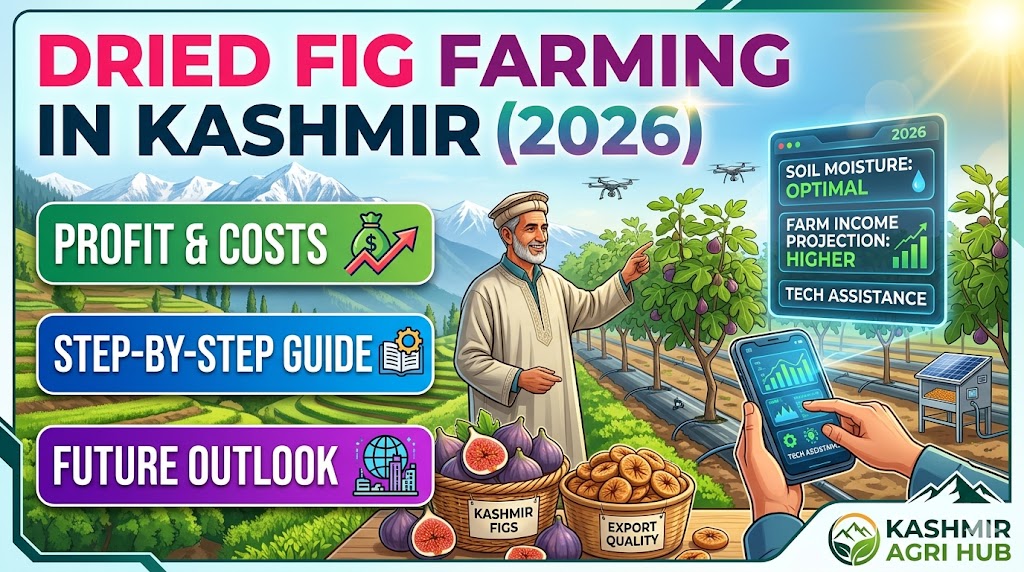
Every few months, a new fruit crop gets talked about as “the next big thing” for Kashmiri orchardists. Walnuts had their moment. So did cherries. Lately, it’s dried figs — locally known as anjeer — that keep coming up in conversations among farmers in Pulwama, Shopian, and parts of Anantnag who are tired of apple price crashes and looking for something that doesn’t need a cold store the moment it’s harvested.
So here’s the honest question this article tries to answer: can a Kashmiri farmer actually make money growing figs for the dried fruit market in 2026, or is this just another trend that sounds good on paper?
We dug into the agronomy, the local growing conditions, and the economics — not the marketing pitch.
Why Figs Are Even Being Considered in Kashmir
Figs are not a traditional Kashmir Valley crop the way apples, walnuts, and almonds are. Most of India’s commercial fig production has historically come from Maharashtra, particularly around Purandar near Pune, where the climate is warm and dry. So why is anyone talking about figs in a valley known for snow and cold winters?
A few reasons keep surfacing:
Diversification pressure. Apple orchards in South Kashmir have been hit hard by erratic hailstorms and falling market prices over the last few seasons. Farmers with even half a kanal of spare land are experimenting with alternatives that don’t compete directly in the apple glut.
Drying solves the perishability problem. Fresh figs spoil within a day or two of picking, which is a nightmare for a region with limited cold-chain infrastructure outside the apple sector. But dried figs have a shelf life measured in months, and dried fruit already has an established trade network through Kashmir’s existing dry fruit markets in Srinagar’s Maharaj Bazar and beyond.
Microclimate variation. Kashmir isn’t climatically uniform. Lower-altitude belts in Kupwara, parts of Baramulla, and sheltered valleys in Kishtwar and Doda (Jammu region, but often grouped with J&K horticulture planning) get warmer, drier summer stretches that are closer to what fig trees actually want.
What Figs Actually Need to Thrive
This is where a lot of enthusiasm runs into reality. Figs are a Mediterranean-origin crop. They want:
- Long, hot, relatively dry summers for fruit ripening and sugar development
- Well-drained soil — figs hate waterlogging and will develop root rot quickly in heavy, wet clay
- Protection from late spring frost, since young shoots are frost-sensitive
- Winter chill that isn’t excessive — most common fig varieties don’t need the deep, prolonged cold that apple varieties like Red Delicious require
Central Kashmir’s high-altitude, heavy-snowfall belts are genuinely risky territory for fig cultivation. But lower, south-facing slopes with good drainage — the kind already used for early-season vegetables or grapes in places like Budgam’s warmer pockets — can work, provided the orchard gets winter protection in the early years.
This isn’t a crop you plant blindly across a kanal and walk away from. It’s a crop that rewards a farmer who actually studies their own plot’s microclimate first.
Variety Selection Matters More Than People Admit
A surprising number of first-time growers buy whatever sapling is available locally without checking if the variety suits drying. Not all figs dry well — some are bred for fresh eating and have too much moisture content or thin skin that splits during sun-drying.
Varieties worth researching for a drying-focused orchard include Poona Fig (commonly grown in Maharashtra and reasonably adaptable), Black Mission, Brown Turkey, and Conadria — the last of which is specifically known for good drying characteristics. Brown Turkey in particular has a reputation for being more cold-tolerant than many other fig cultivars, which makes it worth a closer look for Kashmir’s borderline winter conditions.
Before ordering saplings, it’s worth contacting the regional horticulture department or SKUAST-Kashmir’s research stations to ask whether any fig variety trials have already been conducted locally. Planting based on someone else’s two years of trial data is far cheaper than discovering a variety’s weaknesses after five years of your own.
The Real Cost of Starting a Fig Orchard
Here’s where most online articles get vague. Let’s actually break it down for a one-kanal (roughly 0.125 acre, or about 500 square meters) plot, which is a realistic starter size for a farmer testing the waters.
Year one setup costs:
- Land preparation and drainage work: this varies wildly depending on existing soil condition, but budget for proper drainage if your plot tends to hold water
- Saplings: fig trees are typically planted 12-15 feet apart, so a kanal might hold around 25-30 trees depending on spacing chosen
- Staking, basic irrigation setup (drip is strongly preferred over flood irrigation for figs), and frost protection material for young plants
- Labor for planting and initial care
Years two and three: mostly maintenance — pruning, irrigation, pest monitoring, and winter protection of young trunks. Figs are relatively low-input once established compared to apples, which need constant spraying.
Year three or four onward: first meaningful harvests typically begin, though full production usually isn’t reached until year five or six.
The blunt truth is that fig farming, like most fruit tree crops, is not a fast-money venture. Anyone expecting first-year profit should reconsider. The real return shows up from year four onward, and the question worth asking is whether you can afford the patience and the maintenance costs during the unproductive years.
What the Drying and Processing Step Actually Costs
This is the part that separates fresh fig growing from dried fig farming, and it’s where Kashmir has a genuine logistical question mark.
Traditional sun-drying needs sustained dry, hot weather over several consecutive days — exactly the kind of stretch that’s reliable in Maharashtra’s climate but less guaranteed in Kashmir, where sudden rain or humidity spikes can ruin a drying batch and even encourage mold.
This pushes serious growers toward one of two paths:
- Solar dryers — enclosed structures that protect the fruit from rain and insects while still using sun-generated heat. These cost more upfront than open sun-drying but dramatically reduce spoilage risk and produce a more consistent, market-ready product.
- Mechanical dehydrators — electric or fuel-based dryers that give full control over temperature and humidity regardless of outside weather. More expensive to buy and run, but they make drying a year-round, weather-independent process.
For a small one-kanal grower, a basic solar dryer is usually the more sensible first investment rather than jumping straight to mechanical dehydration. It’s a cost that needs to be planned for from the start, not treated as an afterthought once the fruit is already on the trees.
Where the Money Actually Comes From
Once you have a consistent supply of properly dried figs, the sales side has a few realistic channels:
Local dry fruit markets. Kashmir already has an established dry fruit trade through Srinagar wholesalers who deal in almonds, walnuts, and apricots. A grower with a small but consistent supply can often get a foot in the door here, especially if the product quality is visibly better than commodity-grade imported dried figs.
Direct-to-consumer sales. With dried fruit being shelf-stable, small growers increasingly sell directly through local social media pages, WhatsApp groups, and small retail tie-ups, cutting out middlemen and capturing a bigger share of the final price.
Value-added products. Some growers process a portion of their harvest into fig jam, fig and walnut energy bars, or gift-pack assortments alongside other Kashmiri dry fruits. This adds labor but can significantly raise margins compared to selling plain dried figs.
It’s worth being realistic that Kashmir cannot currently compete with Maharashtra or Turkey on sheer volume. The opportunity here is more about a premium, locally-branded, small-batch product than mass commodity production — at least in these early years of the crop’s adoption in the Valley.
Risks Nobody Should Gloss Over
Honest reporting means listing what can go wrong:
- Winter dieback in young trees if frost protection is inadequate, especially in the first two to three winters
- Inconsistent drying weather, which can ruin a batch or force reliance on solar/mechanical drying that adds cost
- Limited local market data, since this isn’t an established Kashmir crop the way apples or walnuts are — pricing and demand patterns are still forming
- Pest pressure, particularly fig rust and fruit flies, which need monitoring even though figs are generally lower-maintenance than apples
- Long payback period, with meaningful income typically not arriving before year four
Is It Worth Trying in 2026?
For a farmer with even a small plot of well-drained, sheltered land and the patience to wait three to four years before serious income, fig farming for drying purposes is a genuinely interesting diversification option in Kashmir right now — precisely because so few people are doing it yet, which means less competition and room to build a local brand.
It is not, however, a guaranteed substitute for apple income, and it should not be approached as a quick pivot crop. Treat it as a long-term experiment on a small portion of land first — maybe a few kanals at most — rather than converting an entire established orchard. Talk to the local horticulture extension office, check what variety trials exist for your specific elevation and aspect, and budget honestly for the drying infrastructure from day one rather than as an afterthought.
Kashmir’s agricultural future probably isn’t about replacing apples wholesale with something else. It’s about farmers building a more diverse basket of crops so that one bad apple season doesn’t wipe out an entire year’s income. Dried figs, grown carefully and in the right microclimate, could reasonably be one small but useful piece of that basket.
Frequently Asked Questions
Is fig farming suitable for all parts of Kashmir? No. Figs need well-drained soil and relatively warm, dry summers, so they suit lower-altitude, sheltered, south-facing locations better than high-altitude or heavy-snowfall belts.
How long before a fig tree starts giving a real harvest? Most growers see initial fruiting by year three, with meaningful, fuller production typically arriving from year four or five onward.
Do I need a dryer, or can I sun-dry figs in Kashmir? Open sun-drying is riskier here because of unpredictable rain and humidity. A basic solar dryer is a safer investment for consistent, mold-free results.
Which fig variety is best for Kashmir’s climate? Cold-tolerant varieties like Brown Turkey are worth investigating first, but it’s best to check with local horticulture research stations for any region-specific trial results before committing.