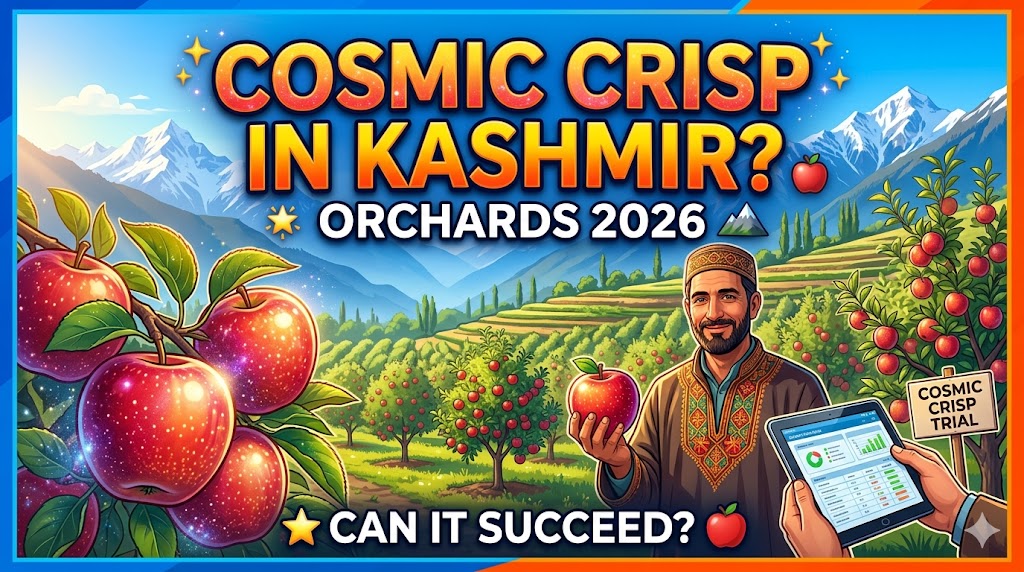
Every couple of years, word of some new apple variety makes its way into orchard conversations across South Kashmir’s apple belt — Shopian, Pulwama, Kulgam, Sopore. Farmers hear about a variety doing well somewhere else in the world and start wondering if it’s worth a try on their own land. Cosmic Crisp is one of those names that’s been coming up more often lately, mostly because of how aggressively it’s been marketed and how fast it’s grown in the American market since its release.
So what actually is Cosmic Crisp, why has it become such a big deal in the US, and does any of that relevance translate to Kashmir’s apple economy? This article walks through the real story, separating the marketing hype from what actually matters for an orchardist deciding what to plant.
What Cosmic Crisp Actually Is
Cosmic Crisp is a relatively new apple variety developed in Washington State, the heart of America’s apple industry. It’s a cross between two well-known varieties — Honeycrisp and Enterprise — bred specifically by researchers at Washington State University over roughly two decades of selection and testing before its commercial release.
The variety gets its name from the pale dots, or lenticels, scattered across its skin, which growers and marketers said resembled stars against a night sky — hence “Cosmic.” It officially entered the US market in late 2019 after a carefully managed, exclusive rollout, and has since become one of the most heavily promoted new apple varieties in recent American agricultural history.
Cosmic Crisp is known for a few specific traits: a notably long shelf life that allows it to stay crisp and fresh in storage for many months longer than many traditional varieties, a balanced sweet-tart flavor profile, and a firm, juicy texture that holds up well during shipping and handling. These traits were intentionally bred in, since the modern apple market increasingly rewards varieties that survive long supply chains without losing quality — exactly the qualities that made Honeycrisp, one of its parent varieties, such a commercial success before it.
Why It Matters in the American Apple Market
Washington State controls patent and licensing rights over Cosmic Crisp, and for the first several years after release, only Washington-based growers were permitted to plant it commercially. This kind of controlled, exclusive release — combined with a substantial marketing budget — is part of why Cosmic Crisp grew its market share so quickly compared to typical new apple varieties, which usually take much longer to gain shelf space against established names like Gala, Fuji, and Red Delicious.
For American growers, Cosmic Crisp represented an opportunity to plant a variety with built-in marketing support and a long storage life that reduces the pressure to sell the entire harvest quickly — a meaningful advantage in a market where storage and post-harvest losses eat heavily into grower margins.
Why Kashmiri Farmers Are Even Hearing About It
Kashmir’s apple economy is, in many ways, structurally similar to what Washington State’s apple industry looked like a generation or two ago — a region whose entire agricultural identity and a huge share of rural income is tied to a single fruit crop. So when American apple news travels, it naturally catches the attention of Kashmiri growers who are constantly looking for ways to diversify beyond the traditional Red Delicious-dominated orchard mix that has increasingly struggled with price volatility and quality competition from imported and domestically grown alternatives in recent years.
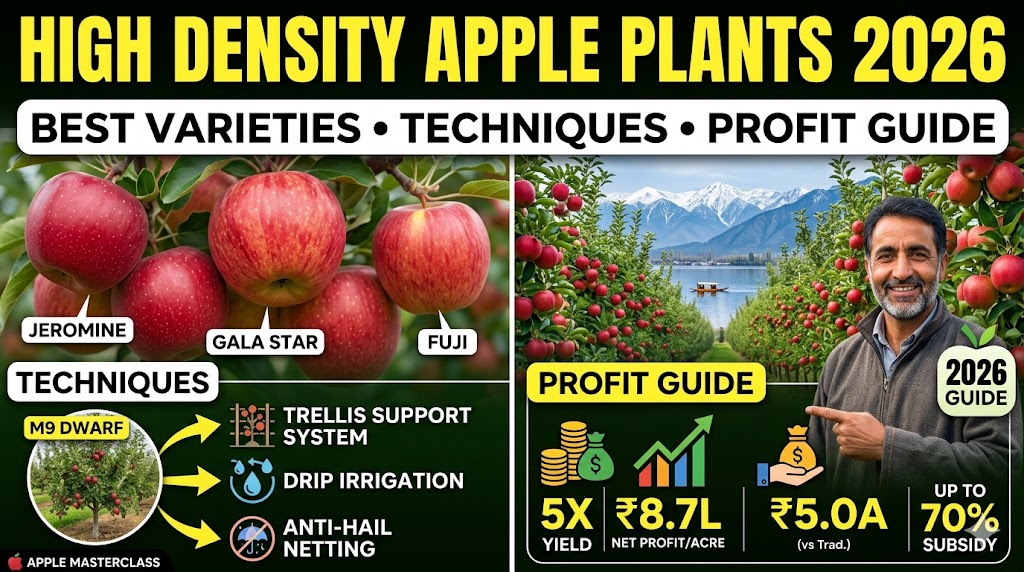
Kashmiri farmers have already gone through a similar shift once before, with many orchardists switching portions of their land to high-density plantings of varieties like Gala and Fuji to compete more directly on quality and consistency. Hearing about a variety like Cosmic Crisp, which markets itself on exactly those qualities — consistency, long shelf life, premium positioning — naturally raises the question of whether it’s the next logical addition.
The Practical Reality: Can Kashmir Actually Grow It?
Here’s where enthusiasm needs to meet some hard agronomic and legal realities.
Patent and licensing restrictions. Cosmic Crisp is a proprietary, patented variety. For years, its planting was restricted almost entirely to licensed growers within Washington State, and even as some international licensing has slowly expanded, accessing genuine, legally licensed planting material is not as simple as ordering saplings from a local nursery. Any Kashmiri orchardist considering this variety needs to verify, through proper horticultural import channels, whether legitimate licensed material is even available for import into India, rather than relying on unverified saplings sold informally as “Cosmic Crisp” — a real risk in any market where a variety becomes internationally hyped before it’s properly available.
Climatic fit is not guaranteed. Cosmic Crisp was bred and extensively tested specifically for Washington State’s growing conditions — long, sunny, relatively dry summers and a particular winter chill pattern. Kashmir’s climate, while suitable for apples broadly, has its own distinct combination of humidity, monsoon-influenced summer rainfall, and chill hours that differs meaningfully from Washington’s high-desert apple-growing regions. A variety performing exceptionally well in Washington offers no guarantee of similar performance in Kashmir without proper region-specific trials first.
No local trial data yet. Unlike well-established Kashmir varieties or even more recently introduced ones like certain high-density Gala and Fuji clones, there’s currently very limited or no published trial data from SKUAST-Kashmir or similar institutions specifically testing Cosmic Crisp’s performance in Valley conditions — yield, disease resistance, color development, and storage behavior under local conditions all remain genuinely unknown for now.
What Kashmiri Growers Can Actually Learn From the Cosmic Crisp Story
Even if planting Cosmic Crisp itself isn’t realistic or advisable in the near term, the underlying story carries some genuinely useful lessons for Kashmir’s apple sector.
Storage life is a competitive advantage worth chasing. Whatever variety Kashmiri growers continue to refine and plant, the broader lesson from Cosmic Crisp’s success is that the global apple market increasingly rewards fruit that performs well in long-term cold storage. Investment in proper post-harvest handling and storage infrastructure — something Kashmir has been gradually building through government-supported cold storage schemes — matters just as much as which variety is in the ground.
Controlled, quality-focused branding works. Washington State’s tightly managed rollout of Cosmic Crisp, prioritizing consistent quality over flooding the market immediately, offers a model worth studying for Kashmir’s own apple branding efforts, including geographical indication tagging and quality-grading systems that have been discussed for Kashmiri apples in recent years.
Diversification still matters, but through proven regional trials. Rather than chasing the newest internationally hyped variety, Kashmir’s horticulture research institutions and progressive farmers are better served by continuing structured trials of varieties that have already shown adaptability to similar humid, monsoon-influenced apple-growing climates elsewhere — places like parts of Himachal Pradesh, or apple regions in countries with climates closer to Kashmir’s own, rather than high-desert Washington State.
A Realistic Path Forward, If Interest Persists
For a Kashmiri orchardist who’s still genuinely curious about eventually trying Cosmic Crisp or a similarly positioned premium variety, a sensible path looks something like this:
- Start with research, not saplings. Reach out to SKUAST-Kashmir or the regional horticulture department to ask whether any institutional interest or trial planning exists for this or similar premium international varieties.
- Verify licensing legitimacy before any purchase, since the apple variety market — both within India and internationally — has a real problem with mislabeled or fraudulently sold “exotic” saplings that turn out to be something else entirely once they bear fruit years later.
- Trial on a small scale first — a few trees on a small plot, not a wholesale orchard conversion — to observe actual local performance over several seasons before any larger investment.
- Compare honestly against already-proven alternatives. Kashmir has had real success stories with high-density Gala, Fuji, and certain newer Red Delicious clones that have track records in local conditions. Any new variety needs to genuinely outperform these known quantities to justify the risk and patience required, not just ride on international name recognition.
The Bottom Line
Cosmic Crisp is a genuinely impressive piece of modern apple breeding and an interesting case study in how a single new variety, backed by patient research and smart marketing, can reshape a regional fruit market. But its success in Washington State doesn’t automatically translate into a guaranteed opportunity for Kashmir.
For now, the more valuable takeaway for Kashmiri growers isn’t “plant Cosmic Crisp” — it’s “study what made Cosmic Crisp succeed, and apply those same principles of patient variety development, proper regional trials, and quality-focused branding” to Kashmir’s own apple economy and its already well-suited, time-tested varieties.
Frequently Asked Questions
Is Cosmic Crisp apple available to grow in India? Genuine, legally licensed Cosmic Crisp planting material is not widely or easily available in India at present, since the variety remains patent-protected with restricted distribution. Farmers should verify legitimacy carefully before purchasing any saplings sold under this name.
What makes Cosmic Crisp different from other apple varieties? It’s known mainly for its long storage life, balanced sweet-tart flavor, and firm texture, bred from a cross between Honeycrisp and Enterprise apples in Washington State.
Would Cosmic Crisp grow well in Kashmir’s climate? There’s currently no published local trial data confirming this. Kashmir’s humidity and rainfall patterns differ from Washington State’s drier growing conditions, so performance would need to be verified through proper regional trials first.
What can Kashmiri apple growers learn from Cosmic Crisp’s success even without growing it? The bigger lessons are around investing in post-harvest storage infrastructure and pursuing controlled, quality-focused branding, both of which matter regardless of which specific apple variety is being grown.