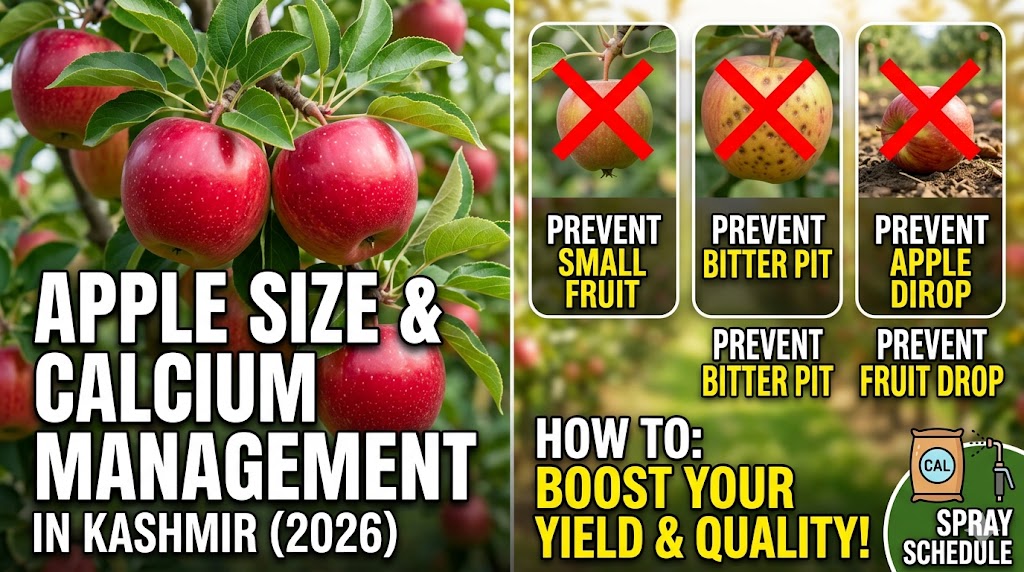
In Kashmir apple orchards, fruit size and fruit quality are determined long before harvest. One of the most overlooked nutrition decisions is calcium management—not only how much calcium you apply, but how calcium reaches the fruit during the critical growth window.
When calcium movement is weak, growers may see small fruit, uneven sizing, internal defects, and disorders such as bitter pit. Sometimes calcium deficiency symptoms appear even when soil calcium levels look “okay” on paper—because the real problem is often uptake, root activity, and fruit transpiration.
This guide is written for practical orchard work in Kashmir. You will learn how to identify calcium-related problems, what causes them, how to plan calcium nutrition by orchard stage (not randomly),
and how to combine calcium sprays with irrigation and canopy practices so you can increase fruit size and reduce quality losses.
Quick calcium checklist (scouting before you spray)
| What to check | Why it matters | Your action |
|---|---|---|
| Fruit size uniformity | Small or uneven fruit often indicates stage-wise nutrition/transport issues | Confirm fruit set, thinning timing, and nutrition plan |
| Water stress pockets | Calcium movement depends on steady root uptake and fruit transpiration | Check irrigation uniformity; fix wet/dry patches |
| Canopy density (airflow) | Dense canopy affects spray coverage and increases disease pressure | Prune/leaf management to improve coverage |
| Early symptoms on fruit | Early signs help you time calcium interventions | Identify likely disorder: bitter pit vs other defects |
1) Why calcium is linked to fruit size in apples
Calcium plays a structural role in plant cell walls and also supports strong fruit development.
In apple orchards, calcium is most beneficial when it reaches the fruit in sufficient amounts during fruit cell expansion and fruit maturation.
That’s why “calcium shortage” in the field is often not a simple soil problem.
Calcium uptake and transport depend on:
root health, water status, transpiration, and canopy/leaf balance.
If trees have inconsistent water supply (common in orchards with uneven drip distribution or soil compaction),
calcium movement to fruit decreases and disorders become more visible later.
2) Calcium disorders you should know (bitter pit and related issues)
2.1 Bitter pit: the most common calcium-related disorder
Bitter pit is usually expressed as small brown spots on the fruit surface and can progress internally as well.
Symptoms may appear closer to harvest or during storage, depending on disorder severity and management.
Important: not every brown spot is bitter pit.
To diagnose correctly, compare:
- Pattern and timing (does it appear after a period of water stress?)
- Distribution across the orchard (does it follow low spots or irrigation patches?)
- Storage behavior (does it worsen after cold storage?)
2.2 Small fruit & uneven sizing
Calcium management affects fruit size indirectly through overall orchard balance.
If leaf/root/fruit transport is weak, the orchard cannot maintain steady fruit development.
This results in small fruit, reduced grade quality, and lower market returns.
2.3 Fruit drop / fruit set issues (indirect link)
Fruit drop can have multiple causes (pollination stress, nitrogen imbalance, hormone timing, disease pressure).
Calcium is often part of the story when water stress and orchard weakness contribute to poor retention.
3) Causes of calcium problems in Kashmir apple orchards
3.1 Water stress and irrigation unevenness
One of the most common reasons calcium does not reach fruit is uneven moisture.
In practice, orchard problems cluster where:
drip lines leak or are blocked,
soil compaction creates poor infiltration,
or low areas remain wet during key periods.
3.2 Excess nitrogen or poor orchard balance
Excess nitrogen pushes vegetative growth.
This can reduce fruit transpiration efficiency and may worsen calcium-related issues.
Orchard balance—shoot growth vs fruit load—is crucial for stable fruit development.
3.3 Dense canopy and poor spray coverage
Even when calcium foliar sprays are done, calcium effectiveness depends on coverage.
Dense canopy reduces penetration and leaf surface coverage, leading to weaker fruit protection and weaker symptom control.
3.4 Root stress (root rot risk and soil health)
If root health is compromised (for example, due to waterlogging or root rot),
nutrient uptake is reduced.
In that scenario, foliar sprays can help, but long-term symptom prevention requires fixing drainage and soil health.
4) How to manage calcium: a practical orchard plan
Calcium management should be planned as a timed program plus orchard corrections.
The program below is a practical framework for Indian orchards—always follow label instructions and local extension advice for specific doses and products.
4.1 Stage-wise calcium strategy (timing)
The best timing depends on fruit growth stages.
Use this framework:
| Apple stage | Why this stage matters | Calcium program focus |
|---|---|---|
| Post fruit set | Fruit cells start expanding; transport begins shaping final fruit quality | Start foliar calcium support early enough for fruit to “build” structure |
| Fruit enlargement | High demand period: uneven water increases disorder risk | Maintain irrigation consistency; ensure spray coverage through canopy management |
| Pre-harvest & harvest window | Calcium balance supports storage potential and reduces visible disorders | Avoid water extremes; finalize the last calcium support sprays as per local guidance |
4.2 Combine foliar calcium with irrigation corrections
Calcium sprays are not a substitute for irrigation uniformity.
Before you increase spray frequency, fix water distribution:
- Check drip emitter flow rates and clogging
- Repair leaks and blocked lines
- Observe soil moisture after irrigation/rain to detect wet/dry pockets
- Use mulching where possible to stabilize moisture
4.3 Canopy/leaf balance: improve fruit transpiration
Calcium movement depends on fruit transpiration.
If canopy is too dense, fruit transpiration efficiency and spray coverage both reduce.
This is why pruning and leaf management should be treated as part of calcium management, not separate tasks.
- Prune during dormancy to open airflow pathways
- Thin crowded shoots to reduce humidity pockets
- Ensure spray volumes and nozzle selection reach interior fruit surfaces
5) Prevention plan: stop small fruit before harvest
If your objective is better fruit size and grade, you must manage orchard balance early.
Use this “prevention-first” routine:
5.1 Nutrition balance (avoid excessive nitrogen)
Excess nitrogen can create soft growth and orchard imbalance.
Balanced nutrition supports better fruit expansion and helps calcium-related disorders stay under control.
5.2 Thinning timing and fruit load
Fruit thinning (done correctly and on time) reduces competition.
When fruit load is too high, fruit sizes reduce and calcium transport can be less efficient.
5.3 Disease pressure management
When disease pressure increases, leaf function reduces.
Less healthy leaf area means less photosynthesis and weaker orchard support to fruit development.
6) Troubleshooting guide (symptoms → likely cause → next actions)
6.1 You see bitter pit spots near harvest
- Likely cause: weak calcium movement due to water stress, uneven moisture, or inadequate spray coverage
- First actions: confirm irrigation uniformity, reduce stress, improve spray penetration
- Next season prevention: build a timed calcium program and maintain orchard balance
6.2 Fruit size becomes smaller than expected
- Likely cause: competition from excessive fruit load or nutrient/transport mismatch
- First actions: check thinning history and canopy health
- Next actions: review stage-wise nutrition plan; correct water extremes
6.3 Symptoms cluster in low spots between rows
- Likely cause: waterlogging, root stress, or irrigation line leaks creating microclimate
- First actions: drain and improve soil aeration in those zones
- Then: apply foliar calcium support as per stage
7) FAQs (Apple fruit size + calcium management)
Q1: Does soil calcium alone prevent bitter pit?
A: Not always. Bitter pit usually relates to how calcium reaches fruit during key growth stages. Water stress, canopy density, and root health also play major roles.
Q2: When is the best time to start calcium foliar sprays?
A: Start early enough after fruit set so the fruit can build calcium structure during enlargement. Use stage-based timing (post-set → enlargement → pre-harvest) rather than one random spray.
Q3: How do I improve calcium effectiveness if my orchard is dense?
A: Improve pruning and airflow so sprays reach the right surfaces. Dense canopies reduce spray coverage and increase humidity, which can worsen other disease problems too.
Q4: Can irrigation mistakes make calcium problems worse?
A: Yes. Sudden water extremes and irrigation unevenness reduce calcium movement to fruit. Fix drip lines, emitter flow, and avoid wet/dry patches.
Conclusion
Calcium management for apple fruit size in Kashmir is not only about “spraying calcium.”
For better grading, your goal is to ensure calcium reaches the fruit during enlargement by controlling:
irrigation uniformity, orchard balance, canopy airflow, and timed calcium support.
When you combine stage-wise calcium planning with practical orchard corrections—especially water management and spray coverage—your orchard can produce larger, more uniform fruit and reduce quality losses like bitter pit.