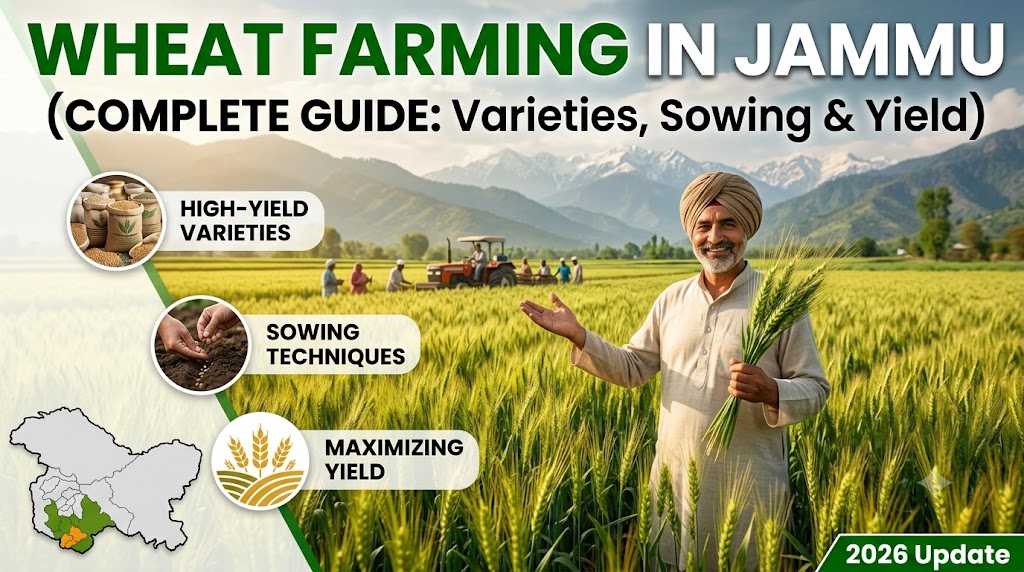
Wheat is the backbone rabi crop of the Jammu plains, sown across lakhs of hectares in Jammu, Kathua, Samba, Udhampur, and the surrounding sub-mountainous belts every winter. Unlike the Kashmir Valley, where wheat competes with the rice–wheat rotation cycle, the Jammu region’s warmer plains and longer growing window allow farmers to grow high-yielding irrigated wheat varieties that are specifically bred for this agro-climatic zone.
This guide walks through everything a Jammu-region farmer needs — from choosing the right variety and sowing window to fertilizer scheduling, irrigation timing, weed and disease management, and harvesting — based on recommendations from agricultural research centres working on wheat improvement for Jammu & Kashmir.
Why Wheat Farming Matters for Jammu’s Agriculture
Wheat remains the single largest rabi cereal in the UT of Jammu & Kashmir, and the Jammu division contributes a major share of the region’s total wheat output because of its plain, irrigated terrain compared to Kashmir’s hill and valley topography. For smallholder farmers across Jammu, Kathua, and Samba, wheat is not just a staple food crop but also a dependable cash crop once the kharif paddy or maize harvest is cleared from the field.
Productivity of wheat in Jammu & Kashmir has grown steadily over the decades — from under 7 quintals per hectare in the mid-1960s to close to 19 quintals per hectare in recent years — largely due to the adoption of high-yielding varieties (HYVs), better irrigation access, and improved agronomic practices. Jammu’s plains, with assured canal and tube-well irrigation in many belts, are well positioned to push this productivity even higher with the right variety and management choices.
Climate and Soil Suitability
Wheat thrives best under a cool, dry winter followed by a warm, dry spring — exactly the climatic window Jammu’s plains offer between November and April. The crop needs:
- Temperature: Around 20–22°C is ideal for germination; cooler temperatures during vegetative growth followed by gradually rising temperature at maturity favour good grain filling.
- Soil: Well-drained loamy or clay-loam soils with a neutral to slightly alkaline pH are best suited. Jammu’s alluvial plains generally support this profile well, though waterlogged or poorly drained patches should be avoided or corrected with proper land levelling.
- Rainfall/Irrigation: While wheat can be grown under restricted irrigation, assured irrigation at critical growth stages (crown root initiation, tillering, flowering, and grain filling) significantly boosts yield in the Jammu belt.
Best Wheat Varieties for the Jammu Region
Variety selection is the single biggest lever for yield improvement. The following varieties are specifically recommended for Jammu and Kathua districts based on research trial data:
| Variety | Sowing Condition | Average Yield | Maturity | Key Trait |
|---|---|---|---|---|
| JAUW 672 (Jammu Wheat 672) | Early & timely sown, restricted irrigation | ~44.1 q/ha (potential 54.5 q/ha) | Medium duration | Resistant to yellow rust; developed by SKUAST-Jammu specifically for the region |
| HD 3086 | Timely sown, irrigated | ~54 q/ha | ~145 days | Resistant to yellow and brown rust; widely adopted across NW plains incl. Jammu & Kathua |
| HD 3059 | Late sown, irrigated | ~43 q/ha | ~121 days | Resistant to yellow, brown and stem rust; suited for delayed sowing after late paddy harvest |
| HD 3043 | Restricted irrigation | ~43 q/ha | 140–145 days | Resistant to yellow and brown rust; performs well under limited water availability |
| DBW 327 (Karan Shivani) | Early sown, high-input irrigated | High yield potential | Medium duration | Highly resistant to stripe and leaf rust; needs higher NPK dose and growth-regulator sprays |
Farmer’s tip: Always source certified seed from SKUAST-Jammu’s seed multiplication farms, the J&K Agriculture Department’s seed corporations, or other verified sources rather than recycling farm-saved seed repeatedly, since seed purity directly affects germination percentage and disease resistance.
Land Preparation
Good wheat establishment in Jammu starts well before sowing:
- Field clearing: Remove paddy or maize stubble promptly after the kharif harvest to avoid delaying sowing.
- Ploughing: 2–3 ploughings followed by planking/levelling create a fine, firm seedbed that supports uniform germination.
- Levelling: Proper land levelling is critical in irrigated tracts to ensure even water distribution and avoid patchy crop stands.
- Pre-sowing irrigation (Rauni): In areas with low residual soil moisture, a light pre-sowing irrigation a few days before sowing helps achieve uniform germination, particularly for early-sown crops.
Sowing Time and Seed Rate
Timing is one of the most decisive factors for wheat yield in the Jammu plains:
- Early sowing (timely sown, irrigated): Late October to mid-November is generally optimal for the Jammu region, allowing the crop to establish well before the cold sets in and matching the maturity window of most recommended HYVs.
- Late sowing (after late kharif harvest): Where paddy or other kharif crops vacate the field later, late-sown-tolerant varieties such as HD 3059 should be preferred, with sowing extending into early December.
- Seed rate: Generally 100 kg/ha for timely sown irrigated conditions, increased slightly (around 125 kg/ha) for late-sown conditions to compensate for shorter tillering time.
- Seed treatment: Treating seed with a recommended fungicide before sowing helps reduce the incidence of seed-borne diseases like loose smut and bunt.
- Row spacing: A row-to-row spacing of about 20–22.5 cm using a seed-cum-fertilizer drill ensures uniform plant population and easier intercultural operations.
Fertilizer and Nutrient Management
Balanced fertilization is essential to realise the yield potential of HYVs in Jammu’s soils:
- Nitrogen (N): Apply in 2–3 split doses — basal dose at sowing, followed by top dressing at the first irrigation (crown root initiation stage) and, if needed, at the tillering stage. Splitting nitrogen reduces lodging risk and improves nitrogen-use efficiency.
- Phosphorus (P): Apply the full recommended dose as basal application at sowing, since phosphorus is largely immobile in soil and works best when placed near the root zone early on.
- Potassium (K): Apply as a basal dose, especially important on soils with low native potassium status, to improve disease resistance and grain quality.
- Micronutrients: Zinc deficiency is common in several wheat-growing soils of the Jammu belt; a soil or foliar zinc application based on a soil test can meaningfully improve yield in deficient fields.
A soil test before the season remains the most reliable way to fine-tune the exact NPK dose for a specific field rather than relying on a blanket recommendation.
Irrigation Schedule
Wheat in the Jammu plains responds strongly to timely irrigation at its critical growth stages:
- Crown Root Initiation (CRI) stage — around 20–25 days after sowing; this is the single most critical irrigation and should never be delayed.
- Tillering stage — supports better tiller development and ultimately more productive ear-bearing tillers.
- Jointing/Booting stage — supports stem elongation and developing spike.
- Flowering stage — critical for grain set; water stress here can sharply cut yield.
- Grain filling/Milk stage — supports grain weight and final yield; the last irrigation should be timed to avoid late-season waterlogging at maturity.
Farmers with restricted irrigation access should prioritise the CRI and flowering-stage irrigations if water availability allows for only two to three irrigations across the season.
Weed, Pest, and Disease Management
- Weeds: Broad-leaved weeds and grassy weeds like Phalaris minor (canary grass) can significantly reduce yield if not managed early. Timely pre-emergence or early post-emergence herbicide application, combined with proper crop rotation, helps keep weed pressure under control.
- Yellow and brown rust: Choosing rust-resistant varieties such as HD 3086, HD 3043, or JAUW 672 is the most effective long-term defence; fungicidal sprays can be used if rust symptoms appear, especially in years with prolonged cool, humid weather.
- Termites and aphids: Seed treatment helps manage termite risk at the early crop stage, while aphid infestation during the grain-filling period should be monitored, particularly in warmer spells.
- Loose smut and Karnal bunt: Both are seed-borne; certified, treated seed remains the most reliable prevention method.
Harvesting and Post-Harvest Handling
Wheat in the Jammu region typically matures and is ready for harvest by April, depending on the variety and sowing date. Key pointers:
- Harvest when the crop turns golden yellow and grains are hard, avoiding both premature and overly delayed harvesting, which can cause shattering losses.
- Threshing soon after harvest with a clean, well-calibrated thresher reduces grain damage and mixing with weed seed or chaff.
- Proper drying to safe moisture levels (around 12%) before storage prevents fungal infestation and storage pest damage.
Economics and Yield Potential
With the right variety, balanced fertilization, and timely irrigation, Jammu’s plains can realistically target yields in the range of 45–55 quintals per hectare under good irrigated management — well above the region’s historical average — making wheat a financially sound rabi choice when paired with sound agronomic practices and access to Minimum Support Price (MSP) procurement through government channels.
Frequently Asked Questions
Q1. Which is the best wheat variety for Jammu region farmers? JAUW 672 and HD 3086 are among the most recommended varieties for the Jammu and Kathua belt, offering high yield potential along with resistance to yellow rust.
Q2. What is the ideal sowing time for wheat in Jammu? Late October to mid-November is generally ideal for timely sown irrigated wheat in the Jammu plains; late-sown-tolerant varieties can be sown into early December where fields are vacated later.
Q3. How many irrigations does wheat need in Jammu’s climate? Ideally 4–5 irrigations at the crown root initiation, tillering, jointing, flowering, and grain-filling stages, though 2–3 well-timed irrigations focusing on CRI and flowering can still support a reasonable yield under restricted water availability.
Q4. What is the recommended seed rate for wheat sowing? Around 100 kg/ha for timely sown conditions, increased to about 125 kg/ha for late sowing.
Q5. How can yellow rust be managed in wheat crops in Jammu? The most reliable approach is choosing rust-resistant varieties such as HD 3086 or JAUW 672, combined with timely fungicide application if early symptoms are noticed.
Official and Research Resources
- SKUAST-Jammu (Sher-e-Kashmir University of Agricultural Sciences and Technology of Jammu): https://www.skuastjammu.ac.in
- Directorate of Agriculture, Jammu & Kashmir: https://agriculturekashmir.nic.in
- Indian Institute of Wheat & Barley Research (IIWBR), ICAR: https://iiwbr.icar.gov.in
Farmers are encouraged to consult their nearest Krishi Vigyan Kendra (KVK) or local agriculture extension officer before finalising variety and input choices, as recommendations can vary by micro-region, soil type, and irrigation access within the Jammu division.
From an Orchardist’s Field Notes
Field-level decisions — seed sourcing, irrigation timing, and disease watch — matter as much as variety selection itself. Drawing on hands-on growing experience in Kashmir’s horticulture belt and a formal background in agricultural science, more practical, season-by-season farming guides for J&K growers are being added regularly. Browse more crop and orchard guides on this site for region-specific farming advice.
Disclaimer
This article is intended for general informational and educational purposes only. Wheat variety performance, sowing windows, fertilizer doses, and irrigation schedules can vary based on local soil conditions, microclimate, water availability, and seasonal weather patterns within the Jammu region. Farmers are strongly advised to consult their local Krishi Vigyan Kendra, agriculture extension officer, or a qualified agronomist, and to refer to official SKUAST-Jammu and J&K Agriculture Department advisories before making variety selection, input application, or investment decisions. This website does not guarantee specific yield outcomes and is not liable for losses arising from reliance on this content.