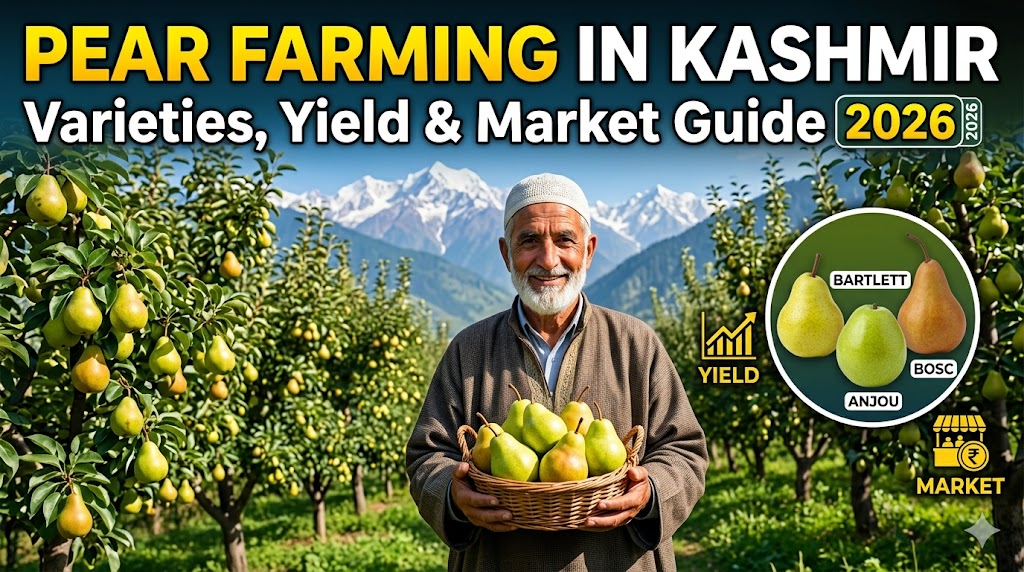
Pear farming in Kashmir has always lived in the shadow of apple orchards. Most Valley farmers treat pear trees as secondary crops — planted on orchard edges, managed loosely, and sold without much planning. That is a missed opportunity, because Kashmir’s climate is genuinely ideal for high-quality pear production, and market demand for good pear fruit — both local and outside the Valley — is consistently strong.
This guide covers everything a Kashmir pear farmer needs: which varieties perform best in our conditions, how to plant and manage an orchard properly, what diseases to watch for, and how to get better prices at harvest.
Why Kashmir Is Ideal for Pear Farming
Pear trees need cold winters for proper dormancy and moderate summers for fruit development. The Kashmir Valley — sitting between 1,500 and 2,000 metres — provides exactly this. The chill hours in districts like Shopian, Pulwama, Anantnag, and Budgam are sufficient for most commercial pear varieties, and the well-drained loamy soils of the Valley floor support healthy root development.
Unlike apple, pear is also more tolerant of slightly heavier soils — which gives farmers with less-than-ideal orchard land a viable alternative crop.
Best Pear Varieties for Kashmir Farmers
Variety selection is the single most important decision in pear farming. The wrong variety means poor market acceptance regardless of how well you manage the orchard.
| Variety | Ripening Season | Fruit Character | Market Suitability |
|---|---|---|---|
| Patharnakh | August–September | Medium size, gritty texture, high yield | Strong local and mandi demand |
| Baggugosha | September–October | Large, juicy, sweet | Premium local + outside Valley |
| Williams / Bartlett | August | Soft, aromatic, export quality | Good for processing and fresh sale |
| Conference | October | Long shape, firm flesh, good shelf life | Suited for cold storage + transport |
| Coscia | July–August | Early ripening, medium size | Fills gap before main apple season |
Recommendation for new orchards: Plant Baggugosha and Patharnakh as your main varieties — both are well-adapted to Kashmir conditions and have reliable local demand. Add one early variety like Coscia to spread your harvest window and generate early-season income.
Planting Season and Orchard Setup
Best planting time in Kashmir: Late winter — January to February — before new growth begins. This gives transplanted saplings the full growing season to establish roots.
Spacing: For standard pear orchards, 5×5 metres is common. For higher-density planting on fertile soil, 4×4 metres works well and increases yield per kanal in early years.
Rootstock: Most Kashmir nurseries supply pear saplings on quince rootstock, which promotes earlier fruiting (3–4 years vs 6–7 on seedling rootstock) and better adaptation to Valley soils.
Pit preparation:
- Dig pits of at least 2×2×2 feet, 4–6 weeks before planting
- Fill with a mix of topsoil, well-rotted FYM, and single superphosphate
- Avoid fresh manure directly at root zone — it causes burning
Irrigation Management Through the Season
Pear trees in Kashmir rely heavily on snowmelt and spring rainfall during early growth, but supplemental irrigation becomes critical from May onwards.
| Growth Stage | Irrigation Need | Key Risk if Ignored |
|---|---|---|
| Bud break (March–April) | Moderate | Stress during flower development reduces fruit set |
| Fruit development (May–July) | Regular, consistent | Small fruit size, premature drop |
| Pre-harvest (August–September) | Reduce gradually | Excess water causes cracking and reduces shelf life |
| Post-harvest (October) | Light | Supports root recovery and nutrient absorption |
Drip irrigation is increasingly adopted in Kashmir pear orchards because it delivers water directly to the root zone without wetting the trunk base — reducing fungal risk significantly.
Fertilizer Program for Pear Orchards
Pear trees respond well to balanced nutrition. Kashmir soils are often deficient in zinc and boron — both of which directly affect fruit size and set.
Annual fertilizer schedule (per mature tree):
- January–February: FYM 20–25 kg + single superphosphate 500g
- March (bud break): Urea 200–250g split into 2 applications
- April–May: Potassium sulphate 150–200g for fruit development support
- June (foliar): Zinc sulphate + Boron spray to correct micronutrient deficiency
- Post-harvest (October): FYM + potash to support root recovery
Always do a soil test before finalizing your fertilizer program — Valley soils vary considerably between districts.
Major Diseases and Pests in Kashmir Pear Orchards
Fire Blight — The Most Serious Threat
Fire blight (caused by Erwinia amylovora) is the most destructive pear disease in Kashmir. It spreads rapidly during warm, wet spring weather — exactly the conditions during Kashmir’s bud break and flowering period.
Early signs: Shoot tips turn brown and curl downward in a “shepherd’s crook” shape. Infected bark shows reddish-brown discolouration beneath the surface.
Action: Prune infected shoots at least 30cm below visible symptoms. Sterilize pruning tools with alcohol between each cut. Remove pruned material from the orchard immediately — do not compost it.
Prevention: Avoid excessive nitrogen application (promotes lush growth that fire blight spreads through). Apply copper-based bactericide sprays before and during flowering.
Pear Scab
Scab causes dark, rough lesions on fruit and leaves. It spreads through wet conditions and reduces fruit marketability significantly.
Management: Apply protective fungicide sprays starting at green tip stage. Maintain orchard sanitation by removing fallen leaves where the fungus overwinters.
Pear Psylla
This small insect sucks sap from leaves and young shoots. Heavy infestations cause leaf curl, honeydew deposits, and sooty mold — all of which weaken the tree and reduce fruit quality.
Management: Monitor early in the season. Use targeted insecticide applications when populations are building, before visible damage appears.
Yield Expectations for Kashmir Pear Farmers
| Orchard Age | Expected Yield (per kanal) | Notes |
|---|---|---|
| Year 3–4 | 1–2 quintals | First commercial harvest, light crop |
| Year 5–7 | 4–7 quintals | Yields building as canopy develops |
| Year 8–12 | 8–14 quintals | Full production if orchard well-managed |
| Year 12+ | 12–18 quintals | Peak yield in healthy, well-pruned orchards |
These figures are based on standard spacing and reasonable management. High-density orchards with drip irrigation and proper nutrition can exceed these ranges from year 6 onwards.
Market and Pricing Guide (2026)
Kashmir pear reaches markets through three main channels:
Local mandi (Sopore, Shopian, Anantnag): Fastest cash, but price fluctuates heavily with supply. Patharnakh typically fetches ₹15–30 per kg depending on grade and season timing.
Outside Valley (Delhi, Punjab, UP): Higher prices for quality grades — Baggugosha can fetch ₹35–55 per kg at peak. Requires proper grading, packing, and a reliable transport arrangement.
Cold storage: Pear stores well at 0–2°C for 3–4 months. Farmers who hold Conference or Baggugosha in cold storage and sell October–December often get significantly better prices than those who rush to harvest mandi.
Grading matters more than volume. A well-graded box of 40–45 count Baggugosha will earn more than twice the price of unsorted mixed-size fruit. Invest in proper packing boxes and size-grading before any sale.
Profit Estimation Per Kanal (Mature Orchard)
| Item | Estimate |
|---|---|
| Yield (mature orchard) | 10–14 quintals/kanal |
| Average sale price (mixed grade) | ₹20–35/kg |
| Gross income | ₹20,000–₹49,000/kanal |
| Input cost (fertilizer, spray, labor) | ₹6,000–₹10,000/kanal |
| Net profit | ₹14,000–₹39,000/kanal |
Returns improve significantly with cold storage, better grading, and direct channel sales outside the mandi system.
FAQ
Q1: How many years before a pear tree gives full yield in Kashmir? A: On quince rootstock, commercial yield begins at year 3–4 and reaches full production by year 8–10 with proper management.
Q2: Is pear farming profitable compared to apple in Kashmir? A: Input costs are lower and management is simpler, but prices are also lower than premium apple. Pear works well as a diversification crop alongside apple — it spreads income across a longer harvest season.
Q3: Which pear variety has the best market price in Kashmir? A: Baggugosha consistently commands the highest price due to its large size, sweet taste, and strong recognition among buyers both inside and outside the Valley.
Q4: Can pear be grown in areas where apple does not perform well? A: Yes. Pear tolerates slightly heavier and wetter soils than apple, making it suitable for lower-elevation orchards and areas with less-than-ideal drainage.
Q5: What is the biggest disease risk for pear farmers in Kashmir? A: Fire blight is the most serious threat. It can destroy entire young orchards in a single wet spring if not caught and managed early.
Conclusion
Pear farming in Kashmir deserves more serious attention than most Valley farmers currently give it. The climate is right, the demand is reliable, and the input costs are manageable. The difference between an average pear orchard and a profitable one almost always comes down to variety selection, disease management — particularly fire blight — and post-harvest grading. Get those three right, and pear becomes a genuinely rewarding crop alongside your main apple production.