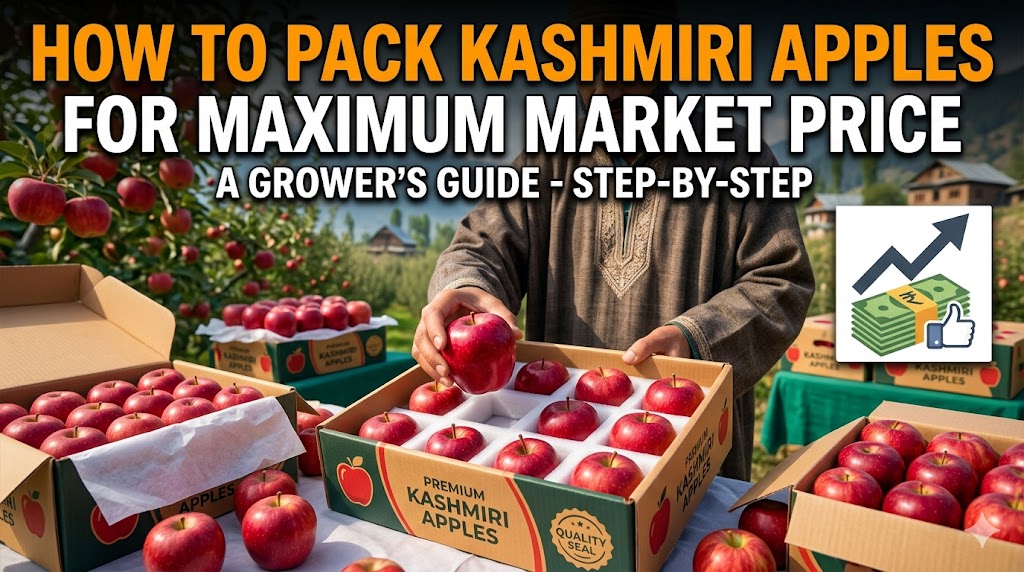
Kashmiri apples have a reputation that travels far beyond the valley. Buyers in Delhi, Mumbai, and even export markets recognise the quality of a well-grown Kashmiri apple. But here is the reality I have seen in our own orchards in Anantnag — a grower can have the best fruit on the hillside and still receive a poor price simply because of how it was packed.
Packing is not just wrapping apples in paper and putting them in a box. It is the final stage of the entire growing season, and it determines what the buyer sees, what they pay, and whether they come back next year. This guide covers everything I have learned about packing Kashmiri apples properly, from sorting and grading to choosing the right carton and timing your dispatch.
Why packing quality directly affects your price
When a commission agent or direct buyer opens a box of Kashmiri apples, they make a judgment within seconds. They look at uniformity — are the apples roughly the same size and colour? They check for bruising — even one or two damaged fruits in the top layer creates doubt about the whole box. They smell for freshness and check whether the carton itself is solid or already compressed from poor stacking.
Premium buyers — supermarket chains, exporters, and urban retailers — pay a significantly higher rate per box for fruit that arrives looking consistent and undamaged. Growers who invest time in proper packing consistently get 15 to 25 percent better rates than those who rush the process.
Step one: harvest at the right time
Good packing starts before you touch a carton. Apples harvested too early lack full colour and sugar development. Apples harvested too late bruise easily during transport and have a shorter shelf life at the destination.
For most Kashmiri varieties, the right harvest window is when the fruit detaches easily with a slight upward twist, the seeds have turned dark brown, and the skin has developed its characteristic colour — deep red for Red Delicious, golden yellow for Golden Delicious, and the distinctive green-pink blush for Ambri.
Harvest in the early morning when temperatures are cooler. This reduces field heat in the fruit and gives you more time before the apples begin to respire actively. Avoid harvesting after rain, as surface moisture encourages fungal growth during storage and transit.
Step two: sort and grade before packing
This is the step that most growers either skip or rush, and it is the most important one. Sorting means separating apples that should not be in the same box — those with cuts, scabs, insect damage, or sunburn. Grading means grouping apples by size so that each carton has a consistent, uniform appearance.
The standard grading system used by HPMC and most commercial buyers in Kashmir divides apples into three size categories based on equatorial diameter:
- Premium grade: 75 mm and above. These are the largest, most uniform fruits and attract the highest price per box.
- Standard grade: 65 to 75 mm. Good commercial quality, suitable for retail markets across India.
- Economy grade: below 65 mm. These are smaller fruits, often sold to juice processors or local markets at a lower rate.
Never mix grades in a single box. Buyers who find small apples in what was presented as a premium box will reduce their offered price — not just for that box, but for your reputation as a supplier.
Step three: choose the right packing material
The carton you choose matters more than most growers realise. A weak carton that compresses under stacking crushes the bottom layer of apples. A poorly ventilated carton traps humidity and encourages rot. A carton with no branding or labelling signals to the buyer that no attention was paid to presentation.
Corrugated fiberboard cartons are the standard for Kashmiri apple exports and long-distance domestic shipments. They are strong, lightweight, and can be printed with your farm name and grade. A good quality corrugated carton costs between ₹40 and ₹55 per unit but protects fruit worth many times that amount.
Wooden crates are still used in some areas but are declining in preference among premium buyers. They are heavier, harder to stack uniformly, and add transport weight without adding protection that corrugated cartons cannot provide.
Plastic crates are useful for transporting apples from orchard to packing shed but are not appropriate for final market dispatch. They offer no cushioning and allow apples to shift and bruise during road transport.
Within the carton, wrap each apple individually in soft tissue paper or moulded pulp trays. This is the single most effective way to prevent bruising during the journey from Anantnag to any market in India. The wrapping also keeps apples from transferring ethylene gas to each other, which slows ripening and extends shelf life.
Step four: fill and seal cartons correctly
A 10 kg carton should be filled so that the top layer of apples sits just slightly above the rim — enough that the lid creates gentle, even pressure when closed. Too loose and apples shift and bruise. Too tight and the top layer is crushed by the lid.
Standard carton sizes used in Kashmir are 10 kg and 20 kg. For premium grade fruit going to supermarkets or export, 10 kg cartons are preferred because they are easier to handle and display. Bulk buyers and commission markets more commonly use 20 kg.
Once filled, seal the carton with gummed tape on both top and bottom flaps. Stack filled cartons with their openings facing the same direction so that ventilation holes line up. Never stack more than six cartons high without a separator layer.
Step five: label every carton properly
Labelling serves two purposes: it tells the buyer what is inside, and it builds your brand over time. A carton with no label is a commodity. A carton with a consistent, professional label is a product.
Every carton should carry at minimum:
- Your farm name or brand (for example, JY Farm, Anantnag)
- Apple variety (Red Delicious, Golden Delicious, Maharaji, etc.)
- Grade (Premium, Standard, Economy)
- Net weight
- Harvest date or packing date
- Your contact number
Growers who have added QR codes to their labels — linking to a WhatsApp number or simple website — report that buyers scan them to place repeat orders directly, cutting out the commission agent and improving the price they receive.
Step six: timing your dispatch
Even perfectly packed apples will arrive in poor condition if dispatched at the wrong time or left in a warm packing shed for too long after being packed.
Ideally, packed cartons should move to cold storage or direct dispatch within 24 hours of packing. If you do not have access to cold storage, pack and dispatch on the same day whenever possible. Avoid dispatching during the hottest part of the day. Early morning or evening departures from Anantnag give the fruit the coolest possible conditions during the critical first hours of transit.
For long-distance shipments to Delhi, Mumbai, or Kolkata, refrigerated trucks are worth the additional cost. A refrigerated truck maintains 1–4°C throughout the journey, which keeps apples firm and fresh for up to four weeks after harvest. At these destinations, the price difference between refrigerated and non-refrigerated shipments regularly exceeds ₹20 per kg for premium grade fruit.
What to avoid
Several common packing mistakes consistently reduce the price Kashmiri apple growers receive:
Mixing varieties in one carton. Golden Delicious and Red Delicious have different ripening rates and ethylene outputs. Mixing them causes one variety to accelerate the ripening of the other.
Using wet or second-hand cartons. A previously used carton has compressed walls, may carry fungal spores from the previous batch, and signals to buyers that standards are low.
Packing in the afternoon heat. High ambient temperature at packing time means the fruit enters the carton already warm, which accelerates respiration and reduces shelf life significantly.
Ignoring damaged fruit at the bottom of a picking bag. Bruised apples at the bottom of a picking bag look fine initially but develop visible browning within 24–48 hours. Sort again at the packing shed, not just at harvest.
Building a direct buyer relationship
The growers in our area who consistently get the best prices for their apples share one characteristic — they have a direct relationship with at least one or two buyers who trust their packing standards. This trust is built one season at a time, by delivering consistently graded, consistently packed, consistently labelled fruit.
If you are currently selling entirely through commission agents, consider setting aside a portion of your premium grade fruit to approach direct buyers — urban retailers, supermarket procurement teams, or online platforms that source directly from Kashmiri farms. The first season may not be dramatically different, but by the second and third year, a reliable direct buyer relationship can add ₹10 to ₹20 per kg to your effective realisation.
Summary
Kashmiri apple growers have a natural advantage — the quality of the fruit itself. Converting that advantage into the best possible market price is entirely a function of what happens after harvest. Sort carefully, grade honestly, use proper cartons, wrap every apple, label every box, and dispatch quickly in cool conditions. These are not complicated changes, but they are the difference between a good season and a very good season.
FAQ
Q: What is the best carton size for Kashmiri apple export? 10 kg corrugated cartons are preferred by most export and premium domestic buyers for their ease of handling and presentation.
Q: How long do properly packed Kashmiri apples last in transit? With refrigerated transport at 1–4°C, properly packed apples remain market-fresh for up to four weeks after harvest.
Q: Should apples be washed before packing? No. Washing apples before packing introduces surface moisture that encourages fungal growth. Wipe gently with a dry cloth to remove field dust only.
Q: How do I get a premium grade price for my apples? Consistent sizing (75 mm+), individual wrapping, correct carton labelling, and establishing a direct buyer relationship are the most reliable routes to premium pricing.