When an apple grower in Shopian brings his harvest to the mandi straight off the tree, he is often at the mercy of that single morning’s price. He cannot wait. The fruit is perishable, the bills are real, and the buyer knows both of those things. This is a trap that has kept generations of Kashmiri fruit growers from getting fair value for some of the finest apples grown anywhere in the world.
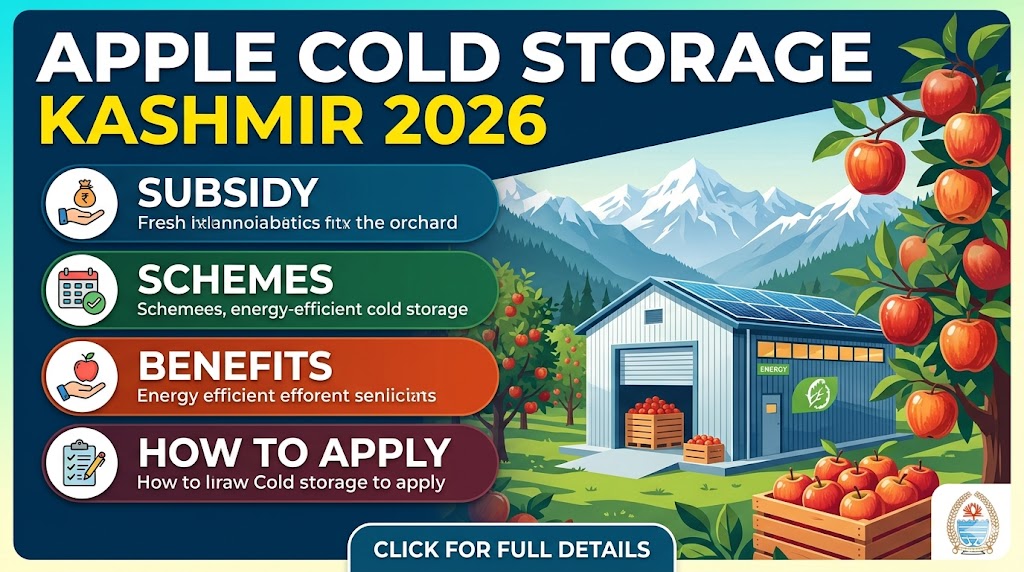
Cold storage — and more specifically, Controlled Atmosphere (CA) storage — changes that equation fundamentally. It puts time back in the hands of the grower. And in 2026, the Government of Jammu and Kashmir, backed by the central government, is pushing harder than ever to expand cold storage infrastructure across the Valley through generous subsidies and dedicated schemes.
If you are an apple grower, a young entrepreneur, a Farmer Producer Organisation (FPO), or anyone interested in setting up cold storage in Kashmir, this guide covers the current landscape — what the schemes offer, how much subsidy you can get, what documents you need, and how to apply.
Why Cold Storage Is a Game-Changer for Kashmir’s Apple Economy
Kashmir is not just an apple-producing region — it is India’s apple capital. Kashmir accounts for about 78% of India’s annual apple production. The Union Territory produced over 21 lakh metric tonnes of apples in 2024–25, with nearly the entire share — 20.79 lakh metric tonnes — coming from the Kashmir division.
That is an enormous volume of perishable fruit produced in a narrow harvest window stretching from August to November. Without adequate storage, growers are forced to sell immediately at whatever price the market offers. The results are predictable: distressed selling, massive post-harvest losses, and income that does not reflect the actual quality of the produce.
CA storage turns this situation around. Apples kept in cold storage units in Kashmir help growers fetch much better rates by selling their production according to their will and market demand. The numbers tell the story clearly: one grower from Shopian reported that for a 16 kg apple box he used to get ₹550–650 at the mandi, compared to ₹1,200–1,500 through cold stores.
CA storage systems ensure an optimum supply of oxygen, carbon dioxide, and nitrogen alongside controlled humidity and temperature, preserving the freshness and quality of apples for extended periods. This technology has made it possible for Kashmiri apples to be available in markets well into spring — months after the harvest season ends.
The Cold Storage Gap: Where Kashmir Stands in 2026
The opportunity is enormous, but so is the gap. The estimated CA storage requirement for Jammu and Kashmir is 600,000 metric tonnes, covering about 30% of annual fruit production. The current available capacity is only 292,000 metric tonnes.
That means Kashmir is operating at less than half the cold storage capacity it actually needs. Currently, 90% of CA stores are concentrated in just two districts of south Kashmir — Pulwama and Shopian. Growers in other districts remain without access to nearby storage, leaving them with the same old problem: sell fast or lose everything.
The government is contemplating increasing CA storage capacity over the next five years, and the subsidy architecture being built around that goal in 2026 is the most comprehensive it has ever been.
Government Schemes for Cold Storage in Kashmir 2026
Two primary funding channels support cold storage development in J&K right now. They can be accessed individually or in combination.
1. Mission for Integrated Development of Horticulture (MIDH)
MIDH is a centrally sponsored scheme under the Ministry of Agriculture and Farmers Welfare. It is the backbone of cold storage subsidy support across India, and Kashmir is a priority beneficiary.
According to official data, the scheme provides assistance up to ₹13.45 crore per project for a capacity of 5,000 metric tonnes, with a 50% subsidy capped at ₹9 crore.
This subsidy is credit-linked and back-ended, meaning:
- You take a bank loan to fund the project.
- After construction and inspection, the subsidy is credited directly to your loan account, reducing your outstanding amount.
- Your actual out-of-pocket investment is significantly reduced.
Eligible beneficiaries include individuals, farmer groups, partnership firms, Farmer Producer Organisations (FPOs), Self Help Groups (SHGs), cooperatives, and companies.
2. UT CAPEX Budget Top-Up Grant
The J&K government layers an additional grant on top of the MIDH subsidy through its own Capital Expenditure (CAPEX) budget.
A top-up grant of ₹7.26 crore from the CAPEX budget has been made available, taking the overall support per project to ₹16.26 crore. The subsidy is released on a pro-rata basis for projects within the 5,000 metric tonne capacity limit.
3. Farm Gate Pack Houses and Smaller Cold Chain Facilities
Not every grower needs a 5,000 MT facility. For smaller needs, the government is also promoting smaller cold-chain facilities at the farm gate under various components of the MIDH scheme, including a 50% subsidy for farm gate pack houses costing up to ₹25 lakh.
This is particularly significant for small and marginal apple growers who want to preserve and grade their produce at or near the orchard itself before sending it to a larger facility or directly to the market.
4. Agriculture Infrastructure Fund (AIF)
The AIF is a central government scheme offering interest subvention on loans for post-harvest infrastructure. Under AIF:
- Loans up to ₹2 crore get a 3% interest subvention per year.
- Credit guarantee coverage is available for eligible projects.
- Farmers, FPOs, agri-entrepreneurs, and Primary Agricultural Credit Societies (PACS) are eligible.
AIF can be stacked with MIDH subsidy in many cases, making it an attractive option for those setting up mid-sized cold storage units.
Key Highlights: Cold Storage Subsidy at a Glance
| Scheme | Subsidy | Maximum Support |
|---|---|---|
| MIDH (Central) | 50% of eligible project cost | Up to ₹9 crore |
| J&K CAPEX Top-Up | Additional grant | Up to ₹7.26 crore |
| Combined (MIDH + CAPEX) | — | Up to ₹16.26 crore per project |
| Farm Gate Pack House (MIDH) | 50% of cost | Up to ₹12.5 lakh |
| AIF Loan Subvention | 3% interest reduction | On loans up to ₹2 crore |
Who Can Apply?
The schemes are open to a broad range of applicants. You may apply if you are:
- An individual apple grower or horticulturist in J&K
- A young entrepreneur from any district of the Valley interested in cold storage as a business
- A Farmer Producer Organisation (FPO) or farmer cooperative
- A Self Help Group (SHG) involved in horticulture
- A partnership firm or private company with a valid project proposal
- An agri-entrepreneur with land access and a sound business plan
There is no restriction that you must already be an apple grower to apply for setting up storage — the government is actively encouraging entrepreneurs to enter this sector as a business.
Awareness programmes are being held in each district to inform young entrepreneurs about available incentives for setting up CA facilities and other post-harvest infrastructure.
Documents Required
Before applying for any cold storage subsidy in J&K, keep the following documents ready:
- Land ownership or lease documents – The land on which the facility will be built, with NA (non-agricultural) permission if required
- Detailed Project Report (DPR) – Covering layout, capacity, technology, cost estimates, and financials
- Bank Sanction Letter – From a scheduled commercial bank confirming the project loan is approved (required for credit-linked subsidies)
- Bank Appraisal Report – The bank’s assessment of your project viability
- Approved Building Maps – Certified by an authorised engineer or architect
- Cost Estimates – Civil, mechanical, CA system, electrical — all separately detailed and certified
- Quotations from Equipment Suppliers – For refrigeration units, CA components, and related machinery
- Pollution Control Certificate (where applicable)
- Identity and Address Proof – Aadhaar card, PAN card
- Bank Account Details – For DBT-linked subsidy disbursement
- Caste/Category Certificate (if claiming additional benefits under SC/ST/OBC provisions)
- Registration Certificate – For FPOs, cooperatives, companies, or firms
For smaller farm-gate facilities, documentation requirements are lighter — your District Horticulture Officer will guide you based on the component you are applying under.
How to Apply — Step by Step
Step 1: Contact Your District Horticulture Officer (DHO)
The first and most important step is visiting your local District Horticulture Officer. J&K’s Horticulture Department has offices in every district. The DHO will:
- Confirm which scheme component fits your project size and budget
- Provide the correct application forms
- Guide you on local documentation requirements
- Register your intent and add you to the beneficiary pipeline
Do not skip this step — walk-in applications at the district office are the starting point for most MIDH-linked schemes in J&K.
Step 2: Prepare Your Detailed Project Report (DPR)
This is the most critical document in your application. The DPR should cover:
- Site details and land status
- Proposed storage capacity (in metric tonnes)
- CA technology specifications
- Civil construction plan and cost
- Mechanical and electrical estimates
- Financial projections: investment, revenue, payback period
- Bank financing plan
For projects above ₹25 lakh, hiring a qualified project consultant or agricultural engineer to prepare the DPR is strongly advised. Banks will not sanction loans without a credible DPR.
Step 3: Get Bank Loan Sanctioned
Approach any scheduled commercial bank — State Bank of India, J&K Bank, NABARD-linked banks — with your DPR. MIDH subsidies are credit-linked, meaning a sanctioned bank loan is a prerequisite for the subsidy. NABARD provides refinance support to banks for these projects, which keeps interest rates manageable.
Step 4: Submit Application to the State Horticulture Mission
After loan sanction, submit your full application package to the State Horticulture Mission (SHM), J&K or through your DHO, depending on the scheme component. For NHM-based activities, apply through your State Horticulture Mission or District Horticulture Officer. For NHB-based commercial projects, applications are submitted online at nhb.gov.in.
Step 5: Site Inspection
A joint inspection committee — comprising officers from the Horticulture Department and the lending bank — will visit your proposed site to verify feasibility. Make sure the land is ready and accessible.
Step 6: Project Construction
Once approved, begin construction as per the approved DPR. Do not deviate from the approved plan without prior written approval, as this can disqualify you from subsidy release.
Step 7: Completion and Final Inspection
After construction, notify the DHO and bank for a completion-stage inspection. The joint committee will verify that the facility matches the approved specifications.
Step 8: Subsidy Disbursement
Post inspection, the subsidy amount is credited to your bank loan account. The CAPEX top-up is processed through the J&K Horticulture Department. This reduces your outstanding loan principal directly.
Where Are Cold Stores Being Prioritised?
Most existing CA stores are located in Lassipora, Pulwama and Aglar, Shopian, but efforts are underway with the Industries and Commerce Department to create horticulture-specific industrial estates in other districts as well.
Districts like Anantnag, Kulgam, Baramulla, Kupwara, and Budgam have significant apple production but limited local cold storage access. These areas are being prioritised for new facility development, and applicants from underserved districts may find a more receptive environment at the DHO level.
Efforts are underway to scale up cold storage, grading, and export infrastructure, with more than 200 new facilities targeted by 2026, according to state budget projections.
The Real Difference Cold Storage Makes
The numbers on paper are convincing, but the on-ground reality is even more so. Cold storage units also provide employment to hundreds of people — labourers get jobs as the work of packing apples continues round the year.
For growers, the ability to store apples and release them when prices are favourable transforms the economics of the entire season. The early 2026 season saw apple growers releasing stored produce ahead of schedule to take advantage of higher prices and ensure fresh apples reached consumers before the winter season ended. That kind of flexibility — timing your sale to match market demand rather than harvest pressure — is the real value of cold storage.
Frequently Asked Questions
Q1. Can I set up a cold storage unit in Kashmir even if I am not a farmer? Yes. Entrepreneurs, companies, FPOs, SHGs, and individuals with a sound project plan and land access are all eligible to apply under MIDH and the J&K CAPEX scheme.
Q2. Is the 50% subsidy on my total construction cost? The 50% subsidy is calculated on eligible cost norms set by the government — not necessarily on your market-rate project cost. Your DHO or the NHB website will have the current eligible cost per metric tonne.
Q3. Can I combine MIDH subsidy with an AIF loan? In many cases, yes. The Agriculture Infrastructure Fund and MIDH can be stacked, though the specific combination depends on project size and bank guidelines. Your bank will clarify the permissible structure.
Q4. What is the minimum capacity for a subsidised CA store? There is no strict minimum, but the MIDH scheme structure is designed around projects up to 5,000 MT. Smaller farm-gate facilities are covered under the pack house component (up to ₹25 lakh). Speak to your DHO for the right entry point.
Q5. How long does the application and approval process take? Typically 3 to 6 months from initial application to sanctioned approval, depending on documentation completeness and the speed of bank processing. Starting early in the financial year (April–June) gives you the best chance of inclusion in the current year’s budget allocation.
Closing Thoughts
Apple farming is Kashmir’s identity, its economy, and for millions of families, it is the income that funds everything else. But growing a world-class apple and getting a world-class price for it are two very different things — and cold storage is the bridge between them.
The government’s push to fill the 3-lakh metric tonne storage gap in J&K is backed by real money, real subsidies, and a genuine awareness effort at the district level. Whether you are a grower tired of distressed mandi selling, or a young entrepreneur looking for a viable business in the horticulture space, 2026 is the right time to explore what these schemes offer.
Visit your District Horticulture Office, carry your land documents, and start that first conversation. The subsidy is there. The demand is there. The question is whether you act on it before this season passes.
For official scheme details, visit the J&K Horticulture Department website or contact your nearest District Horticulture Officer. For NHB-linked projects, visit nhb.gov.in.