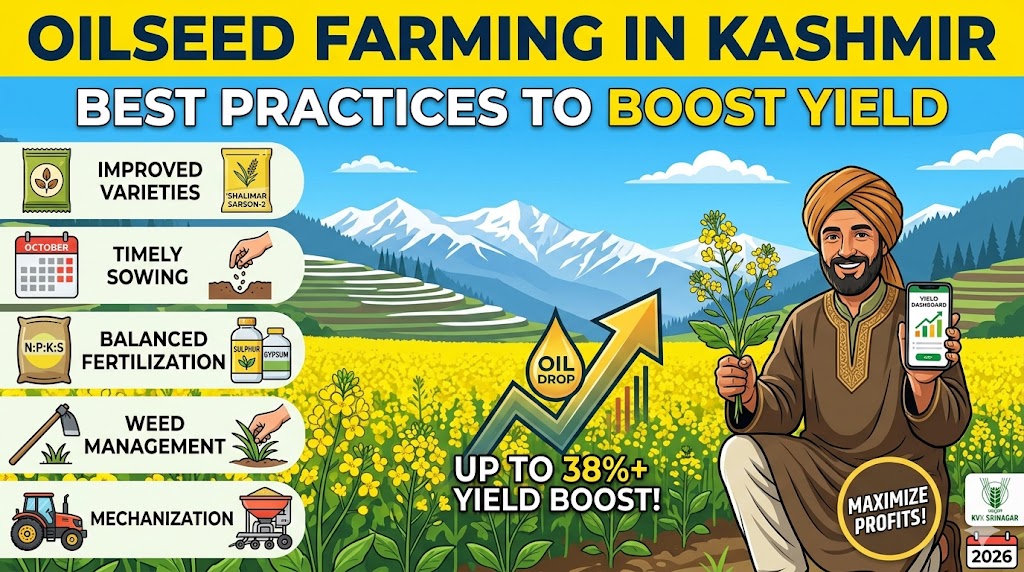
Drive through Kashmir’s lowland belts in late March and you’ll see it — wide stretches of mustard fields turning the valley floor yellow. Oilseeds, mainly mustard and a smaller share of other brassicas, have quietly remained one of the most consistent crops grown by smallholder farmers across districts like Budgam, Pulwama, Baramulla, and parts of Kupwara. Unlike orchard crops that take years to mature, oilseeds give a return within a single season, which is exactly why so many farmers keep coming back to them, even as orchard farming gets more attention.
But here’s the gap a lot of farmers run into: yields per kanal in Kashmir often lag behind what’s achievable with the same seed varieties elsewhere in India. The crop isn’t the problem. The practice often is. This article goes through what actually moves the needle on oilseed yield in Kashmir’s specific climate and soil conditions, based on what agricultural extension data and experienced growers consistently point to.
Why Oilseeds Still Matter for Kashmiri Farmers
Before getting into technique, it’s worth being clear about why this crop deserves more attention than it usually gets.
Oilseed crops like mustard fit naturally into Kashmir’s rabi cropping cycle, often grown after paddy or alongside it on land that would otherwise sit unused through the cooler months. They need relatively low water input compared to paddy, which matters in years when irrigation channels run low. And because mustard oil has a strong, steady local demand — most Kashmiri households use it as their primary cooking oil — farmers rarely struggle to find a buyer, unlike with some perishable cash crops.
The issue isn’t demand. It’s that average yields have stayed lower than they should be, largely because of a handful of avoidable practices that get repeated season after season simply because “that’s how it’s always been done.”
Mistake One: Sowing Too Late
This is the single most common yield killer in Kashmir’s oilseed belt. Mustard is sensitive to its sowing window — sow too late, and the crop’s critical flowering and pod-filling stages get pushed into warmer, less favorable weather, which directly cuts down on seed formation and oil content.
The ideal sowing window for mustard in Kashmir generally falls in the first half of September for early varieties, though exact timing depends on elevation and local microclimate. Farmers who delay sowing because they’re finishing paddy harvest first often end up with visibly weaker stands by comparison to neighbors who planned their rotation to sow on time.
Practical fix: if paddy harvest timing conflicts with the ideal mustard sowing window, it’s worth considering early-maturing paddy varieties specifically so the land frees up in time, rather than treating mustard sowing as whatever’s left over after paddy is done.
Mistake Two: Overcrowded or Uneven Plant Spacing
Walk through many Kashmiri mustard fields and you’ll notice the seed was broadcast by hand rather than sown in proper rows — a habit carried over from generations of farming but one that actively works against yield.
Broadcasting leads to overcrowded patches where plants compete heavily for light, nutrients, and water, alongside bare patches where seed simply didn’t land. The result is an uneven stand where some plants are stunted and others are weak from overcrowding, and overall yield per kanal suffers compared to properly spaced rows.
Practical fix: line sowing with a seed drill, or even careful manual row sowing, at a spacing of roughly 30 cm between rows and 10-15 cm between plants within the row, gives each plant enough room to develop a full canopy and root system. This single change — without any added input cost — is one of the most reliable ways to lift yield.
Mistake Three: Skipping Thinning
Even when seed is broadcast, many farmers skip the thinning stage entirely, leaving every germinated seedling to fight it out. Thinning excess seedlings around 15-20 days after sowing, so that only well-spaced, healthy plants remain, redirects the field’s nutrient and water resources toward fewer, stronger plants rather than spreading them thin across too many weak ones.
It feels counterintuitive to a farmer to deliberately remove plants after putting in the effort to grow them, but the math works out in favor of fewer, healthier plants producing more total seed than a crowded field of weak ones.
Mistake Four: Imbalanced or Missing Fertilizer Application
Many smallholders either skip fertilizer application for oilseeds entirely — treating it as a “low-input, low-output” crop not worth investing in — or apply only nitrogen-heavy fertilizers without considering phosphorus, potassium, and sulfur, the last of which is particularly important for oilseed crops since sulfur directly affects oil content.
A balanced approach, ideally informed by an actual soil test from the local agriculture department rather than guesswork, tends to make a noticeable difference. As a general practice, mustard responds well to a combination of nitrogen split across sowing and a later top-dressing, along with phosphorus and sulfur applied at the time of sowing. Sulfur deficiency in particular is an underrecognized issue in many Kashmiri soils and can quietly suppress both yield and oil quality even when the plant otherwise looks healthy.
Practical fix: get a soil test done before the season rather than applying the same fertilizer mix every year out of habit. It typically costs little and tells you exactly what your specific field is lacking.
Mistake Five: Ignoring Aphid and Pest Pressure Until It’s Visible
Mustard aphid is the most common pest issue in Kashmir’s oilseed crop, and by the time infestation is visible to the naked eye across a field, a meaningful chunk of yield potential is often already compromised.
Aphids cluster on flowering shoots and pods, draining the plant’s sap and weakening seed development. Cold, humid mornings in late winter and early spring tend to favor aphid buildup, which lines up with the exact period when Kashmir’s mustard crop is flowering and most vulnerable.
Practical fix: regular field monitoring starting from the flowering stage, rather than waiting for visible damage, allows for earlier intervention — whether that’s recommended need-based pesticide application or encouraging natural predators like ladybird beetles, which are genuinely effective against aphids if given the chance rather than killed off by unnecessary blanket spraying.
Mistake Six: Harvesting at the Wrong Time
Oilseed pods can shatter and drop seed if harvest is delayed too long past maturity, while harvesting too early means seeds haven’t fully developed their oil content. The right harvest window is when pods have turned a yellowish-brown color but before they’re fully dry and brittle enough to shatter on contact.
This is a narrow window, and timing it well — rather than harvesting based on convenience or when labor happens to be available — can meaningfully reduce field losses that otherwise quietly eat into total yield before the crop even reaches storage.
Crop Rotation and Soil Health Considerations
Continuous mustard cultivation on the same plot without rotation tends to deplete specific nutrients and can allow soil-borne diseases to build up over successive seasons. Rotating oilseeds with legumes like peas or with cereals helps break pest and disease cycles while legumes specifically help replenish soil nitrogen naturally.
Farmers running a tight paddy-mustard rotation year after year on the same land might consider occasionally working in a legume season, even on a portion of the land, to give the soil a chance to recover some of what continuous cropping draws down.
What Realistic Improvement Looks Like
None of these fixes require expensive machinery or large capital investment — that’s really the point. Proper sowing timing, row spacing instead of broadcasting, thinning, balanced fertilizer based on an actual soil test, early pest monitoring, and correctly timed harvest are all practice changes, not purchases.
Farmers who’ve adopted even three or four of these changes together — not just one in isolation — tend to report visibly fuller pod formation and a noticeably better harvest compared to previous seasons using old habits. The improvement isn’t dramatic overnight, but compounds season over season as soil health and farming discipline both improve together.
A Word on Expectations
It’s worth being upfront that Kashmir’s climate, with its shorter effective growing window compared to plains regions, will likely never match the per-acre oilseed yields seen in states like Rajasthan or Haryana, which have longer, more stable rabi seasons suited to mustard. That’s not a reason to ignore the crop — it’s a reason to focus on practices that close the gap rather than chasing unrealistic yield targets borrowed from a completely different growing region.
For a smallholder farmer in Kashmir, oilseed farming remains one of the more dependable, low-risk components of a yearly cropping plan — and the difference between an average season and a genuinely good one often comes down to these basic, low-cost practices rather than anything exotic or expensive.
Frequently Asked Questions
What is the best time to sow mustard in Kashmir? Generally the first half of September for early varieties, though the exact window can shift slightly depending on elevation and local weather conditions that particular year.
Does broadcasting seed instead of row sowing really affect yield that much? Yes. Uneven spacing from broadcasting leads to overcrowded and bare patches in the same field, which lowers overall yield compared to properly spaced row sowing.
Why is sulfur important for oilseed crops specifically? Sulfur directly influences oil content and seed development in mustard and other oilseeds, and deficiency is a commonly overlooked issue in many Kashmiri soils.
How can a farmer reduce aphid damage without heavy pesticide use? Regular monitoring from the flowering stage onward, combined with allowing natural predators like ladybird beetles to establish, can reduce the need for blanket pesticide spraying.