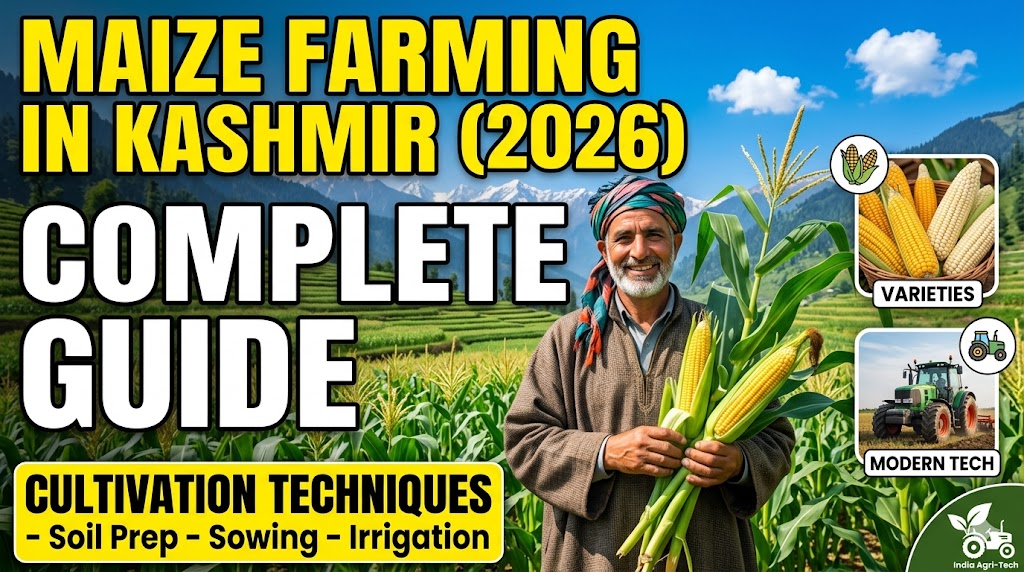
When most people think of Kashmir’s farmlands, they picture golden paddy fields or apple orchards draped across terraced hillsides. But there is another crop quietly powering the agricultural economy of the valley and its surrounding districts — maize. Known locally as Makki, maize has been grown across Kashmir and the Jammu region for generations, providing food, fodder, and income to thousands of farming families.
In 2026, maize farming in Kashmir is entering an exciting new phase. Driven by improved hybrid seed availability, rising demand from the poultry and starch industries, government support schemes, and the adoption of modern cultivation techniques, maize has transformed from a subsistence crop into a genuine cash crop with strong commercial potential.
This comprehensive guide covers everything you need to know about growing maize in Kashmir in 2026 — from choosing the right variety and preparing your land, to managing water, controlling pests, and connecting with the best markets for your harvest.
“Maize is no longer just the farmer’s breakfast grain in Kashmir — it is a high-value commercial crop that, when grown right, can double a family’s agricultural income within a single season.”
1. Introduction: Maize in Kashmir’s Agricultural Story
Maize (Zea mays) arrived in Kashmir centuries ago and quickly embedded itself in the cultural and culinary fabric of the region. Makki ki roti — thick flatbread made from maize flour — paired with mustard greens remains a beloved winter staple. In rural households across districts like Kupwara, Bandipora, Kulgam, Shopian, Rajouri, and Doda, maize is not a seasonal side crop — it is a pillar of the farming system.
Maize in Kashmir is grown in both the Kharif season (summer-sown, April to September) and, in some lower-altitude areas, as a spring crop (February to June). Its ability to grow across a wide range of altitudes — from the foothills at 500 metres to mountainous terrain above 2,000 metres — makes it one of the most geographically versatile crops in the entire J&K union territory.
According to agriculture department records, maize is cultivated on over 2.5 lakh hectares across Jammu & Kashmir — making it the second most widely grown food grain after rice. In 2026, with improving seed technology, rising market prices, and stronger government support, the crop’s commercial importance has never been greater.
2. Why Maize Farming Is a Smart Choice in Kashmir in 2026
Farmers across the Kashmir Valley and surrounding hill districts are increasingly turning to maize — and for very good reasons. Here is why maize stands out as one of the most attractive Kharif crops to grow in 2026:
- 🌽 High Demand, Rising Prices: India’s poultry industry, dairy sector, and food processing industry have created enormous and growing demand for maize. Prices in 2026 range from ₹1,800 to ₹2,400 per quintal — well above MSP — making maize financially rewarding for well-managed farms.
- 💧 Less Water Than Paddy: Maize requires significantly less water compared to paddy rice. In a valley where water availability is becoming increasingly variable, this is a major practical advantage for farmers looking to reduce irrigation costs.
- ⏱️ Short Duration: Most hybrid maize varieties mature in just 90–110 days — far shorter than paddy. This allows farmers to harvest early and prepare their fields for a winter crop, increasing overall farm productivity.
- 🌍 Wide Altitude Range: Maize can be successfully grown from 500 metres to over 2,200 metres above sea level in J&K — giving it far greater geographic reach than almost any other cereal crop.
- 🐄 Dual Purpose — Food & Fodder: Beyond grain, maize stalks and green cobs are excellent livestock fodder — reducing feed costs for dairy farmers who integrate maize into their mixed farming systems.
- 🌱 Improves Soil Structure: The deep root system of maize improves soil aeration and organic matter content when residues are incorporated — benefiting subsequent crops in crop rotation systems.
| Parameter | Maize | Paddy (Comparison) |
|---|---|---|
| Water requirement | 400–600 mm/season | 1,000–1,500 mm/season |
| Crop duration | 90–110 days | 130–160 days |
| Average yield (qtl/acre) | 20–40 | 18–28 |
| Market price (2026) | ₹1,800–2,400/qtl | ₹2,000–2,200/qtl |
| Altitude range | 500–2,200 m | 500–1,700 m |
3. Best Maize Varieties for Kashmir in 2026
Choosing the right maize variety is one of the single most important decisions you will make as a farmer. The right choice depends on your altitude, target market (grain, fodder, or sweet corn), and access to irrigation. Here are the top varieties performing well across J&K in 2026:
| Variety | Type | Yield (qtl/acre) | Duration (days) | Best For |
|---|---|---|---|---|
| Vivek Hybrid-9 | Hybrid | 28–35 | 90–95 | High altitude (1,500–2,200 m), early maturity |
| Palam Sankar Makka-1 | Hybrid | 25–32 | 95–100 | Mid-altitude districts, rainfed conditions |
| HQPM-1 (Quality Protein Maize) | QPM Hybrid | 22–28 | 95–105 | Nutritional improvement; better protein content |
| DK-9141 | Commercial Hybrid | 35–42 | 100–110 | Irrigated lowland areas; maximum grain yield |
| Seedtech-2324 | Commercial Hybrid | 32–40 | 100–108 | Commercial grain production, fodder dual use |
| Azad Uttam | OPV (Open-Pollinated) | 14–18 | 80–90 | Marginal land, subsistence farming, seed saving |
| Sweet Corn Hybrids | Sweet Corn | 60–80 qtl green cobs | 75–85 | Local fresh markets, tourism sector, hotels |
💡 2026 Recommendation: Farmers in the Kashmir Valley with access to irrigation should seriously consider Sweet Corn cultivation. With Kashmir’s booming tourism sector, demand for fresh sweet corn from hotels, dhabas, and street vendors has grown dramatically. Sweet corn fetches ₹15–30 per cob at retail — far higher returns per acre than grain maize.
4. Maize Farming Calendar 2026 — Month by Month
Maize in Kashmir is primarily sown in the Kharif season (April–May sowing) with harvest in September–October. In warmer lower-altitude zones, a spring crop sown in February–March and harvested in June–July is also practised. Plan your season around the following calendar:
| Month | Key Activity |
|---|---|
| March (Late) – April | Land preparation; soil testing; procurement of certified seeds & inputs |
| April (Late) – May (Early) | Sowing (Valley / mid-altitude areas); seed treatment before sowing |
| May (Mid–Late) | High-altitude sowing (above 1,800 m); first irrigation if needed |
| May – June | Germination monitoring; gap filling; first weeding; basal fertilizer application |
| June – July | First top-dressing of nitrogen; second weeding; irrigation at knee-high stage |
| July – August | Tasseling & silking stage — most critical for yield; irrigation & second nitrogen dose |
| August – September | Cob formation & grain filling; pest monitoring (fall armyworm watch) |
| September – October | Grain maturity; field drying; harvesting begins |
| October – November | Threshing; grain drying; storage; market sale |
5. Land Preparation & Soil Requirements
Maize is a relatively adaptable crop but performs best in well-drained, fertile, loamy soils with a pH between 6.0 and 7.5. Unlike paddy, maize does not tolerate waterlogging — even a single day of standing water during the early growth stages can damage root development and significantly reduce yield.
Step-by-Step Land Preparation
- 🌱 Primary Tillage: Plough the field to a depth of 20–25 cm using a tractor or power tiller. This breaks up compacted soil layers, improves water infiltration, and exposes soil pests to natural predation.
- 🪴 Secondary Tillage: Cross-plough or harrow 2–3 times to break clods and achieve a fine, uniform seedbed. Maize seeds need good soil contact for proper germination.
- 📐 Field Leveling: Level the field carefully to prevent water stagnation in low spots. In hilly areas, make bunds across the slope to prevent rainwater runoff and reduce soil erosion.
- 🌿 Organic Matter Addition: Incorporate 4–5 tonnes of well-decomposed FYM (farmyard manure) per acre during the final ploughing. This improves soil structure, water retention, and microbial activity — benefits that last multiple seasons.
- 🧪 Soil Testing: Test your soil before every season if possible. Maize is a heavy feeder — especially of nitrogen — and soil-test-based fertilization prevents both underfertilization (yield loss) and overfertilization (wastage and environmental damage).
In hilly terrain across districts like Kupwara, Bandipora, and Kulgam, terraced maize fields require additional attention to bund maintenance and drainage channel management to prevent landslides and soil loss during heavy monsoon rains.
6. Seed Selection, Treatment & Sowing
The quality of seed you plant determines the ceiling of what your crop can achieve. Always purchase certified hybrid seeds from registered dealers or the J&K Agriculture Department seed stores. Avoid using grain saved from the previous year’s hybrid crop — saved hybrid seed loses its genetic vigor and will significantly underperform.
Seed Rate
- Hybrid varieties: 6–8 kg per acre
- Open-pollinated varieties (OPVs): 8–10 kg per acre
- Sweet corn: 4–5 kg per acre
Seed Treatment — Never Skip This Step
Treat seeds before sowing with Thiram or Captan (2–3 g per kg of seed) to protect against seed-borne and soil-borne fungal diseases. For additional protection against soil pests like wireworms and cutworms, treat with Imidacloprid (Gaucho) at 5 ml per kg of seed. Seed treatment is one of the highest return-on-investment practices in maize farming.
Sowing Method & Spacing
- Sow seeds at a depth of 4–5 cm — not too shallow (poor germination) and not too deep (weak seedlings).
- Maintain row spacing of 60–75 cm and plant spacing of 20–25 cm within rows.
- For mechanized sowing using a seed drill or maize planter, set row spacing to 60 cm for high-yield hybrid varieties.
- Sow 2 seeds per hill and thin to one healthy plant per hill after germination (within 10–12 days of sowing).
7. Irrigation & Water Management
One of maize’s great advantages over paddy is its significantly lower water requirement. While paddy needs continuous flooding, maize requires only 5–7 well-timed irrigations during the growing season under Kashmir’s conditions. Rainfall during the monsoon months of July and August typically meets a large portion of the crop’s water needs — reducing irrigation requirements further.
Critical Irrigation Stages
If water is limited and you can only irrigate a few times, prioritize these growth stages — missing water at any of these points causes permanent, irreversible yield loss:
- 💧 Pre-sowing irrigation — ensures adequate soil moisture for germination
- 💧 Knee-high stage (25–30 days after sowing) — fast vegetative growth phase
- 💧 Tasseling stage — pollen formation; water stress here causes poor pollination
- 💧 Silking stage — silk emergence; the single most critical irrigation in the entire season
- 💧 Grain filling stage — directly determines final grain weight and yield
⚠️ Important: Never allow water stress during tasseling and silking — these occur within 1–2 weeks of each other and are the most yield-sensitive stages in the entire maize crop cycle. Even a 2–3 day water deficit during silking can reduce yield by 20–30%.
Drainage Is Equally Critical
In Kashmir’s heavy monsoon months, excess rainfall can waterlog maize fields — especially in low-lying valley areas. Ensure proper field drainage channels are in place before sowing. Waterlogging for even 24–48 hours causes root asphyxiation and can destroy a standing crop completely.
8. Fertilizer & Nutrient Management
Maize is a heavy feeder — particularly of nitrogen — and responds dramatically to good fertilization. Getting your fertilizer program right is the fastest way to increase maize yield on your farm. Always combine soil-test results with the general recommendations below for best results.
| Nutrient | Dose (per acre) | Timing & Method |
|---|---|---|
| Nitrogen (N) | 50–60 kg (as Urea) | Split in 3: 1/3 basal + 1/3 at knee-high + 1/3 at tasseling |
| Phosphorus (P₂O₅) | 25–30 kg (as DAP/SSP) | Full dose at sowing as basal fertilizer |
| Potassium (K₂O) | 20–25 kg (as MOP) | Full dose at sowing as basal fertilizer |
| Zinc Sulphate | 5 kg | Basal — once every 2–3 seasons |
| FYM / Compost | 4–5 tonnes | Incorporated during final ploughing before sowing |
| Boron (foliar) | 0.5 kg dissolved in water | Foliar spray at tasseling — improves pollination |
Nano Urea — The 2026 Game Changer
In 2026, Nano Urea liquid (developed by IFFCO) is being promoted across J&K as a supplement to conventional urea. A single 500 ml bottle can replace one conventional bag of urea when applied as a foliar spray at the knee-high and tasseling stages. Nano Urea improves nitrogen use efficiency significantly — reducing input costs while maintaining or improving yield. The J&K Agriculture Department is providing Nano Urea at subsidized rates through cooperative societies.
9. Weed Management in Maize Fields
Weeds are one of the top causes of maize yield loss in Kashmir. Uncontrolled weed competition during the first 30–45 days after sowing — the critical weed-free period — can reduce yield by 40–60%. Effective weed management is therefore non-negotiable for profitable maize farming.
Integrated Weed Management Approach
- 🌿 Pre-emergence Herbicide: Apply Atrazine 50 WP at 400–600 g per acre dissolved in 200 liters of water within 3 days of sowing but before crop emergence. This creates a chemical barrier that prevents most annual grasses and broadleaf weeds from germinating.
- ✂️ First Manual Weeding: Carry out the first hand-weeding or inter-cultivation using a wheel hoe at 20–25 days after sowing. This also loosens the soil and improves aeration around young plants.
- 🔄 Second Weeding: Carry out a second weeding or inter-cultivation at 40–45 days after sowing, combined with the knee-high top dressing of nitrogen fertilizer.
- 🚜 Mechanical Inter-cultivation: In large fields, a tractor-mounted cultivator run between rows at 25 and 45 days significantly reduces manual labor costs while effectively controlling weeds.
10. Pest & Disease Control
The single biggest new threat to maize farmers in Kashmir in 2026 remains the Fall Armyworm (FAW) — Spodoptera frugiperda — an invasive pest first detected in India in 2018 that has now firmly established itself across J&K’s maize-growing districts. Beyond FAW, several other pests and diseases require monitoring.
Fall Armyworm (FAW) — Priority Pest in 2026
FAW caterpillars bore into the whorl of young maize plants, feeding on leaves and the developing tassel from within. Look for ragged feeding damage in the whorl, pellet-like droppings, and small caterpillars with a distinctive inverted “Y” mark on the head. Act at first sign of infestation:
- Apply Emamectin Benzoate 5 SG at 80 g per acre dissolved in 200 liters of water, sprayed into the whorl
- Use Chlorantraniliprole (Coragen) at 60 ml per acre for severe infestations
- Install pheromone traps (1 per acre) to monitor FAW adult moth populations and time sprays correctly
- In early-season infestations, sand mixed with ash or lime applied into the whorl is an effective, low-cost mechanical control
Other Key Pests
- 🐛 Stem Borer (Chilo partellus): Spray Chlorpyrifos 20 EC at 400 ml per acre when deadheart symptoms appear in young plants.
- 🦗 Aphids: Heavy aphid infestations at tasseling stage disrupt pollination. Spray Dimethoate or Imidacloprid at recommended doses.
- 🐜 Termites: A problem in sandy soils. Apply Chlorpyrifos to soil during land preparation.
Key Diseases
- 🍄 Turcicum Leaf Blight: Long, elliptical, greyish-green lesions on leaves. Use resistant hybrid varieties and spray Mancozeb 75 WP at 400 g per acre if incidence is high.
- 🌽 Common Smut: Causes grotesque galls on ears, tassels, and leaves. No effective chemical control — remove and destroy infected plant parts immediately to prevent spore spread.
- 🌱 Pythium Stalk Rot: Favoured by waterlogging. Ensure proper drainage and avoid over-irrigation near maturity.
11. Modern Techniques Being Used in Kashmir Maize Fields in 2026
Progressive farmers and the J&K Agriculture Department are together driving a wave of modernization in Kashmir’s maize sector in 2026. These technologies and practices are delivering measurable improvements in yield, input efficiency, and farm profitability.
Ridge and Furrow Sowing
In areas prone to waterlogging during monsoon, sowing maize on raised ridges (30–35 cm high) with furrows in between dramatically improves drainage, reduces root rot, and can boost yield by 15–20% compared to flat sowing. This technique is now being promoted in low-lying maize areas of Pulwama and Ganderbal.
Maize Planters & Mechanized Sowing
Tractor-mounted multi-row maize planters available through Custom Hiring Centers (CHCs) allow precise seed and fertilizer placement simultaneously — maintaining exact inter-row and intra-row spacing at optimal sowing depth. This replaces inconsistent manual sowing and reduces seed wastage by up to 25%.
Silage Making for Dairy Integration
In 2026, many dairy farmers in Kashmir are growing dedicated silage maize varieties and harvesting the entire plant at the dough stage — before grain maturity — to make high-nutrition fermented silage for cattle. This approach generates revenue from the maize crop 30–40 days earlier than grain harvest and produces animal feed worth ₹3,000–5,000 per tonne, reducing costly commercial cattle feed purchases dramatically.
Drip Irrigation in Maize
While less common than in horticulture, drip irrigation in maize fields is gaining ground in water-scarce blocks of Anantnag and Shopian. Drip-irrigated maize plots have demonstrated 30–40% water savings and 15–25% higher yields compared to conventional flood irrigation — and the system is eligible for subsidy under the NMSA scheme.
FAW Drone Monitoring
Agricultural extension workers in several maize-growing blocks now use drones equipped with cameras to monitor crop health and FAW infestation levels across large areas — enabling timely, targeted spray advisories rather than blanket spraying across entire districts.
12. Harvesting, Drying & Storage
Proper harvesting and post-harvest handling can make the difference between a profitable season and significant losses. In Kashmir, maize harvesting typically occurs between late September and November, depending on altitude, variety, and sowing date.
When to Harvest
Harvest grain maize when the grain moisture content drops to 25–30% — indicated by the husk turning brown and papery, the kernels hardening, and a black layer forming at the base of the kernel (visible when a kernel is cut). Harvesting too early leads to shriveled grain; too late risks lodging and field losses.
Drying — Critical Step Before Storage
Fresh maize at harvest contains 25–35% moisture — far too high for safe storage. Grain must be dried to below 13% moisture content before storage to prevent mold growth (especially Aspergillus) and aflatoxin contamination, which makes grain unsellable and dangerous.
- Sun drying on clean tarpaulins for 7–10 days is the most common method in Kashmir
- Mechanical dryers (available at some CHCs and FPO collection centers) reduce drying time to 12–18 hours and produce more uniform results
- Always dry on clean surfaces — never directly on bare ground
Storage
Store dried grain in metallic storage bins, HDPE bags, or hermetic storage bags (such as GrainPro or PICS bags) in clean, dry, well-ventilated storage rooms. Treat storage structures with Malathion or Deltamethrin before filling to control stored grain weevils and beetles. Properly stored maize can maintain quality for 6–9 months — allowing farmers to sell when market prices are highest rather than immediately after harvest when prices are lowest.
13. Market & Income Potential for Kashmir Maize Farmers
Understanding the market for maize is as important as understanding its agronomy. In 2026, Kashmir maize farmers have access to a wider range of market channels than ever before — and choosing the right one can significantly improve net income.
Market Channels Available
- 🏪 Local Grain Markets (Mandis): The most accessible channel. Prices fluctuate seasonally — lowest at harvest time (October–November) and highest in lean months (April–June). Holding grain in storage and selling in March–May can fetch ₹300–500 per quintal more than harvest-time prices.
- 🐔 Poultry Feed Companies: Large poultry integrators operating in J&K and Punjab purchase maize in bulk directly from farmers or FPOs. These contracts offer stable, pre-agreed prices — protecting farmers from market volatility.
- 🌽 Sweet Corn Direct Sales: Fresh sweet corn sold directly at farm gates, weekly markets, and tourist spots in Kashmir commands ₹15–30 per cob — far higher returns per acre than grain maize sold through mandis.
- 📱 e-NAM (National Agriculture Market): Farmers registered on the e-NAM digital platform can sell directly to buyers across India, bypassing local intermediaries and earning better prices.
- 🤝 Farmer Producer Organizations (FPOs): Joining or forming an FPO allows farmers to aggregate produce, reduce transaction costs, access bulk input discounts, and negotiate better prices with large buyers.
Estimated Income per Acre — Grain Maize (2026)
| Item | Details |
|---|---|
| Average Yield | 25–30 quintals per acre |
| Market Price | ₹1,900–2,200 per quintal |
| Gross Income | ₹47,500–66,000 per acre |
| Total Input Cost | ₹15,000–20,000 per acre |
| Net Profit | ₹27,000–46,000 per acre |
14. Government Schemes & Support for Maize Farmers in J&K 2026
The J&K administration and Government of India together provide substantial financial and technical support to maize farmers through a range of schemes. Every farmer should know and access these entitlements:
| Scheme | Benefit for Maize Farmers | How to Access |
|---|---|---|
| PM-KISAN | ₹6,000/year direct income support regardless of crop grown | pmkisan.gov.in or local agriculture office |
| PMFBY (Crop Insurance) | Insurance coverage against flood, drought, hailstorm, pest damage | Nearest bank branch or CSC; enroll before June 30, 2026 |
| National Food Security Mission (NFSM-Maize) | Free/subsidized certified seeds, demonstrations, training | Block-level Agriculture Extension Officer |
| SMAM | 50–80% subsidy on maize planters, shellers, dryers | J&K AgriStack portal or tehsil agriculture office |
| Nano Urea Subsidy | Subsidized Nano Urea liquid via IFFCO cooperative network | Primary Agricultural Cooperative Societies (PACS) |
| Kisan Credit Card (KCC) | Crop loans up to ₹3 lakh at 4% interest per annum | Any nationalized bank with land/revenue documents |
| e-NAM Registration | Access to pan-India digital market for maize grain | enam.gov.in or nearest APMC mandi office |
15. Frequently Asked Questions — Maize Farming Kashmir 2026
Q1. Which is the best maize variety for high-altitude areas of Kashmir?
Vivek Hybrid-9 is the top-recommended variety for high-altitude areas above 1,500 metres in Kashmir and J&K. It was specifically developed for early maturity in cool, short-season conditions and consistently delivers 28–35 quintals per acre even at elevations where other varieties fail to mature before frost.
Q2. When is the best time to sow maize in the Kashmir Valley?
The optimal sowing window for maize in the Kashmir Valley (1,500–1,800 m altitude) is late April to early May. This ensures the crop enters its critical tasseling and silking stages during July–August when temperatures are warm enough for good pollination, and allows harvest before October frosts.
Q3. How can I control Fall Armyworm (FAW) in my maize field?
Early detection is key. Monitor your field from 15 days after germination by checking plant whorls for feeding damage and caterpillars. At first sign, spray Emamectin Benzoate 5 SG (80 g/acre) directly into the whorl in the early morning or evening. Install pheromone traps (1 per acre) for ongoing monitoring. The J&K Agriculture Department also provides FAW-specific advisories — contact your block-level Agriculture Extension Officer for current 2026 recommendations.
Q4. Is sweet corn farming profitable in Kashmir?
Yes — sweet corn is among the most profitable maize options available to Kashmir farmers in 2026. With Kashmir’s booming tourism sector, fresh sweet corn sells for ₹15–30 per cob at markets and tourist spots. A single acre of sweet corn can generate gross returns of ₹60,000–90,000 in one season — significantly higher than grain maize. It also matures in just 75–85 days, allowing a faster turnaround.
Q5. Can I save seeds from this year’s hybrid maize for next year?
No. Hybrid seeds (F1 hybrids) should never be saved and re-sown. The offspring of hybrid plants do not retain the parent variety’s high-yielding traits — yields in saved hybrid seed typically drop by 20–40% compared to fresh certified seed. Always purchase fresh certified seed from registered dealers each season. Only OPV varieties (like Azad Uttam) can be saved and replanted successfully.
Q6. What is the MSP (Minimum Support Price) for maize in 2026?
The Government of India announces the MSP for Kharif maize each season. For the 2025–26 Kharif season, the MSP for maize was set at ₹2,090 per quintal. Open market prices in J&K have been trading above MSP through most of 2026, reaching ₹2,200–2,400 per quintal in peak demand months. Farmers should register with their nearest APMC mandi to access MSP procurement facilities.
16. Conclusion: The Bright Future of Maize Farming in Kashmir
Maize farming in Kashmir in 2026 represents one of the most compelling agricultural opportunities available to farmers across the valley and surrounding hill districts. It is a crop that fits Kashmir’s climate and terrain beautifully — thriving from the temperate valley floor to the cool mountainous zones above 2,000 metres. It requires less water than rice, matures faster, and in 2026 commands strong market prices driven by India’s booming poultry, dairy, and food processing sectors.
The challenges are real — Fall Armyworm remains a serious threat that demands vigilance, post-harvest losses from poor drying and storage continue to erode farmer incomes, and market price volatility means timing of sale matters as much as quality of production. But these challenges are manageable with the right knowledge, inputs, and institutional support.
The most successful maize farmers in Kashmir in 2026 are those who combine good variety selection, timely sowing, precise fertilization, proactive pest management, and smart market linkage. Farmers who join FPOs, register on e-NAM, access crop insurance, and invest in even basic storage infrastructure are consistently outearning those who go it alone.
Kashmir’s maize sector stands at the edge of a genuine transformation — from a subsistence grain to a commercially significant cash crop that can power rural prosperity across the valley. The season of 2026 is an excellent time to be part of that transformation.
🌽 If this guide helped you, share it with fellow farmers in your village. Better knowledge means better harvests — for every family, every season.
📌 Disclaimer: This article is for educational and informational purposes only. For official crop advisories specific to your district, contact your local Agriculture Extension Officer or the Directorate of Agriculture, Jammu & Kashmir.