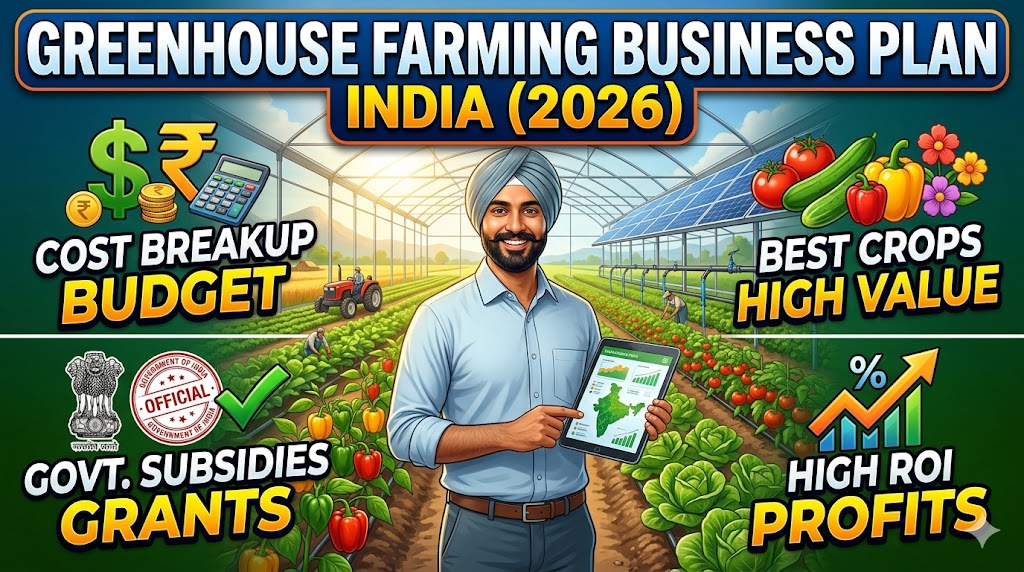
A greenhouse can turn farming into an organized business: year-round production, better quality, and predictable harvesting schedules. But to succeed, you need more than a structure—you need a real business plan: the correct crop mix, accurate cost budgeting, subsidy planning, and risk management.
This guide gives you a practical greenhouse business plan framework for Indian growers—focused on what typically decides ROI: your crop selection, irrigation/fertigation system, energy/water costs, labour planning, and the way you sell/market produce.
Greenhouse Business Plan Checklist (before construction)
- Confirm your market channel: local retail, bulk wholesalers, supermarkets, exporters, or online.
- Choose crops based on your target temperature range and your ability to manage pests/diseases.
- Estimate monthly energy and water cost (heating/cooling, pumping, fertigation units).
- Plan labor: daily monitoring is essential in controlled environments.
- Check subsidy eligibility (NHM/NHB/State schemes) and required documents.
1) Types of greenhouses in India (and what each is best for)
Low-cost polyhouse
Suitable for basic protected cultivation. It reduces weather risk but gives limited climate control.
It works best when your region’s climate already supports crop growth and you only need protection from rain/hail and moderate heat/cold.
Medium-cost greenhouse
Adds better ventilation and drip/fertigation systems. Usually balanced for vegetables like tomato/capsicum/cucumber.
ROI is higher when crops are stable and your market can pay for premium quality.
Hi-tech climate-controlled greenhouse
Designed for controlled temperature/humidity with automation and monitoring (cooling pads, fans, sensors).
High ROI is possible, but only when you can manage technical operations and stable market demand.
2) Greenhouse cost breakup: what you should budget
Your total cost depends on structure quality, area size, crop type, automation level, and whether you need cooling/heating systems.
Use this breakup to create an accurate estimate for your project.
| Cost head | What’s included | ROI impact |
|---|---|---|
| Structure & covering | GI/pipe frame, polythene sheets, cladding, gutters | Controls durability and climate stability |
| Drip & fertigation | Pumps, filters, lines, fertigation injector, dosing tanks | Improves nutrient efficiency and consistent yields |
| Climate control (if needed) | Fans, cooling pads, vents, shading nets, sensors | Reduces crop stress, improves quality |
| Planting material & inputs | Seedlings, coco peat/grow media (where used), fertilizers | Directly affects yield and disease pressure |
| Labor & operations | Pruning/training, scouting, irrigation management, sanitation | Consistency and lower losses |
| Utilities & maintenance | Electricity, replacement sheets, filters, spares | Protects operating cost assumptions |
3) Best greenhouse crops for Indian markets (and why)
Choose crops that:
(1) match your climate control level,
(2) have stable market demand, and
(3) justify protected cultivation premium.
| Crop | Typical greenhouse suitability | Main advantage |
|---|---|---|
| Tomato | Medium to hi-tech | Higher quality, reduced rain disease |
| Cucumber | Medium | Stable production and better grading |
| Capsicum | Medium/hi-tech | High value crop in premium markets |
| Gerbera / cut flowers | Specialized setups | Higher margins if buyer exists |
| Herbs/leafy greens | Lower climate requirements | Short cycles, faster cashflow |
4) Subsidy and financing planning (what to prepare)
Government subsidy coverage depends on state, farmer category, and project size.
For business planning, treat subsidies as “additional benefit,” not as your only ROI driver.
- Collect land records and ownership/lease documents.
- Keep quotations and technical drawings from suppliers/contractors.
- Plan your procurement timing so you meet compliance requirements.
5) ROI planning: a practical method (don’t rely on generic numbers)
ROI depends on two things: your net income after operating costs and your replacement/maintenance budget.
Many people fail because they underestimate electricity, water, labor, and plant protection cost.
Simple ROI formula you can fill
- Total Investment: structure + irrigation + climate equipment + installation
- Annual Revenue: expected harvest volume × average sale price (after grading)
- Annual Operating Cost: labor + fertilizer + plant protection + utilities + maintenance
- Net Profit: revenue − operating cost (minus packing/handling losses)
- ROI: net profit ÷ total investment × 100
Risk adjustment (must-do)
Apply a realistic loss factor for:
crop disease outbreaks, rejected produce, delayed sales, and price volatility.
This makes your ROI plan safer.
6) Implementation strategy (step-by-step)
- Market research: confirm weekly buying capacity and minimum quality requirements.
- Site selection: reliable water and electricity; drainage to prevent water stagnation.
- Crop calendar: plan sowing/planting cycles so harvest occurs continuously.
- Infrastructure: install drip/fertigation and climate equipment first-class.
- Start small: begin with a manageable crop mix to learn operations.
- Monitoring: daily scouting and records—greenhouse farming is a “management business.”
- Marketing: secure buyers before peak harvest begins.
7) Operational requirements (what makes the greenhouse succeed)
- Skilled labor: trained staff for pruning, training, and scouting
- Record keeping: yields, disease observations, fertilizer schedules
- Quality control: uniform grading and packaging standards
- Sanitation: footbaths/clean tools to reduce pest introduction
8) Common greenhouse challenges and how to fix them
Challenge #1: power supply instability
If fans/pumps fail, temperature/humidity becomes stressful and disease risk increases.
Add backup planning: generator or power arrangement for critical systems where possible.
Challenge #2: pest resistance and outbreaks
Random pesticide spraying leads to resistance. Use IPM:
monitoring, biological options, targeted interventions, and sanitation.
Challenge #3: price volatility
Reduce dependency on one buyer by building multiple selling channels and scheduling harvest to avoid extreme price drops.
9) FAQ (greenhouse business plan)
Q1: What is the minimum land requirement for greenhouse farming?
A: Greenhouses can start from smaller areas and scale, but ROI improves when crop cycle planning and labor utilization are optimized.
Q2: Which greenhouse crops bring higher profitability?
A: Capsicum, cucumber, and premium flowers can be highly profitable if buyers and management systems are in place.
Q3: What is the lifespan of a greenhouse structure?
A: Structure can last longer; plastic covers typically require replacement based on weather exposure and material quality.
Conclusion
A greenhouse becomes a profitable business when you link three parts: infrastructure + crop plan + buyer plan. Use this business-plan framework to estimate real costs, choose crops that match your climate-control level, and plan ROI with risk adjustments. That is how you build stable greenhouse income in India.