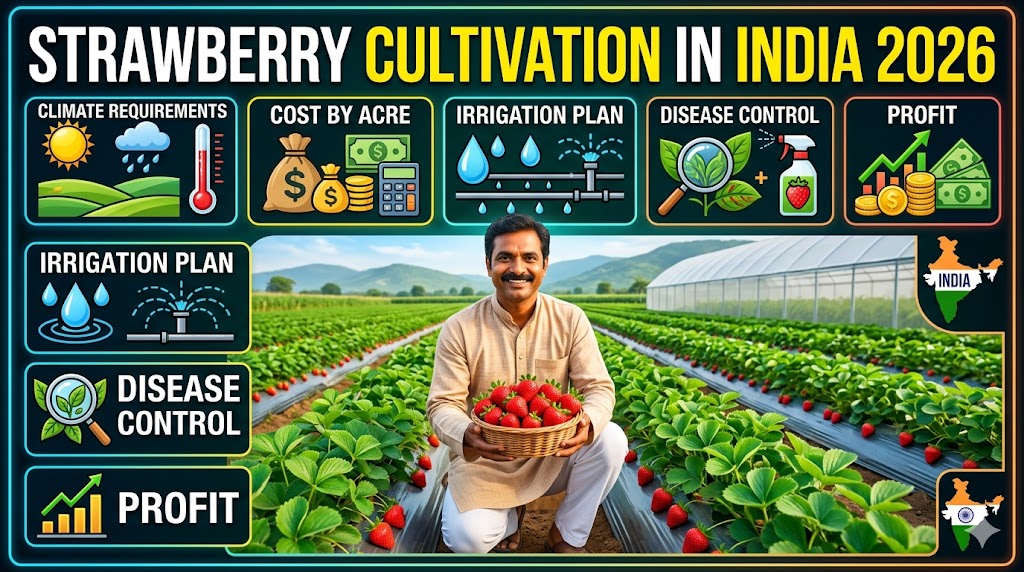
Strawberry farming is a high-value crop in India because buyers prefer premium berries with good color, firm texture, and low rot. But strawberries are also sensitive to climate and moisture management. Many farms fail not because strawberry is “hard,” but because the grower does not control key factors: temperature window, soil drainage, irrigation timing, mulching, and fungal disease prevention.
This guide is AdSense-friendly and practical. You will learn strawberry climate requirements, ideal planting windows, spacing and variety planning, an irrigation and nutrient framework, disease troubleshooting, harvesting/packing workflow, and a profit planning method.
Quick Strawberry Facts (for planning)
| Topic | What matters |
|---|---|
| Temperature | Cool to mild climate during vegetative growth and fruiting; avoid heat stress |
| Moisture | Strawberries need irrigation but hate waterlogged soil and wet foliage |
| Disease risk | Grey mold/botrytis and powdery mildew increase with humidity |
| Market value | Grade and pack quickly; rejects from rot reduce profit fast |
1) Climate requirements (how to know your farm is suitable)
Strawberry grows best in cool to mild climates.
When daytime temperatures are too high, berries become smaller and disease risk increases.
Heavy frost during flowering can reduce fruit set.
In many Indian regions, protected cultivation (drip + polyhouse/net) improves consistency.
Climate “windows” for decision-making
- Vegetative stage: cooler days support strong leaves and runners.
- Flowering and fruit set: cool days and not-too-high humidity help pollination and reduce fungal pressure.
- Fruit enlargement: balanced moisture prevents fruit cracking and rot.
2) Soil requirements and land preparation
Soil quality decides drainage, nutrient uptake, and berry health.
Choose well-drained loamy soil with good organic matter.
Avoid compacted soils that hold water around roots.
Soil targets (use as guidance)
- pH: slightly acidic to neutral (confirm using soil test)
- Organic matter: higher organic content improves structure and moisture stability
- Drainage: raised beds reduce waterlogging and root rot risk
3) Planting time, runners, and spacing
Strawberry planting depends on your region’s climate.
In many places, transplanting is done when conditions support runner establishment.
Use certified runners to reduce pest/disease introduction.
Spacing framework (practical)
- Plant to plant spacing: set so runners do not overcrowd
- Row spacing: leave enough airflow to reduce humidity pockets
- Plant density: adjust based on variety vigor and whether you use mulch/poly
4) Irrigation and nutrient management (stage-wise)
Strawberries require regular irrigation, but the secret is how you irrigate.
Use drip irrigation for precise watering and to keep foliage drier.
Apply nutrients stage-wise; do not flood the field with nitrogen.
Irrigation stage planning
| Stage | Irrigation goal | What to watch |
|---|---|---|
| Transplant establishment | Moist root zone without waterlogging | Runner growth; avoid puddles |
| Flowering | Steady moisture for fruit set | Check for wilt from stress and leaf diseases |
| Fruit enlargement | Balanced moisture for berry firmness | Grey mold risk if humidity stays high |
Nutrient management framework
- Base nutrition: organic matter + balanced P for root support
- Nitrogen: split doses; avoid too much vegetative growth
- Potassium: supports fruit quality and firmness
- Micronutrients: correct based on soil/test symptoms
5) Mulching and weed control (reduces rot + saves time)
- Plastic mulch: reduces soil splash and keeps berries cleaner
- Organic mulch: supports soil but needs good management to avoid moisture trapping
- Weed control: consistent early weeding improves airflow and reduces competition
6) Common strawberry diseases (symptoms → causes → solutions)
6.1 Grey mold / Botrytis (most important)
- Symptoms: soft brown patches on berries, grey fuzzy growth
- Causes: high humidity, wet foliage, close runner canopy
- Solutions: prune runners for airflow, reduce leaf wetness, remove infected fruit quickly
6.2 Powdery mildew
- Symptoms: white powder coating on leaves
- Causes: dense canopy + certain temperature/humidity combinations
- Solutions: improve airflow, use disease management based on local disease calendar
6.3 Root rot / crown issues
- Symptoms: plant wilting, poor vigor, crown decay
- Causes: waterlogged soil, poor drainage
- Solutions: raised beds, improve drainage, manage irrigation carefully
7) Harvesting and post-harvest handling
- Harvest frequently (strawberries ripen quickly).
- Pick with care to avoid bruising.
- Sort berries by size and quality.
- Pack quickly; avoid long delays in warm conditions.
- If refrigeration is available, cool quickly to maintain freshness.
8) Cost and profit planning (how to estimate your strawberry ROI)
Strawberry profit depends on two things:
yield/quality and losses due to rot.
Use a “real cost breakup” and a “loss-adjusted revenue” method.
Cost heads to include
- Land prep + raised beds
- Runners/seedlings
- Drip irrigation and filter setup
- Mulch materials
- Fertilizers + plant protection + labor
- Packing boxes/punnets and transport
Revenue method
- Expected yield × expected sale rate
- Reduce revenue for rejection rate (rot, small size, damaged berries)
- Check how price changes by season (early harvest vs peak)
9) FAQ (strawberry cultivation)
Q1: Which Indian states are best for strawberry?
A: Many cool temperate/subtropical regions like Mahabaleshwar, Nainital, Kalimpong, parts of Himachal and similar areas.
Q2: How often should irrigation be done?
A: Depends on temperature and soil; use drip and adjust based on moisture and plant growth stage.
Q3: Why do berries rot quickly?
A: Usually due to humidity + wetness + soil contact. Mulch and airflow reduce rot risk significantly.
Conclusion
Strawberry farming in India can give strong returns when growers manage climate conditions, drainage, drip irrigation, and fungal disease prevention (especially grey mold). Build your strawberry farm around a routine:
mulch + drip + airflow + scouting + quick harvest/packing.