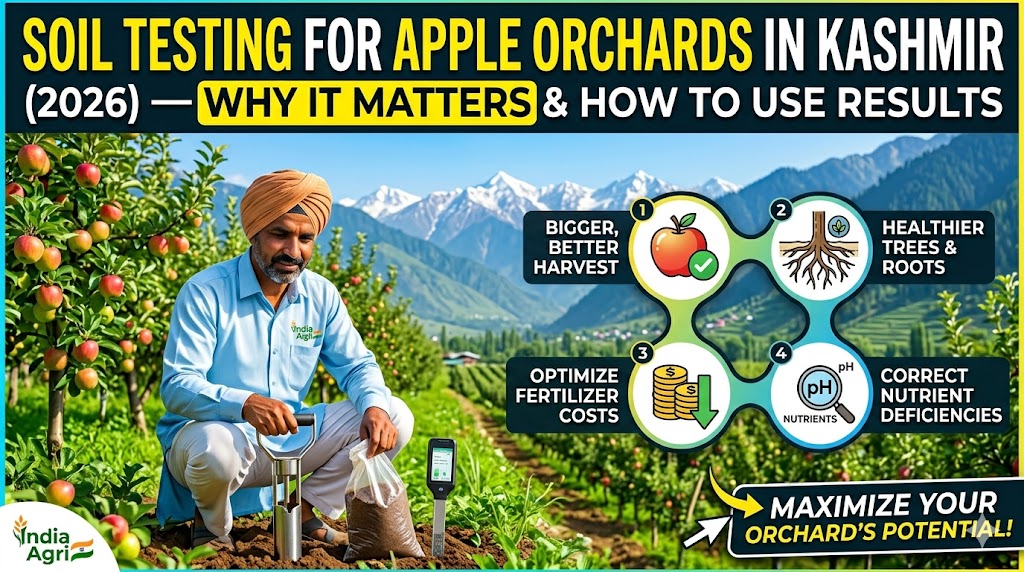
Soil is the foundation of every apple orchard, yet most growers in Kashmir plant trees or apply fertilisers without ever testing the soil beneath them. This is one of the most avoidable causes of poor orchard performance — trees that produce small, poorly coloured fruit, show chronic nutritional deficiency symptoms, or respond poorly to fertiliser applications despite significant investment.
A basic soil test costs between ₹300 and ₹600 per sample through SKUAST-K or the J&K Horticulture Department. The information it provides can save many times that cost in wasted fertiliser and lost yield. This guide explains what a soil test tells you, how to collect a soil sample correctly, and how to act on the results.
What a soil test measures
A standard horticultural soil test in India measures the following parameters:
Soil pH is the measure of acidity or alkalinity on a scale of 0 to 14. Apple trees grow best in a slightly acidic soil with a pH between 6.0 and 6.5. At this pH, the major nutrients — nitrogen, phosphorus, and potassium — are most available to roots. At pH above 7.5 (alkaline), iron, manganese, and zinc become locked up in the soil and unavailable to trees even if they are physically present.
Many soils in the Kashmir valley have a pH in the range of 6.0 to 7.5, but there is significant variation between sites. Soils in low-lying areas with poor drainage tend to be more alkaline. High-altitude soils with heavy organic matter accumulation tend to be more acidic.
Organic matter content tells you how biologically active and physically healthy your soil is. Most productive apple orchard soils have organic matter content of 2–4%. Below 1.5%, soils are considered low and benefit significantly from compost, cover crops, or green manure additions. Most Kashmiri orchard soils that have not received compost inputs for several years fall below 2%.
Available nitrogen (N) gives an indication of the soil’s capacity to supply nitrogen to the tree. However, nitrogen is mobile in soil and changes rapidly with rainfall and temperature, so soil nitrogen tests are less reliable than tissue (leaf) tests for nitrogen management decisions.
Available phosphorus (P) indicates the phosphorus accessible to roots. Phosphorus is critical for root development, flowering, and fruit set. It is relatively immobile in soil and builds up over time with repeated applications.
Available potassium (K) indicates potassium supply. Potassium is the nutrient most directly linked to fruit size, colour development, and shelf life in apples. Many Kashmir soils are naturally well-supplied with potassium, but high-density orchards with large crops can deplete it quickly.
Secondary and micronutrients — calcium, magnesium, iron, manganese, boron, and zinc — are measured in more comprehensive tests. Boron deficiency is particularly common in Kashmiri apple orchards and causes cork spot disease in fruit and poor fruit set. Zinc deficiency causes little leaf disease.
How to collect a soil sample
The quality of a soil test result is only as good as the sample collected. A poor sampling technique will give results that do not represent the actual conditions in your orchard.
Collect samples from at least 10–15 different points across the orchard, following a W or zigzag pattern. Avoid areas near field edges, near roads, near compost heaps, or directly under the tree trunk — these are not representative of the root zone.
At each point, use a clean soil auger or spade to collect soil from two depths: 0–30 cm (topsoil, where feeder roots are concentrated) and 30–60 cm (subsoil, which influences drainage and deeper root activity). Keep these two depths separate.
Mix all samples from the same depth into a clean plastic bucket, remove stones, and take a 500g subsample to send for testing. Label clearly with your name, orchard location, depth, and the crop grown.
Interpreting the results and taking action
If pH is below 6.0: Apply agricultural lime (calcium carbonate) to raise pH toward the 6.0–6.5 range. The amount required depends on your soil’s buffer capacity, which the lab report will usually indicate. Apply lime in autumn, as it takes several months to react in the soil.
If pH is above 7.0: Do not apply lime. If pH is above 7.5, consider applying sulphur to acidify the soil, or switch to acidifying fertilisers like ammonium sulphate rather than calcium nitrate.
If organic matter is below 2%: Apply 10–15 tonnes per acre of well-rotted compost or farmyard manure. Maintain a permanent grass or legume cover crop in the inter-row and mow it regularly rather than spraying it with herbicide.
If phosphorus is low: Apply single superphosphate or diammonium phosphate based on the recommended quantity in your lab report. Phosphorus should be incorporated into the soil at planting time in new orchards and applied as a surface application in established orchards.
If potassium is low: Apply muriate of potash or sulphate of potash. In orchards with high production targets, split potassium applications between spring and post-harvest reduce luxury consumption and improve efficiency.
If boron is deficient: Apply borax at 1–2 kg per acre as a soil application, or use a foliar boron spray at 0.3% concentration during bloom and again at petal fall. Boron is critical for pollen germination and fruit set — its deficiency is one of the most common causes of poor fruit set in Kashmir orchards.
Leaf (tissue) testing as a complement to soil testing
A soil test tells you what nutrients are in the soil. A leaf test tells you what the tree is actually taking up. The two together give a much more complete picture than either alone.
Leaf samples for apple are collected in mid-summer — typically late July — from the mid-shoot leaves of non-fruiting spurs on representative trees. The SKUAST-K and J&K Horticulture Department both offer leaf analysis services.
Normal ranges for apple leaf nutrients have been established for Kashmir conditions. If a nutrient is within the normal leaf range but deficient in the soil, the tree may be meeting its needs from soil reserves or the deficiency may not yet be affecting yield. If both soil and leaf tests show a deficiency, correction is urgent.
Building a long-term soil management plan
The goal of soil testing is not just to correct current deficiencies but to build a long-term plan for improving orchard soil health. The best-performing apple orchards in Kashmir — those that consistently produce premium-grade fruit over many decades — have soils with stable pH, high organic matter, and balanced nutrition. These are not achieved in a single year but through consistent management decisions made over many seasons.
Test your soil every three years at minimum, and every year if you are intensively managing a new high-density orchard. Keep records of your results so you can track changes over time and adjust your management accordingly.
Summary
Soil testing is one of the highest-return investments an apple grower in Kashmir can make. It removes guesswork from fertiliser decisions, identifies limiting factors that cannot be seen above ground, and provides the foundation for a rational long-term orchard management plan. The cost is minimal; the benefit — in improved yields, better fruit quality, and reduced wasted fertiliser expense — can be substantial.
FAQ
Q: Where can I get my soil tested in Kashmir? SKUAST-K in Srinagar, the J&K Horticulture Department field offices, and HPMC all offer soil testing services. Private labs are also available in Srinagar.
Q: How often should I test my apple orchard soil? Every 2–3 years for established orchards; every year for new high-density plantations in the first five years.
Q: What is the ideal soil pH for apple orchards in Kashmir? 6.0 to 6.5 is the optimal range. Most nutrients are most available and most root functions are most efficient within this range.
Q: My apple leaves are yellow between the veins — what does this mean? This pattern (interveinal chlorosis) on young leaves usually indicates iron deficiency, which is common in alkaline soils. Get a soil and leaf test to confirm before applying any correction.