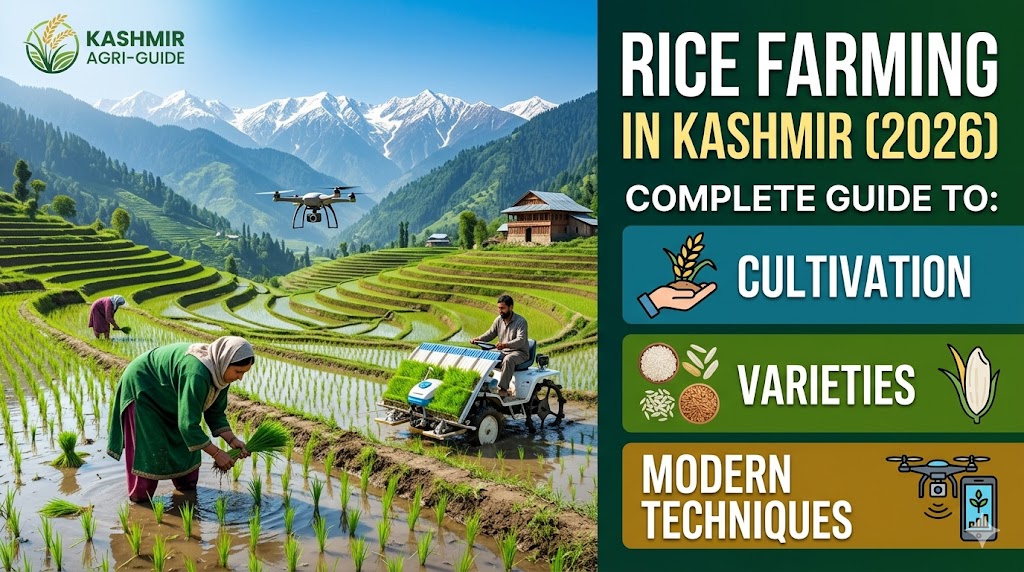
Nestled between the towering Himalayas, the Kashmir Valley has cultivated rice for over a thousand years. The lush green paddy fields that stretch from Sopore to Anantnag — shimmering under a cool summer sky — are not just a source of food. They are a cultural identity, a livelihood, and a living tradition passed down through countless generations of Kashmiri farmers.
In 2026, rice farming in Kashmir stands at a historic crossroads. Farmers continue to preserve ancient grain varieties like Mushkbudji, revered globally for their fragrance and taste. At the same time, the pressure of a changing climate, urban expansion, and the growing need for higher productivity is pushing agriculture to modernize rapidly.
This guide provides a complete, up-to-date resource for farmers, students, and agriculture enthusiasts who want to understand every dimension of rice cultivation in the Kashmir Valley today.
“Kashmir’s paddy fields are more than farmland — they are the lungs of the valley, feeding millions and sustaining the ecological balance of one of the world’s most beautiful landscapes.”
1. Kashmir’s Centuries-Old Rice Heritage
Rice has been the heartbeat of Kashmir’s agricultural life since ancient times. Historical records and trade documents from the Mughal era describe the Valley’s paddy fields as among the most fertile and productive in the entire Indian subcontinent. The legendary Kashmiri hospitality — embodied in the grand Wazwan feast — is built around rice as its centerpiece.
Today, paddy cultivation covers approximately 1.5 lakh hectares across Jammu & Kashmir, with the Kashmir Valley accounting for the lion’s share. Districts like Pulwama, Anantnag, Budgam, Ganderbal, and Baramulla are the primary paddy-growing regions, each with its own micro-climate and soil conditions.
What makes Kashmir’s rice farming truly unique is the diversity it sustains — from high-yielding modern varieties bred at SKUAST-Kashmir to centuries-old heirloom grains like Mushkbudji, whose aroma is said to be unmatched anywhere in the world.
2. Why Rice Farming Matters in Kashmir
Rice is far more than a crop in Kashmir — it is the foundation of food security, rural employment, cultural identity, and ecological sustainability all at once.
- 🌾 Food Security: Rice is the staple food for over 7 million people in the Kashmir Valley. Local production directly determines whether families eat affordably or must depend on expensive imports from other states.
- 💼 Employment: Paddy cultivation — from nursery preparation and transplanting to harvesting and milling — provides seasonal livelihoods to hundreds of thousands of rural families.
- 💰 Economy: Premium varieties like Mushkbudji generate significant foreign and domestic market revenue, with farm-gate prices reaching ₹150–250 per kg and retail prices touching ₹1,200/kg in premium markets.
- 🌿 Ecology: Kashmir’s flooded paddy fields function as seasonal wetlands, supporting migratory bird species at Hokersar and Wular Lake, recharging groundwater, and maintaining the valley’s fragile microclimate.
Protecting and modernizing rice farming in Kashmir is, therefore, not merely an agricultural priority — it is an ecological, cultural, and economic imperative.
3. Popular Rice Varieties Grown in Kashmir
Kashmir grows a rich spectrum of rice varieties — from ancient aromatic heirlooms to modern high-yield cultivars developed by agricultural research stations. Choosing the right variety for your field, market, and climate conditions is one of the most important decisions a farmer makes each season.
| Variety | Type | Yield (qtl/acre) | Key Feature |
|---|---|---|---|
| Mushkbudji | Heritage / Aromatic | 8–12 | GI-tagged, unique musk fragrance, premium price |
| Jhelum | High-Yield | 22–28 | Disease-resistant, widely grown, medium grain |
| Shalimar Rice-1 | High-Yield | 20–25 | Developed by SKUAST-K, suited to valley climate |
| Kohsar | High-Yield | 24–30 | Early-maturing, performs well in cold conditions |
| K-39 | Traditional | 10–15 | Long grain, preferred in premium local markets |
| SKUA-40 | Improved (2025 release) | 25–30 | Blast-resistant, high tillering, top 2026 pick |
Mushkbudji deserves special attention. This ancient variety holds a Geographical Indication (GI) tag, meaning only rice grown in specific Kashmir Valley districts can legally carry this name. Its intoxicating fragrance and superior cooking quality make it one of the most sought-after specialty rice varieties in India — and increasingly, in global export markets.
4. Rice Farming Calendar 2026 — Season by Season
Rice in Kashmir is a Kharif crop, meaning it grows during the warm months. Unlike plains states where 2–3 rice crops are possible annually, Kashmir’s altitude and climate allow only one main paddy season per year. Precision timing at every stage is critical.
| Month | Key Activity |
|---|---|
| April (Late) | Nursery bed preparation; seed soaking & seed treatment |
| May | Nursery sowing; monitor seedling growth |
| June (Early–Mid) | Main field preparation; puddling & leveling |
| June (Late) – July (Early) | Transplanting — the most critical window of the season |
| July – August | Weed control; top dressing of fertilizers; irrigation management |
| September | Panicle emergence; pest monitoring; gradual field drying |
| October | Grain filling; harvest readiness assessment |
| October (Late) – November | Harvesting; threshing; grain drying; storage |
⚠️ 2026 Advisory: The J&K Department of Agriculture advises farmers to complete transplanting by July 15, 2026 at the latest. Late transplanting significantly reduces both grain yield and quality. Farmers using Direct-Seeded Rice (DSR) techniques should target mid-June sowing.
5. Land Preparation & Soil Requirements
Good rice farming begins with the soil. Kashmir Valley soils are predominantly loamy to clay-loam with a slightly acidic to neutral pH — ideal conditions for paddy cultivation. Most paddy fields are low-lying terraced plots that naturally retain water, a significant advantage for wet rice farming.
Key Steps in Land Preparation
- 🌱 Deep Ploughing: Carry out 2–3 rounds of ploughing to a depth of 15–20 cm to break compacted layers and improve soil aeration.
- 💧 Puddling: Flood the field and puddle it thoroughly to destroy weeds, create an impermeable hardpan that reduces water seepage, and make transplanting easier.
- 📏 Leveling: Use a leveling board or laser leveler (now subsidized under PMKSY) for uniform water distribution. Uneven fields waste water and cause patchy crop stands.
- 🧪 Soil Testing: Get your soil tested at the nearest Soil Testing Laboratory. It is low-cost, widely available across all J&K district headquarters, and prevents expensive fertilizer mistakes.
- 🌿 Green Manuring: Grow Sesbania (Dhaincha) or Sunhemp before the rice season and plough it in while still green. This boosts organic nitrogen naturally, reducing chemical fertilizer dependence.
6. Nursery Management & Transplanting
A healthy nursery is the foundation of a productive harvest. In Kashmir, nursery raising begins in late April to early May. Seedlings spend approximately 25–30 days in the nursery before being transplanted to the main field.
Nursery Preparation Tips
Prepare nursery beds on well-drained, fertile land. Mix well-decomposed farmyard manure (FYM) at 3–4 kg per square meter. Make raised beds about 1–1.2 meters wide. Treat seeds with Carbendazim or Trichoderma solution before sowing to guard against fungal diseases. Sow seeds uniformly and cover lightly with soil or straw.
Transplanting Best Practices
- 🌾 Transplant when seedlings are 25–35 days old and 20–25 cm tall.
- 📐 Maintain spacing of 20 cm × 15 cm for high-yield varieties; 25 cm × 20 cm for aromatic varieties like Mushkbudji.
- 🤲 Plant 2–3 seedlings per hill for high-yield varieties; 3–4 per hill for heritage varieties.
- ⏰ Transplant in early morning or late afternoon to minimize seedling stress from heat.
- 🚜 In 2026, mechanical transplanters available through Custom Hiring Centers (CHCs) reduce labor costs by up to 40%.
7. Water & Irrigation Management
Rice is often called a “thirsty crop,” but modern research has shown that a large portion of water used in traditional paddy farming is actually wasted. In 2026, Kashmiri farmers are increasingly adopting smarter water management strategies — both to conserve the valley’s precious water resources and to reduce input costs.
Alternate Wetting and Drying (AWD)
AWD is a water-saving technique now actively promoted by the J&K Agriculture Department and supported by international organizations including the FAO. Under AWD, farmers allow the field to dry after each irrigation until the soil surface just begins to crack, and then re-irrigate. Studies confirm AWD can reduce water use by 20–30% with no significant yield loss.
Critical Irrigation Stages — Never Allow Water Stress At:
- Active tillering stage
- Panicle initiation stage
- Heading and flowering stage
- Grain filling stage
Monitor soil moisture carefully during these four growth phases and ensure timely irrigation regardless of the water management approach you are following.
8. Fertilizer & Nutrient Management
Proper fertilization is one of the most impactful factors in determining rice yield. Kashmir paddy soils are generally deficient in nitrogen, phosphorus, and zinc. A soil-test-based approach ensures you apply the right nutrients in the right amounts — saving money and preventing environmental damage.
| Nutrient | Recommended Dose (per acre) | Timing |
|---|---|---|
| Nitrogen (N) | 40–50 kg (as Urea) | 3 splits: basal + tillering + panicle initiation |
| Phosphorus (P₂O₅) | 20–25 kg (as SSP/DAP) | Entirely at basal — before transplanting |
| Potassium (K₂O) | 15–20 kg (as MOP) | Basal + one top dressing at tillering |
| Zinc Sulphate | 5–10 kg | Basal — once every 3 years |
| FYM / Compost | 4–5 tonnes | 2–3 weeks before transplanting |
💡 Pro Tip: Research from SKUAST-Kashmir confirms that three-split nitrogen application (basal + active tillering at 21 days + panicle initiation) increases yield by 12–18% compared to single or two-split applications.
9. Pest & Disease Control in Kashmir Paddy
Kashmir’s cool, moist climate creates favourable conditions for several rice pests and diseases. Early identification and timely action prevent serious crop losses. Integrated Pest Management (IPM) — combining cultural, biological, and minimal chemical methods — is the recommended approach in 2026.
Major Pests to Watch
- 🐛 Stem Borer: The most damaging pest in Kashmir paddies. Look for “dead heart” (vegetative stage) or “white ear” (heading stage) symptoms. Use light traps and apply insecticides only when pest population crosses the economic threshold.
- 🪲 Gall Midge: Causes “silver shoot” or onion leaf symptoms. Use resistant varieties like Shalimar-1 and practice early planting to avoid peak pest incidence periods.
- 🌿 Weeds (Barnyard Grass, Sedges): Apply Bispyribac-sodium or Pretilachlor herbicide within 3–7 days of transplanting for effective weed suppression.
Major Diseases to Watch
- 🍄 Rice Blast: Fungal disease causing diamond-shaped lesions on leaves. Use blast-resistant varieties (SKUA-40) and spray Tricyclazole if symptoms appear at seedling or panicle stage.
- 🌾 Sheath Blight: Encouraged by dense planting and high nitrogen levels. Maintain proper spacing and apply Hexaconazole at first symptoms.
- 🔶 Bakanae Disease: Seed-borne fungal disease causing tall, spindly seedlings. Treat seeds with Carbendazim before sowing to prevent this effectively.
10. Modern Farming Techniques Adopted in Kashmir in 2026
The agriculture landscape in Kashmir is undergoing a quiet but powerful transformation. Several modern technologies and practices are now being adopted — independently by progressive farmers and through government-backed programs — that are changing how paddy is grown across the valley.
Direct-Seeded Rice (DSR)
In DSR, pre-germinated seeds are sown directly into the prepared field using seed drills, eliminating the nursery and transplanting stages entirely. This saves 15–20 labor days per acre and reduces water consumption significantly. The J&K Agriculture Department is promoting DSR aggressively in 2026, especially in water-scarce districts.
Agricultural Drone Spraying
Agricultural drones are now operational across blocks in Anantnag, Baramulla, and Budgam. A single drone covers 10 acres in 30–40 minutes — compared to a full day using manual knapsack sprayers — and delivers pesticides and foliar fertilizers with far greater precision and uniformity.
System of Rice Intensification (SRI)
SRI uses younger seedlings (8–12 days old), wider spacing (25 cm × 25 cm), intermittent irrigation, and active weeding-based soil aeration. Farmers practicing SRI in Ganderbal and Pulwama districts have reported yield gains of 20–40% with reduced water and fertilizer inputs.
Soil Health Cards & Precision Nutrition
In 2026, soil health data is integrated with mobile advisory apps, giving farmers real-time, personalized fertilizer recommendations based on their specific field’s nutrient profile — eliminating guesswork and reducing input waste significantly.
11. Government Schemes & Support for Rice Farmers in J&K 2026
The Government of India and the J&K administration together operate a robust network of farmer support schemes. Many benefits go unclaimed simply because farmers are unaware of them. Here are the most important ones for paddy farmers in 2026:
| Scheme | Benefit | How to Apply |
|---|---|---|
| PM-KISAN | ₹6,000/year direct income support | pmkisan.gov.in or local Agriculture Office |
| PMFBY (Crop Insurance) | Coverage against flood, drought, pest damage | Nearest bank or Common Service Centre (CSC) |
| SMAM (Farm Mechanisation) | 50–80% subsidy on transplanters, threshers, drones | J&K AgriStack portal or tehsil agriculture office |
| NMSA (Micro-Irrigation) | Subsidy on drip/sprinkler equipment | Department of Agriculture offices |
| One District One Product | Branding & market linkage for Mushkbudji | District Industries Centre (DIC) |
| Kisan Credit Card (KCC) | Crop loans up to ₹3 lakh at just 4% interest | Any nationalized bank with land documents |
12. Challenges Facing Kashmir Rice Farmers in 2026
Despite its rich potential, rice farming in Kashmir faces several serious, interconnected challenges that demand urgent attention from both farmers and policymakers.
Climate Change & Weather Unpredictability
The Kashmir Valley has experienced measurable shifts in weather patterns over the past decade. Delayed monsoon onset, sudden hailstorms during grain-filling, and early October frosts have caused significant crop damage in recent years. Farmers need to adapt by choosing early-maturing varieties, purchasing crop insurance, and diversifying livelihoods.
Declining Agricultural Land
Rapid urbanization around Srinagar, Baramulla, and Anantnag is converting prime paddy land into residential and commercial areas every year. Once converted, this land is rarely reclaimed for agriculture — posing a long-term threat to rice self-sufficiency in the valley.
Labor Shortage & Rising Costs
Rural youth outmigration has made agricultural labor increasingly scarce and expensive in Kashmir. Transplanting and harvesting — which require large numbers of workers — are most affected. Farmer Producer Organizations (FPOs) and Custom Hiring Centers (CHCs) offering shared machinery access are the most practical near-term solutions.
Post-Harvest Losses & Market Access
Kashmir’s paddy farmers lose an estimated 10–15% of their harvest annually due to poor storage, inadequate drying facilities, and limited market connectivity. Linking farmers to e-NAM (National Agriculture Market), FPOs, and direct-to-consumer digital platforms is a top priority for 2026.
13. Frequently Asked Questions — Rice Farming Kashmir 2026
Q1. Which is the best rice variety to grow in Kashmir in 2026?
For maximum profit, Mushkbudji is ideal if you have access to premium or export markets. For higher volume and food security, Shalimar Rice-1, Kohsar, or the newly released SKUA-40 offer the best yields with strong disease resistance.
Q2. When should I start a paddy nursery in Kashmir?
The ideal nursery period is late April to early May. This ensures seedlings are ready for transplanting by late June to early July — the optimal transplanting window for paddy in Kashmir.
Q3. How can I get certified Mushkbudji seeds?
Authentic certified Mushkbudji seeds are available through SKUAST-Kashmir, district agriculture offices, and registered seed dealers in Anantnag, Pulwama, and Budgam districts.
Q4. Is crop insurance available for rice farmers in Kashmir?
Yes. Pradhan Mantri Fasal Bima Yojana (PMFBY) covers paddy against losses from natural calamities, pests, and diseases. The Kharif crop premium is just 2% of the sum insured. Enroll at your nearest bank or CSC before July 31, 2026.
Q5. What is the market price of Mushkbudji rice in 2026?
Farm-gate prices for Mushkbudji range from ₹150–250 per kg, while packaged retail prices reach ₹600–1,200 per kg in premium stores and online platforms. Direct-to-consumer selling through FPOs or e-commerce maximizes farmer earnings.
Q6. What is DSR and is it suitable for Kashmir?
Direct-Seeded Rice (DSR) eliminates the nursery and transplanting stage — seeds are drilled directly into prepared fields. It saves 15–20 labor days per acre and reduces water use by 20–25%. In 2026, DSR is being promoted in water-scarce districts of J&K and is proving highly effective.
14. Conclusion: The Future of Rice Farming in Kashmir
Rice farming in Kashmir in 2026 is a story of resilience, heritage, and transformation. The valley’s farmers are the custodians of one of the world’s most beautiful landscapes and some of its most treasured grain varieties. They face real challenges — climate change, shrinking farmland, labor shortages, and market barriers. But they also have more tools and opportunities at their disposal than any previous generation: precision agriculture, drone spraying, government subsidies, digital market access, and a growing global appetite for premium grains like Mushkbudji.
The path forward lies in combining the wisdom of traditional Kashmiri farming with the efficiency of modern agricultural science — choosing the right variety for your land and market, applying inputs precisely, managing water smartly, and connecting to the best possible buyers.
Whether you are a paddy farmer in Pulwama, an agriculture student at SKUAST-K, or simply someone who loves Kashmir and its remarkable food culture — understanding rice farming deeply is the first step toward securing a prosperous, sustainable future for this iconic valley crop.
🌾 If you found this guide helpful, share it with a farmer or agriculture student in your community. Knowledge shared is yield multiplied.
📌 Disclaimer: This article is for informational and educational purposes only. For official crop advisories, contact the Directorate of Agriculture, Jammu & Kashmir, or your local Agriculture Extension Officer