There is a particular kind of frustration that builds in a farmer who has been using chemical inputs for decades — watching soil quality decline season after season, spending more on fertilisers and pesticides every year, and realising that the crop prices at the mandi have not kept pace with any of it.
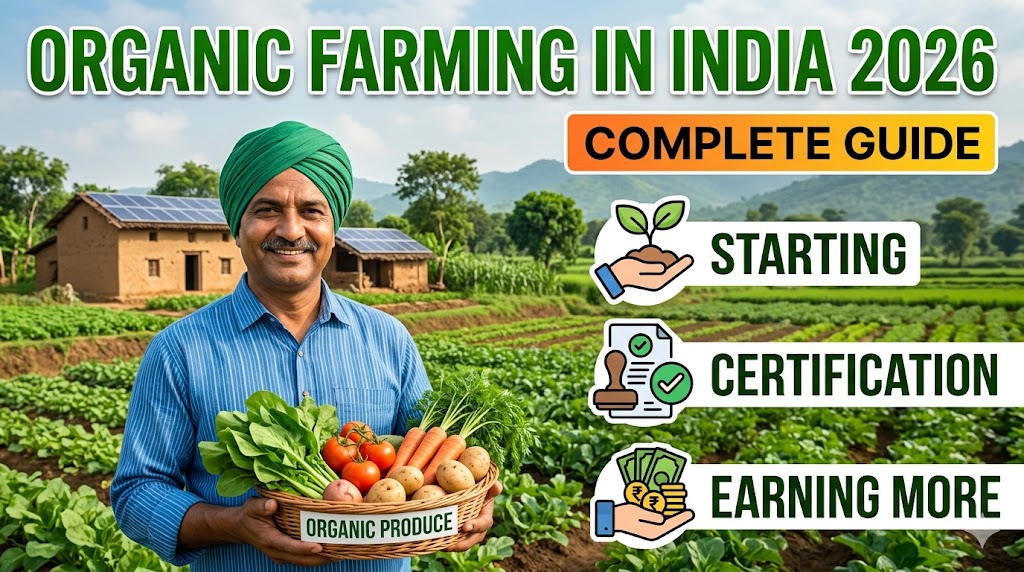
Organic farming is, for many Indian farmers, the answer they did not know they were looking for. Not just philosophically, but practically and financially. In 2026, organic farming in India sits at the intersection of surging consumer demand, generous government support, and a global export market that is hungry for certified Indian organic produce.
India’s cumulative organic farming area has grown from 11.83 lakh hectares in 2014 to 59.74 lakh hectares under NPOP and PGS-India certifications — a five-fold expansion in just over a decade. The domestic organic food market crossed $2.3 billion in 2025 and is growing at a 19.3% annual rate. By 2034, it is projected to reach $11.3 billion.
These are not abstract statistics. Behind every number is a farmer who made a decision to change — and found that the market rewarded them for it. This guide tells you exactly what that change looks like: what organic farming means in Indian law, how to get certified, which government schemes pay you to make the switch, and how to find buyers who will pay more for what you grow.
What Is Organic Farming? — The Indian Definition
Organic farming is a system of agriculture that avoids synthetic fertilisers, pesticides, growth regulators, and livestock feed additives. Instead, it relies on natural processes — composting, crop rotation, biological pest control, green manuring, and soil-building through organic matter — to maintain fertility and manage pests.
In India, the legal and commercial definition of “organic” is tied to certification. Calling your produce organic without certification is not permitted for commercial sale, especially for export. The two main certification systems in India are:
NPOP (National Programme for Organic Production): The government’s formal third-party certification system, administered by APEDA under the Ministry of Commerce and Industry. Required for export and institutional supply chains. Launched in 2000, NPOP sets the standards, guidelines, and accreditation system for organic farming and processing in India.
PGS-India (Participatory Guarantee System): A peer-certification model where farmers certify each other within a local group. Government-recognised, nearly free to obtain, and accepted by most direct-sale buyers, farmers’ markets, and many retail chains within India.
Understanding which certification you need — and why — is the most important decision you will make before starting your organic journey.
NPOP vs PGS-India: Which Certification Do You Actually Need?
This is the question most guides skip over, and it is the one that matters most to your wallet.
Choose PGS-India if:
- You are selling directly to consumers — through a farmers’ market, WhatsApp groups, a roadside stall, or a local organic store
- Your buyers are within India and trust the government-recognised PGS label
- You want to minimise certification costs (PGS-India is essentially free beyond the cost of your local group’s administration)
- You are beginning your organic transition and want recognition without a large upfront investment
Choose NPOP if:
- You are exporting your produce to overseas markets (mandatory for the EU, USA, Japan, and most international buyers)
- You are supplying a supermarket chain or institutional buyer that requires formal third-party certification
- You want to use the “India Organic” logo (the Unified India Organic logo launched in 2024 by FSSAI and APEDA, replacing the older India Organic and Jaivik Bharat logos)
In practical terms: most small and marginal farmers should start with PGS-India, build their market, and upgrade to NPOP only when a specific export buyer demands it. NPOP certification costs ₹30,000–50,000 per year — a significant sum that eats into margins unless you are already accessing markets where it adds value.
The NPOP Certification Process — Step by Step
For farmers who are ready for formal NPOP certification, here is how the process works:
Step 1: Understand the Standards
Before applying, study the National Standards for Organic Products (NSOP). These cover permitted and prohibited inputs, soil management practices, pest control methods, record-keeping requirements, and processing standards. APEDA’s website (apeda.gov.in) hosts the full standards.
Step 2: Adopt Organic Practices — The Conversion Period
The most important and often misunderstood aspect of organic certification is the conversion period. Land that has previously used synthetic chemicals must be managed organically for a minimum period — typically 2 years for annual crops and 3 years for perennial crops — before the produce can be certified as organic.
During this period, your farm management must conform to organic standards even though your produce cannot yet be labelled organic. This is the hardest phase financially, which is precisely why government support during conversion is so critical.
Step 3: Choose an Accredited Certification Body
APEDA accredits approximately 25 certification bodies (CBs) across India. Choose a CB based on:
- Geographic presence in your state
- Fee structure (shop around — rates vary)
- Which export markets their certification is recognised in (important if you plan to export)
The list of accredited CBs is available on the APEDA website.
Step 4: Submit Your Application
Apply to your chosen CB with:
- Completed application form
- Farm map and field boundaries
- Description of crops to be certified
- Farm management plan (inputs used, pest management, water sources)
- Records of inputs used in the past three years
- Signed declaration of compliance with NPOP standards
Step 5: On-Site Inspection
The CB sends an inspector to visit your farm. The inspection covers:
- Verification that no prohibited inputs are being used
- Soil samples and sometimes water samples
- Review of farm records and input purchase receipts
- Interview with the farmer about practices
Step 6: Certification and the India Organic Logo
If the inspection is satisfactory, your CB issues an organic certificate. You are then permitted to label your produce with the Unified India Organic logo and sell it as certified organic. Annual renewal inspections are required to maintain certification.
Step 7: Ongoing Record-Keeping
Certification requires maintaining detailed records of all inputs used, all sales, and all crop movements. This traceability — from farm to market — is the backbone of the organic certification system’s credibility with buyers.
Government Schemes That Pay You to Go Organic
The Indian government does not just certify organic farming — it actively funds the transition. Here are the two most significant schemes:
Paramparagat Krishi Vikas Yojana (PKVY)
PKVY is the flagship organic farming scheme under the Ministry of Agriculture and Farmers Welfare. It works through clusters of farmers organised into local groups.
What it provides: ₹46,575 per hectare over three years for:
- Organic input support (including ₹15,000 per hectare as direct cash transfer to farmers)
- ₹17,500 worth of planting material provided in kind through the State Lead Agency
- Training and handholding
- Third-party NPOP certification costs
Under PKVY, 38,043 clusters covering 8.41 lakh hectares have been established — making it one of the largest farmer-to-organic conversion programmes in the world.
How to apply: Contact your block-level agriculture office or Krishi Vigyan Kendra. Farmers are enrolled in groups of 20–50 through the state agriculture department.
MOVCDNER — Mission Organic Value Chain Development for North East Region
This scheme specifically targets the eight north-eastern states, where traditional farming practices are already close to organic standards, and where the brand equity of “organic from the North East” is increasingly valuable globally.
What makes it different from PKVY: MOVCDNER does not just support on-farm practices — it funds the complete value chain, from input supply to processing to market linkages, with FPO development at its core. It is one of the most comprehensive organic farming support programmes in India.
PM Kisan Sampada Yojana — Processing Infrastructure
Organic farming without value-addition is leaving money on the table. This scheme funds food processing units, sorting and grading facilities, cold chains, and packaging infrastructure — the gap between raw organic produce and a premium-priced finished product.
The Income Reality: What Organic Farming Actually Pays
Organic farming’s income advantage comes from two sources: premium pricing and reduced input costs. Understanding both is essential.
Premium pricing: Certified organic produce typically commands a 20–50% price premium over conventionally grown equivalents in domestic markets, and 30–100% in export markets. Organic turmeric powder, for instance, sells at ₹300–500 per kg compared to ₹100–180 for conventional powder.
Reduced input costs: After the conversion period, organic farms operate without expensive synthetic fertilisers and pesticides. Well-managed organic soil with good organic matter requires less external input every year. Long-term, input costs drop by 30–60% compared to conventional systems.
The honest caveat: Yields during the conversion period typically drop by 20–30% as soil biology adjusts from chemical to organic management. This is real and should be budgeted for. Government support under PKVY is specifically designed to bridge this income gap during the transition.
After the conversion period, with stable organic soil and a reliable premium market, most well-managed organic farms match or exceed the net income of conventional farms — on lower inputs and with a more stable price outlook.
Finding Buyers: The Market Linkage Challenge
Growing organic produce is the easier half of organic farming. Finding buyers who will pay organic prices is the real challenge — and the one most guides underestimate.
Domestic premium markets:
- Urban supermarket chains (More, Big Bazaar, Natures Basket, D-Mart organic sections)
- Organic food startups and e-commerce platforms (Organic India, 24 Mantra, Nature’s Basket Online, Jaivik Bharat government portal)
- Direct-to-consumer sales through WhatsApp groups, subscription boxes, and local farmers’ markets
- Hotels, restaurants, and wellness centres — a rapidly growing segment
Export markets: India exported organic products worth over $800 million in 2023-24, with significant growth each year. Major destination markets include the USA, the European Union, Canada, Australia, and the UAE. Exporters typically work with aggregators and export houses — you supply certified organic produce to them, and they handle international logistics and compliance.
The FPO advantage: Farmer Producer Organisations (FPOs) are increasingly becoming the bridge between organic farmers and organised markets. Selling through an FPO gives small farmers collective bargaining power, shared certification costs, and access to buyers who will not deal with individual farmers producing small volumes.
Common Mistakes to Avoid
Starting without a buyer: Do not grow organic produce and then look for a buyer. Identify your market first, understand what certification they require, and then begin your transition to match those requirements.
Ignoring the conversion period: Many farmers try to rush through or hide the conversion period. This is both legally risky and practically counterproductive. Build your conversion into your financial plan from the start.
Underestimating record-keeping: NPOP certification requires detailed, ongoing records of all farm activities. Poor records are the most common reason for certification failures during inspection.
Choosing the wrong certification for your market: Paying ₹40,000 per year for NPOP when you sell at a local haat is unnecessary. Trying to export without NPOP is impossible. Match your certification to your actual market.
Going it alone: Organic certification is much cheaper, and the transition much smoother, when done as a group. Join or form a local PGS group or approach the nearest PKVY cluster before starting individually.
Organic Farming State by State — Who Is Leading
Sikkim: India’s first 100% organic state, certified in January 2016. A model of what state-level commitment to organic farming can achieve.
Lakshadweep: India’s first Union Territory on track to become fully organic, following Sikkim’s path.
Madhya Pradesh, Rajasthan, Uttarakhand: Leading states in organic area under NPOP certification, with strong government extension support.
North-Eastern States: Naturally low in chemical usage, these states are positioned to become India’s organic export powerhouses with the right market linkage support under MOVCDNER.
Frequently Asked Questions
Q1. How long does it take to get NPOP organic certification in India? The certification process itself takes 3–6 months from application to certificate issuance. However, the land must first complete a conversion period of 2–3 years under organic management before it can be certified. Total time from starting organic practices to first certified organic sale: 2–3 years.
Q2. Can I mix organic and conventional farming on the same land? You can farm organically on some fields and conventionally on others, but there must be clear physical separation and documented buffer zones to prevent contamination. Each certified field is assessed independently.
Q3. Is organic farming viable for small farmers with less than 1 acre? Yes — and PGS-India certification makes it even more viable by eliminating the high cost of third-party certification for small producers. Many of India’s most successful organic micro-farms operate on less than half an acre, focusing on high-value crops like vegetables, spices, and medicinal plants.
Q4. What does the PKVY scheme actually give me in cash? Under PKVY, farmers receive ₹15,000 per hectare as direct cash transfer over three years (roughly ₹5,000 per hectare per year). Additionally, planting material worth ₹17,500 per hectare is provided in kind. The scheme also covers certification costs, training, and input support — the total package is ₹46,575 per hectare over three years.
Q5. Can I get organic certification for just one crop on my farm? Certification is typically applied to specific land parcels (fields) and the crops grown on them, not to the entire farm as a whole. So yes — you can certify specific fields while keeping others under conventional management, as long as you maintain the required separation and documentation.
The Bigger Picture
India’s organic farming movement is not a niche trend. It is becoming mainstream — driven by consumers who are reading ingredient labels more carefully, by export markets that are tightening their standards for residue-free produce, and by a government that has made it financially attractive to make the switch.
The cumulative organic farming area grew from 11.83 lakh hectares in 2014 to 59.74 lakh hectares by 2025. That is five times more land under organic management in eleven years. The trajectory is clear.
For Indian farmers standing at the crossroads of an agricultural system that is producing declining returns, organic farming offers a path that is better for the soil, better for health, and — with the right crop, right certification, and right market — better for income too.
The transition takes time. The paperwork is real. But so are the premiums, the government support, and the growing market waiting on the other side.
For official information on NPOP certification, visit APEDA at apeda.gov.in. For PKVY scheme details, contact your block-level agriculture office or visit the Ministry of Agriculture’s website at agriculture.gov.in.