There’s a particular kind of dread that settles over South Kashmir’s apple belt every year between April and August. Farmers in Shopian, Pulwama, Kulgam, and parts of Anantnag watch the sky the way sailors watch the horizon — because a sudden hailstorm lasting just ten or fifteen minutes can wipe out an entire season’s income in a single afternoon, regardless of how well the orchard was managed for the preceding eleven months.
This isn’t a new problem. Kashmir’s hailstorm vulnerability has been a recurring story for years. But the pattern in 2026 has reignited the same hard questions that come up every season: why does this keep happening, what protection actually works, and is the government doing enough — or doing it in time?
Why Kashmir’s Apple Belt Is So Exposed to Hail
Hailstorms aren’t random bad luck in this region — they’re a fairly predictable consequence of Kashmir’s geography and seasonal weather patterns. The Valley’s topography, with the Pir Panjal range on one side and the main Himalayan range on the other, creates conditions where warm, moisture-laden air gets pushed upward rapidly during pre-monsoon and early summer months, leading to the kind of intense, localized convective storms that produce hail.
South Kashmir’s apple-growing districts sit in a belt that’s particularly prone to this pattern, especially during the exact window — late spring into mid-summer — when apple trees are carrying young, vulnerable fruit that hasn’t yet developed the toughness to survive a hail impact without bruising, scarring, or being knocked off the tree entirely.
The frustrating part for growers is the localized, almost lottery-like nature of hailstorms. One orchard can be devastated while a neighboring orchard a few kilometers away escapes nearly untouched, which makes blanket planning difficult and adds to the sense that damage is unpredictable even when the general seasonal risk is well known.
What Hail Actually Does to an Apple Crop
For anyone outside farming, it’s worth being specific about why hail is so much more damaging than ordinary heavy rain.
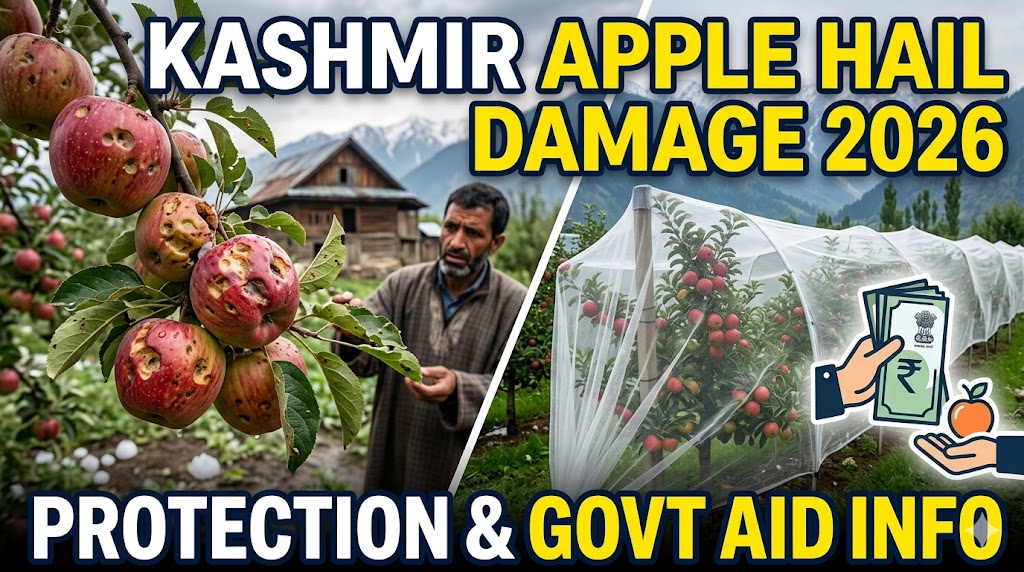
Hailstones, even relatively small ones, strike fruit and foliage with enough force to cause physical bruising, skin punctures, and scarring on apples. Even when a damaged apple survives on the tree and continues growing, the cosmetic damage — dents, scarring, discoloration — usually downgrades it from premium “A-grade” export-quality fruit to a lower grade that fetches a significantly lower price, even though the fruit itself may still be perfectly edible.
In more severe storms, the damage goes beyond cosmetic. Heavy hail can strip leaves entirely, damage young shoots and branches, and knock a significant portion of the season’s fruit straight off the tree. Beyond the immediate season’s loss, repeated severe hail damage to branches and bark also weakens the tree’s health going into subsequent years, meaning a single bad storm’s impact can echo across more than one harvest.
For a smallholder farmer whose entire annual income rides on a few kanals of orchard, a severe hailstorm hitting at the wrong moment isn’t just a bad season — it can mean a year of debt, since input costs for fertilizer, spraying, and labor have already been spent by the time hail strikes in early-to-mid summer.
Protection Methods That Actually Work
The good news is that hail damage isn’t entirely unmanageable. Several protection approaches have been tested and proven effective, though each comes with real cost and logistical tradeoffs that matter for smallholders.
Anti-hail nets. This is the most direct and effective protection method available. These are specially designed nets stretched over orchard rows on a supporting structure, physically intercepting hailstones before they reach the fruit and foliage. Where properly installed, anti-hail netting has shown to dramatically reduce crop damage even in fairly severe storms. The catch is upfront cost — netting plus the structural framework to support it represents a real capital investment that many smallholder farmers struggle to afford without financial support, which is exactly where government subsidy schemes are supposed to come in.
Orchard design and tree training. Lower-density, open-canopy training systems can sometimes reduce the surface area of exposed fruit compared to certain high-density training methods, though this is a secondary factor compared to physical netting and shouldn’t be relied on as a primary defense.
Crop insurance. Where netting isn’t financially feasible, insurance becomes the fallback protection — not against the physical damage itself, but against the financial loss it causes. This only works, however, if the insurance scheme is actually accessible, the premiums are affordable for smallholders, and — critically — claims get processed and paid out promptly enough to matter for a farmer who needs that money before the next season’s input costs come due.
Weather forecasting and early warning systems. While you can’t stop a hailstorm with a forecast, advance warning does allow farmers to take some last-minute protective measures and, more importantly, builds a foundation for region-specific hail-prediction models that could eventually help target subsidy and infrastructure support toward the most consistently vulnerable micro-zones within the apple belt.
What the 2026 Government Response Has Looked Like
This is the part where farmer frustration tends to concentrate, and it’s worth being specific rather than vague about it.
J&K’s horticulture department and the broader state administration have, over recent years, run subsidy schemes aimed at helping orchardists install anti-hail nets, typically covering a percentage of the installation cost rather than the full amount. The intent behind these schemes is sound — netting genuinely works — but the recurring complaints from farmers tend to center on a few consistent issues: the subsidy application and approval process being slow and paperwork-heavy, the subsidized amount not always keeping pace with actual rising material and installation costs, and limited awareness in some of the more remote orchard belts about how to even apply.
On the insurance side, schemes covering horticultural crops against weather damage including hail exist, but farmer experience with claim settlement speed and assessment fairness has been inconsistent across different seasons and districts. When a hailstorm hits in June, a farmer needs compensation processed well before the next year’s input costs are due — not stuck in bureaucratic delay for months.
Following damaging hailstorm events in the 2026 season, the typical government response pattern has included damage assessment surveys conducted by horticulture and revenue department officials, followed by announcements of compensation or relief packages for affected orchardists. Farmers and grower associations have continued to push for these processes to move faster and for compensation amounts to more realistically reflect the actual value of lost premium-grade fruit, rather than flat per-kanal rates that don’t account for the difference between a wiped-out high-density commercial orchard and a smaller traditional one.
What Would Actually Move the Needle
Beyond the existing subsidy and insurance framework, a few structural improvements keep coming up in conversations among growers, horticulture experts, and agricultural economists looking at Kashmir’s hail problem specifically:
Faster, fuller subsidy disbursement for anti-hail netting, treating it as essential infrastructure rather than an optional upgrade, given how directly it protects both farmer income and the broader apple economy that the region depends on.
Localized hail-risk mapping, using historical storm data to identify the specific micro-zones within the apple belt that face disproportionate hail risk year after year, allowing protection investment to be targeted where it matters most rather than spread thin and evenly.
Streamlined, faster insurance claim processing, with clear, transparent timelines so farmers can plan around when compensation will actually arrive rather than treating it as an indefinite wait.
Cooperative netting installation models, where smaller farmers in a given micro-region pool resources and government support to install shared netting infrastructure across adjoining smaller plots, since individual smallholders often can’t justify or afford the capital cost alone even with partial subsidy.
What This Means for Individual Farmers Right Now
For a Kashmiri apple grower trying to make a practical decision today rather than waiting for systemic fixes, a few things are worth acting on directly:
Apply for whatever anti-hail net subsidy is currently available through the horticulture department, even if the process feels slow — partial coverage is still meaningfully better than none, and waiting another season without applying only delays protection further.
Enroll in available crop insurance schemes covering weather damage, treating the premium cost as a genuine risk-management expense rather than an optional add-on, particularly for high-density, high-investment orchard blocks where a single bad storm represents a larger financial exposure.
Keep documented records — photos, dated notes — of orchard condition before and after any hail event, since clear documentation tends to support faster and fairer damage assessment when compensation claims are filed.
The Bigger Picture
Hailstorms aren’t going away, and given how Kashmir’s geography drives this weather pattern, no amount of policy improvement will eliminate the risk entirely. What can genuinely change is how much of that risk gets absorbed by infrastructure and insurance rather than falling entirely on an individual farmer’s shoulders in a single bad afternoon.
The 2026 season has, once again, made clear that the gap between available protection technology and what’s actually installed across Kashmir’s orchards remains wide — and closing that gap faster, through both government support and farmer-level action, is where the real difference between a manageable bad season and a devastating one will continue to be decided.
Frequently Asked Questions
Why does Kashmir get so many hailstorms during apple season?
The Valley’s geography, sitting between major mountain ranges, creates conditions for intense, localized convective storms during the pre-monsoon and early summer months, which coincides directly with the period when apple fruit is most vulnerable.
Do anti-hail nets really work?
Yes, properly installed anti-hail netting significantly reduces fruit and foliage damage compared to unprotected orchards, though the upfront installation cost remains a barrier for many smallholder farmers without subsidy support.
Is crop insurance available for hail damage to apples in Kashmir?
Yes, weather-related crop insurance schemes covering horticultural crops including apples do exist, though farmer experience with claim processing speed has varied across different seasons and districts.
What should a farmer do immediately after a hailstorm damages their orchard?
Document the damage with photos and dated notes, and promptly contact the local horticulture department to ensure the orchard is included in damage assessment surveys for potential compensation.