Banana farming can be profitable in India because the crop has steady year-round demand and supports many processing uses (chips, puree, export grade bunches). But the difference between a good harvest and a disappointing one usually comes from four practical areas:planting material quality, soil and drainage readiness, balanced irrigation + nutrient program, and early disease/pest prevention.
This guide is designed to help you build a banana farm as a system. You will get a clear workflow for orchard setup, yield planning, disease diagnosis (what to look for and what to do first), and modern techniques like tissue-culture planting and drip fertigation.
Quick Banana Farming Facts (use this before you start)
| Topic | What you must plan |
|---|---|
| Planting material | Virus-free, disease-free suckers/corms or tissue-culture plants |
| Soil & drainage | Avoid waterlogging; ensure good root zone aeration |
| Irrigation | Maintain consistent moisture; prevent drought stress & rot risk |
| Nutrition | Balanced NPK + micronutrients; follow stage-wise dosing |
| Disease control | Scout early; manage Panama wilt, Sigatoka, viruses, weevil damage |
| Modern techniques | Tissue culture, drip fertigation, mulching, sanitation, IPM |
1) Climate and soil requirements for banana farming
Climate: temperature and rainfall stability
Banana prefers warm, humid climates. Growth slows in cold weather and becomes unstable if temperatures drop too far.
Consistent moisture is important, especially during early establishment and during bunch development.
Soil: loam with good structure and drainage
Banana roots require oxygen. Heavy waterlogging soils reduce oxygen in the root zone and increase disease risk.
Ideally, your soil should be fertile, well-drained, and rich in organic matter.
Soil pH guidance
Many banana farms perform well when soil pH is in a workable range for nutrient availability.
The best approach is to do a soil test and correct major limitations before planting.
2) Popular banana varieties in India (and how to pick the right one)
Variety choice should match your market and management style. Some varieties are preferred for fresh bunch sales, while others are favored for processing (chips/pulp) or export grade.
Also, your variety choice should consider disease pressure in your area—some farmers prefer planting systems that reduce disease risk (for example, tissue-culture based establishment).
- Grand Naine / Cavendish types: often preferred for export and quality bunches.
- Robusta / plantain-type: often used for processing and robust production under suitable conditions.
- Local cultivars: may suit specific markets but always confirm disease tolerance in your field history.
3) Planting material: the biggest lever for healthy yield
Many banana disease problems start from infected planting material.
If your farm has previously suffered from viral diseases, Panama wilt, or heavy weevil attacks, use stricter planting material selection.
Option A: traditional sucker planting
- Choose suckers from healthy mother plants.
- Avoid planting suckers from fields with known disease outbreaks.
- Plant quickly and keep establishment moisture consistent.
Option B: tissue culture plants
Tissue culture plants can give more uniform establishment and help reduce early disease risk when sourced from trusted labs.
Farmers often use tissue-culture plants for orchards aiming for consistent bunch production.
4) Land preparation and pit/row planning
Land preparation determines root development and early vigor.
Before planting, remove weeds, loosen the soil, and plan drainage.
- Deep ploughing/soil loosening to improve aeration.
- Incorporate well-rotted organic matter to improve soil structure.
- Make furrows or drainage channels in low spots.
- Plan row direction for uniform sunlight and worker access.
5) Spacing and planting density for yield optimization
Spacing controls plant competition for nutrients and water. Too dense means reduced airflow and higher disease risk; too wide reduces potential yield per area.
Choose spacing based on variety vigor, soil fertility, and drainage capacity.
| Orchard approach | Common spacing concept | Why it affects yield |
|---|---|---|
| Standard production | Moderate density | Balanced competition, easier management |
| Quality/consistent bunch focus | Density adjusted to soil fertility | Improves nutrient distribution and reduces disease hotspots |
| Disease-prone fields | Avoid over-crowding | Airflow reduces spread of foliar diseases |
6) Irrigation management (stage-wise) — avoid common mistakes
Banana needs water, but waterlogging is equally harmful. Good irrigation manages both drought stress and excess moisture.
Drip irrigation is often adopted because it improves water use efficiency and reduces wetting of leaf areas.
Stage-wise irrigation plan (practical approach)
| Growth stage | Irrigation goal | Scout checklist |
|---|---|---|
| Establishment | Consistent moisture for root establishment | Leaf color + new sucker growth; check for water stagnation |
| Vegetative growth | Stable moisture; avoid drought stress | Check leaf turgidity; look for stress patches in rows |
| Bunch development | Steady water for fruit filling | Bunch size + uniformity; avoid excess waterlogging |
| Harvest window | Avoid sudden water extremes | Reduce risk of rot around bunch bases |
7) Nutrient management: what to feed and when
Banana nutrition requires balanced NPK and micronutrients. Overuse of nitrogen can increase lush growth but may worsen disease susceptibility.
A practical method is to combine organic matter + stage-wise dosing guided by soil/leaf observations.
Fertilizer program framework (simple)
- Basal/early: organic matter + phosphorus support roots
- Vegetative: nitrogen support leaf growth; potassium supports robustness
- Bunching/fruit filling: increase potassium support for fruit quality and bunch development
- Micronutrients: correct based on symptoms and testing (zinc, iron, boron where relevant)
8) Major banana diseases and pests (diagnosis-first approach)
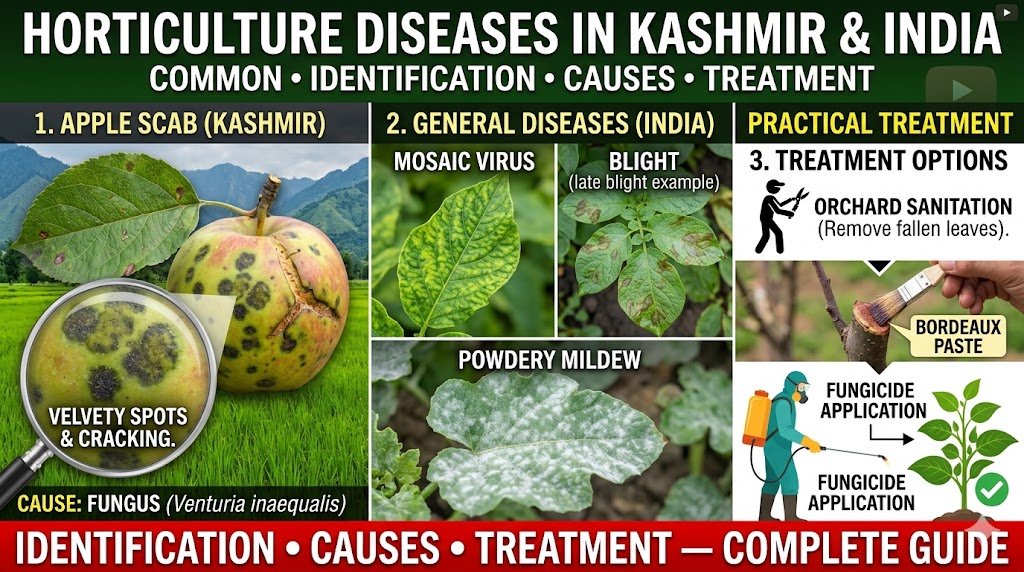
8.1 Panama wilt (Fusarium oxysporum) — what to notice early
Panama wilt is one of the most serious banana diseases. Early symptoms often appear as leaf yellowing and progressive wilting.
When a plant shows strong symptoms, roots may already be heavily damaged.
First actions: remove heavily affected plants, prevent spread through sanitation, and avoid using infected suckers.
8.2 Sigatoka leaf spot — why it spreads
Sigatoka-type leaf spot diseases reduce photosynthesis and cause yield loss.
Wet, humid weather combined with dense canopy increases spread.
First actions: improve airflow by sucker management, keep irrigation controlled, and start preventive protection before heavy humid periods.
8.3 Viral diseases (symptoms overview)
Viral diseases in banana often spread through insect vectors and infected planting material.
Once infected, plants cannot be “cured” easily; management focuses on prevention.
- Watch: stunting, distorted leaves, abnormal bunch development
- Act: remove infected plants and control vector insects
- Prevention: use disease-free planting material
8.4 Rhizome weevil — damage pattern and quick response
Rhizome weevil damage can weaken plants and create entry points for secondary problems.
Infestations often start in patches—so early scouting is critical.
First actions: remove infested plants early, use monitoring traps, and keep orchard sanitation strict.
9) Modern banana techniques that improve yield and reduce losses
9.1 Tissue culture planting (where suitable)
Tissue culture plants help uniform establishment and can reduce early disease risk if sourcing is trusted.
Many farmers adopt tissue culture for new orchards to start “clean.”
9.2 Drip irrigation with fertigation
Drip irrigation helps control moisture precisely and reduces wet leaf conditions.
Fertigation improves nutrient efficiency when done correctly.
9.3 Mulching for moisture stability
Mulching reduces evaporation, stabilizes soil temperature, and helps suppress weeds.
In disease-prone orchards, mulch also helps reduce soil splash to leaves.
9.4 IPM (Integrated Pest Management) routine
- Scout weekly and record issues by row/patch
- Use traps and preventive measures before outbreaks
- Use targeted interventions instead of repeated random spraying
- Keep sanitation strict: remove infected plant parts and control weeds
10) Harvesting and post-harvest: protect shelf life and buyer value
- Harvest bunches at the right maturity stage for your market (fresh/local/export).
- Handle carefully during cutting and transport to prevent bruising.
- Sort by quality and pack uniformly for better buyer acceptance.
- Use ripening methods (where required) to standardize fruit readiness.
11) Profit planning for banana growers (practical method)
Instead of copying profit numbers, estimate your banana profitability based on:
orchard age, expected bunch count, market price range, and loss percentage from disease and grading.
| Profit component | How to fill for your farm |
|---|---|
| Expected yield | Estimate bunches per plant and plants per acre by spacing |
| Price | Use your past 3–5 season average mandi/market rate or export quote range |
| Losses | Disease + rejected fruit/quality reduction due to bruising or leaf spot |
| Costs | Saplings/planting + fertilizer + plant protection + labor + irrigation + packing |
12) FAQ (banana)
Q1: What is the typical banana crop cycle?
A: Banana plants complete a production cycle roughly over a year with suckers replacing plants, but actual timing depends on variety, climate, and management.
Q2: Which is more important: irrigation or fertilizer?
A: Both matter, but irrigation and drainage stability come first because nutrient uptake fails in waterlogged or drought-stressed root zones.
Q3: How do I reduce disease losses in banana?
A: Use healthy planting material, maintain sanitation, scout weekly, manage drainage and canopy density, and start disease prevention during high-risk weather windows.
Conclusion
Banana farming succeeds when you treat the orchard as a controlled system: clean planting material, drainage-safe soil, precise irrigation/nutrition, and early disease prevention.
Use this guide as your season routine, and your banana plantation becomes predictable—strong yields with fewer preventable losses.