Kashmir grows some of the finest apples in the world. The combination of altitude, cool summers, cold winters with adequate chilling hours, and well-drained loamy soils in districts like Anantnag, Shopian, Pulwama, and Sopore creates conditions that simply cannot be replicated in most other parts of India.
But not all apple varieties perform equally well across Kashmir’s different microclimates, and not all varieties command the same price in the market. Choosing the wrong variety for your location, soil type, or target market can mean years of work with mediocre returns. Choosing the right one — with the right rootstock and the right management — can transform an orchard’s profitability.
This guide is based on my experience in Anantnag district and conversations with growers across the valley. It covers the main varieties grown in Kashmir, their characteristics, market performance, and who should consider growing them.
Understanding Kashmir’s apple growing zones
Before discussing varieties, it helps to understand that Kashmir is not a single apple-growing environment. Different altitudes and aspects create meaningfully different conditions:
The lower valleys — roughly 1,500 to 1,800 metres — have warmer summers and may not provide sufficient chilling for some varieties. They suit earlier-ripening varieties and are generally where the bulk of commercial Red Delicious is grown.
The mid-altitude zones — 1,800 to 2,200 metres — provide the classic Kashmir apple-growing conditions with adequate chilling, cool summer nights, and good sun exposure. Most high-value varieties perform well here.
The higher zones above 2,200 metres have longer, colder winters and shorter growing seasons. Only early-to-mid ripening varieties are suitable. These zones often produce exceptionally flavoured fruit due to the high temperature differential between day and night.
Red Delicious
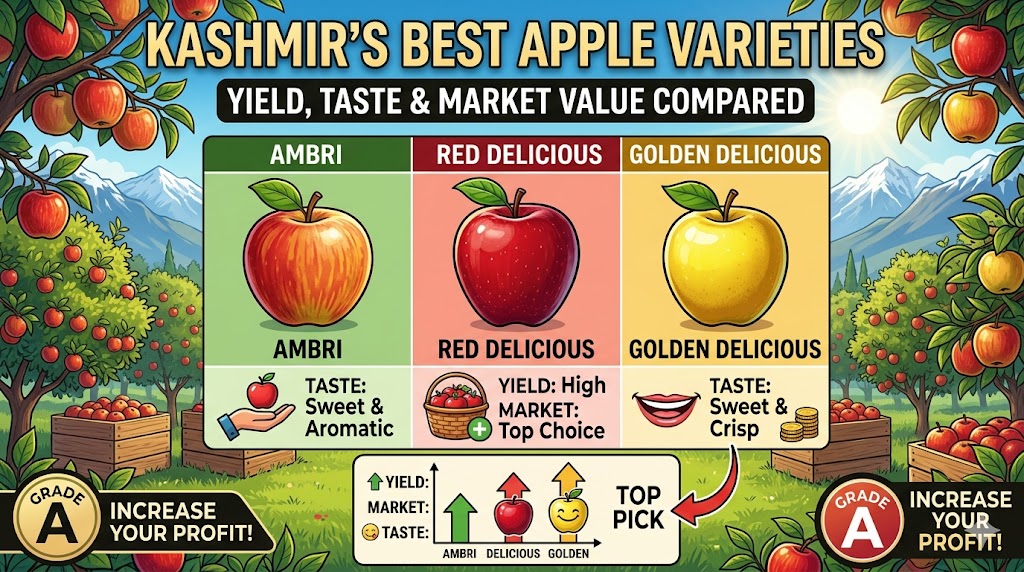
Red Delicious is the most widely planted apple variety in Kashmir and the one most associated with the valley’s apple identity. Its distinctive deep red colour, elongated shape, and firm texture made it the dominant commercial variety for decades.
Ripening: mid-September to early October in most of the valley Yield: 15–20 tonnes per acre in mature orchards Market: strong domestic demand; recognised brand in Indian retail markets Shelf life: good — holds well in cold storage for 3–4 months
The challenge with Red Delicious today is market saturation. It remains the most commonly traded variety in mandis, which keeps prices relatively low for average-grade fruit. To get premium prices with Red Delicious, growers need to focus on premium grading (75 mm+), good colour development through reflective mulches, and direct supply to retail buyers rather than commission markets.
Spur-type Red Delicious strains — which produce more fruit per tree and require less pruning — have increasingly replaced standard Red Delicious in newer plantations.
Golden Delicious
Golden Delicious is the second most important commercial variety in Kashmir. It has a distinctive golden-yellow skin, a sweeter and more aromatic flavour than Red Delicious, and particularly good performance in the mid-altitude zones of Anantnag and Shopian.
Ripening: late September to mid-October Yield: 12–18 tonnes per acre Market: strong demand from premium retailers; higher per-kg realisation than Red Delicious in most markets Shelf life: excellent in cold storage — up to 5 months
Golden Delicious is more sensitive to russeting (a rough, brownish skin condition caused by humidity, frost, or certain sprays) than Red Delicious. Managing this through proper canopy management and avoiding copper sprays close to fruit set is important for maintaining the clean golden skin that commands premium prices.
Golden Delicious is also an important pollinator for many other varieties, so its presence in mixed orchards serves a dual purpose.
Ambri (Kashmiri Ambri)
Ambri is the indigenous apple of Kashmir — a variety that has been grown in the valley for centuries and is considered by many Kashmiri growers to be the finest-tasting apple produced here. It is small to medium in size with a distinctive striped red-green skin and a flavour that is noticeably more complex than most commercial varieties.
Ripening: early to mid-October Yield: lower than commercial varieties — typically 8–12 tonnes per acre Market: niche premium market; significant price premium over Red Delicious when properly branded Shelf life: moderate — best consumed or marketed within 6–8 weeks of harvest
Ambri has suffered in recent decades from competition with high-yielding commercial varieties, but there is a growing market — particularly in urban India and among the Kashmiri diaspora — for authentic heritage varieties. Growers who position Ambri correctly, with branding that tells its story, can achieve very high per-kg prices.
The main limitation of Ambri is its irregular bearing — it tends to produce heavily in alternate years — and its relatively small fruit size, which reduces the number of premium-grade pieces per tree. Thinning and nutrition management can partially address both issues.
Maharaji
Maharaji is a medium-to-large apple with attractive red striping and a good balance of sweet and tart. It ripens relatively early compared to most Kashmiri varieties, which gives it a market window before the main season supply peak.
Ripening: mid-August to early September Yield: 15–20 tonnes per acre Market: good demand, especially early in the season when competition is lower Shelf life: moderate — best dispatched promptly after harvest
The early ripening of Maharaji is both its biggest advantage and its main risk. It reaches the market before the main Kashmiri apple season, which means less competition and often better prices. However, it is also more exposed to late monsoon conditions, and wet weather at harvest time significantly increases the risk of fungal diseases and post-harvest rot.
Tydeman’s Early Worcester
This early-season variety ripens in late July to early August in most Kashmiri growing zones — well ahead of the main season. It produces attractive bright red fruit with good flavour. Like Maharaji, its value is largely in its timing rather than absolute yield.
Ripening: late July to early August Yield: 10–14 tonnes per acre Market: limited supply in early season gives good price premiums
Tydeman’s is best suited to growers who can dispatch quickly and have relationships with buyers who value early-season Kashmiri apples. It is not well suited to cold storage.
Newer varieties gaining ground in Kashmir
In recent years, several varieties introduced through the J&K Horticulture Department and SKUAST-K have begun to gain traction in the valley. These include:
Gala (Royal Gala and Crimson Gala): A medium-sized, sweet, yellow-red apple with excellent consumer popularity internationally. It is a biennial bearer but produces well in good seasons and has strong export demand. HPMC has been actively promoting Gala cultivation in the valley.
Fuji: A large, sweet, late-season apple with exceptional shelf life. Fuji stores well in controlled atmosphere for up to eight months, which gives growers significant flexibility in marketing. It has strong demand in metro cities and from export channels.
Jonagold: A large apple with attractive red-yellow colouring and excellent flavour. It is a triploid variety and requires two pollinators. Jonagold performs best in mid-to-high altitude zones and produces very large fruit suitable for premium retail.
These newer varieties typically command higher prices than Red Delicious but require more careful management, better training systems, and access to cold storage to realise their full value.
High-density planting and rootstock selection
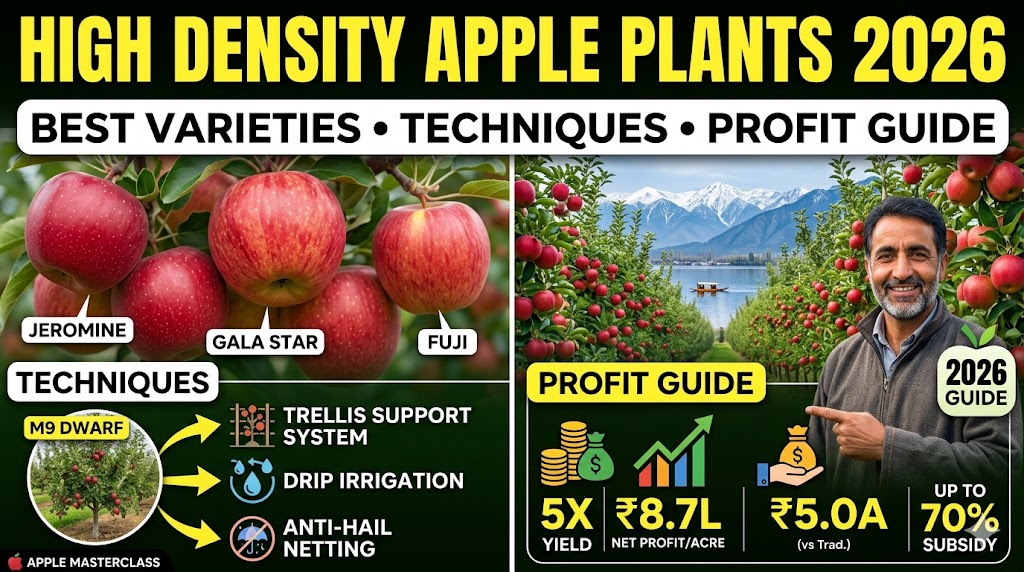
The shift toward high-density apple planting — using dwarfing rootstocks like M9 and M26 to plant 500 to 1,500 trees per acre instead of the traditional 100 to 200 — is one of the most significant changes in Kashmiri apple horticulture in the past decade.
High-density systems come into production much earlier (year 2–3 instead of year 6–7), produce higher yields per acre, and allow better fruit colour and uniformity through improved light penetration. However, they require more capital investment upfront, demand precise drip irrigation and fertigation, and are more sensitive to waterlogging and root rot.
For growers considering a new plantation, matching variety to rootstock to site conditions is critical. Golden Delicious and Fuji on M9 in a well-drained site with drip irrigation is a combination that consistently produces premium fruit. Red Delicious on MM106 rootstock suits sites where M9 is too sensitive to waterlogging.
Which variety should you plant?
For a grower establishing a new orchard in Anantnag or the broader South Kashmir region, my recommendation based on current market conditions would be:
If your site is well-drained and you can invest in drip irrigation and cold storage access: consider Golden Delicious or Fuji on M9 rootstock in a high-density system. The upfront investment is higher but the returns per acre are significantly better.
If you want lower investment and reliable performance: Red Delicious on MM106 in a standard or semi-high-density system remains a sensible choice, especially if you have established buyer relationships.
If you want to differentiate and build a premium brand: Ambri is worth including in your orchard even if yields are lower. The per-kg price for well-presented, properly branded Ambri has been rising steadily and the variety has a unique identity story that no commercial variety can match.
Summary
Kashmir’s apple industry is evolving. The varieties that dominated for decades are being joined by newer introductions with better market appeal, and planting systems are becoming more intensive and productive. Making the right variety choice for your specific site, resources, and market access is one of the highest-value decisions an apple grower in Kashmir can make.
FAQ
Q: Which apple variety is most profitable in Kashmir right now? Golden Delicious and Fuji currently command the strongest premium prices among buyers in metro cities and for export. Red Delicious has higher overall volume but lower per-kg prices.
Q: Can I grow Fuji apples in Anantnag? Yes. Anantnag’s mid-altitude zones are well-suited to Fuji, which ripens in October–November and benefits from the region’s chilling hours and cool nights.
Q: What is the best rootstock for Kashmir apple orchards? M9 is best for well-drained, irrigated high-density orchards. MM106 suits heavier soils and sites with some waterlogging risk. Seedling rootstocks suit traditional, lower-density systems.
Q: Is Ambri apple cultivation worth it commercially? Yes, if you can brand and market it directly. Ambri’s unique identity commands premium prices in niche markets. It is not suited to commodity trading through commission agents.