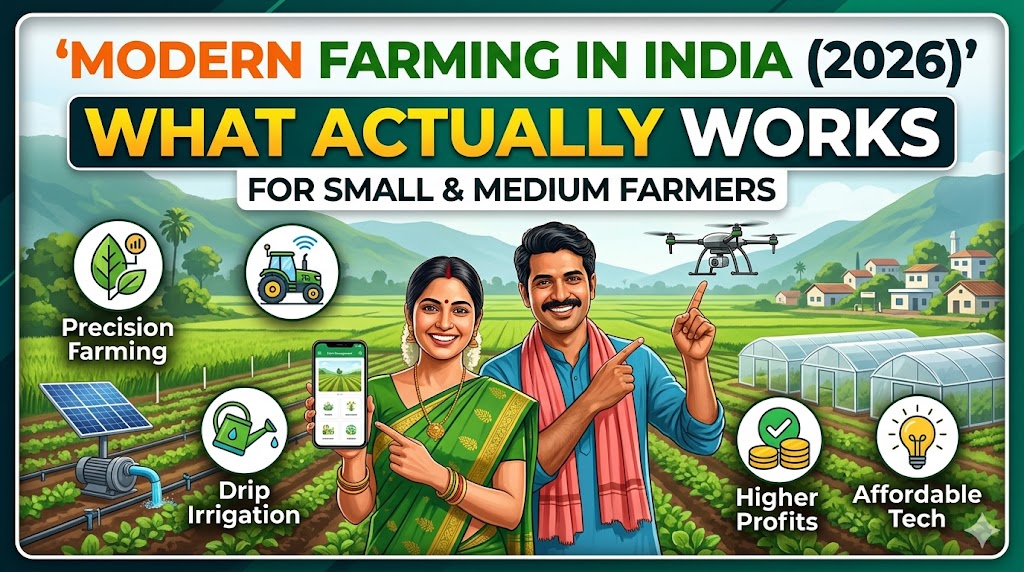
Modern farming” is a broad phrase. For small and medium farmers, modern farming should mean something practical: technologies that increase income, reduce risk, and are realistic to manage. Many farmers lose money when they adopt expensive tools without market planning or without solving their biggest farm problem (usually water, soil nutrition, or disease prevention).
This guide focuses on techniques that are commonly adopted in India with measurable benefits—and explains how to choose, implement, and maintain them. You will also learn where these techniques fail, so you can avoid the same mistakes.
Start with the right order: Water → Nutrition → Protection → Marketing
Most Indian farms have the same bottlenecks:
- Irrigation inefficiency (overwatering or drought stress)
- Fertilizer waste (wrong doses, wrong timing)
- Disease losses (late detection, preventive timing missing)
- Weak sale channels (poor price realization)
Modern techniques work best when you solve these bottlenecks in a practical sequence.
1) Drip irrigation: the highest-impact adoption for many farms
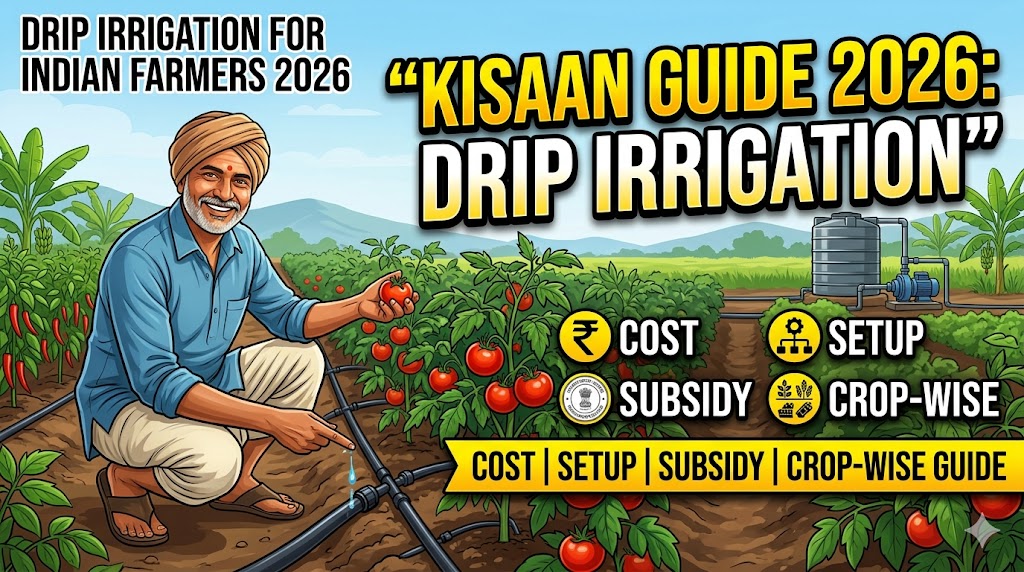
Drip irrigation delivers water directly near roots with better control than flood or furrow irrigation.
This improves plant growth and reduces water waste.
Why drip works
- Improves water use efficiency
- Reduces water stress and waterlogging problems
- Supports fertigation systems for better nutrient delivery
- Often reduces foliar disease risk (less leaf wetness)
How to implement drip successfully
- Plan water source capacity and filtration quality
- Install correct spacing and emitter flow rate
- Use mulching to stabilize moisture
- Adjust irrigation based on soil response, not only calendar days
2) Fertigation: improve fertilizer efficiency instead of increasing cost
Fertigation means applying soluble fertilizers through irrigation.
It can improve fertilizer efficiency by delivering nutrients at the right time and root zone.
However, fertigation must be planned—wrong mixing can clog lines or burn plants.
Fertigation safety checklist
- Use proper filters and clean tanks
- Do test dosing first (small area)
- Maintain pH and mixing compatibility of fertilizers
- Split doses instead of heavy single applications
3) Polyhouse and greenhouse farming: when protected cultivation makes sense
Protected cultivation reduces weather risk and helps maintain consistent growing conditions.
But it requires careful management of ventilation, pests, and energy costs.
Where polyhouse works best
- Areas with heavy rain/hail risk
- High-value crops with stable market demand
- Regions where outdoor season is too short for multiple cycles
Key operational points
- Ventilation control (fans/vents/shading nets)
- Drip and fertigation accuracy
- Daily scouting for early pest/disease symptoms
- Sanitation practices to prevent entry of pests
4) Soil testing and tissue/leaf diagnosis: fix nutrition using evidence
Soil test is one of the most affordable modern tools.
It reduces fertilizer waste and prevents nutrient imbalance.
Many farmers apply fertilizers repeatedly without knowing whether the deficiency exists or whether pH is blocking nutrients.
How to use soil test results
- Collect samples using a proper pattern (don’t take random single points)
- Test pH, organic matter, and major nutrients
- Correct pH first (lime or acidifying actions if needed)
- Then apply nutrients stage-wise based on crop needs
- Keep records and retest when required
5) Simple sensors for small farmers (practical precision)
Many expensive “smart farming” tools are not necessary.
Practical precision can be achieved with simple sensors and basic tools:
- Soil moisture sensors to avoid overwatering and drought stress
- Weather data to time disease prevention sprays
- Leaf color charts to guide nitrogen management visually
Sensors are most useful when you already have drip irrigation and a routine of scouting.
6) Organic inputs and bio-controls (modern approach to soil health)
Organic management is a modern technique when it improves soil biology.
Compost, vermicompost, and cover crops can stabilize yield and reduce pest/disease stress over time.
- Use compost regularly rather than only at the beginning
- Use cover crops to build organic matter
- Use biological pest control strategies in combination with monitoring
7) Adoption failures: why some modern techniques do not work
- Buying expensive equipment without market access
- Not training workers to maintain systems
- Ignoring sanitation and scouting routine
- Overestimating yield and underestimating operating costs
- Using wrong fertilizer mixing or irrigation timing
8) Beginner implementation plan (first 90 days)
- Do soil test and plan nutrition corrections
- Start drip where possible or improve irrigation scheduling
- Set weekly scouting routine for pests/diseases
- Use mulching to stabilize moisture
- Plan a crop protection calendar based on local weather history
- Review results after 4–6 weeks and adjust irrigation/nutrition
FAQ (modern farming techniques)
Q1: What is the simplest modern technique for small farmers?
A: Soil testing + drip irrigation scheduling (and mulching) is one of the most practical starting points.
Q2: Is precision farming only for big farms?
A: No. Many small farms can use simple sensors and weather-based disease timing to gain precision without huge investment.
Q3: Are polyhouses profitable?
A: Yes when crops are selected correctly and buyers are secured in advance. Poor crop choice or weak marketing can reduce profit.
Conclusion
Modern farming in India is about using technology in the right order: improve water control, optimize nutrition with tests, prevent diseases early, and sell through reliable channels. Adopt techniques that you can manage consistently, and your farm income becomes more stable and predictable.