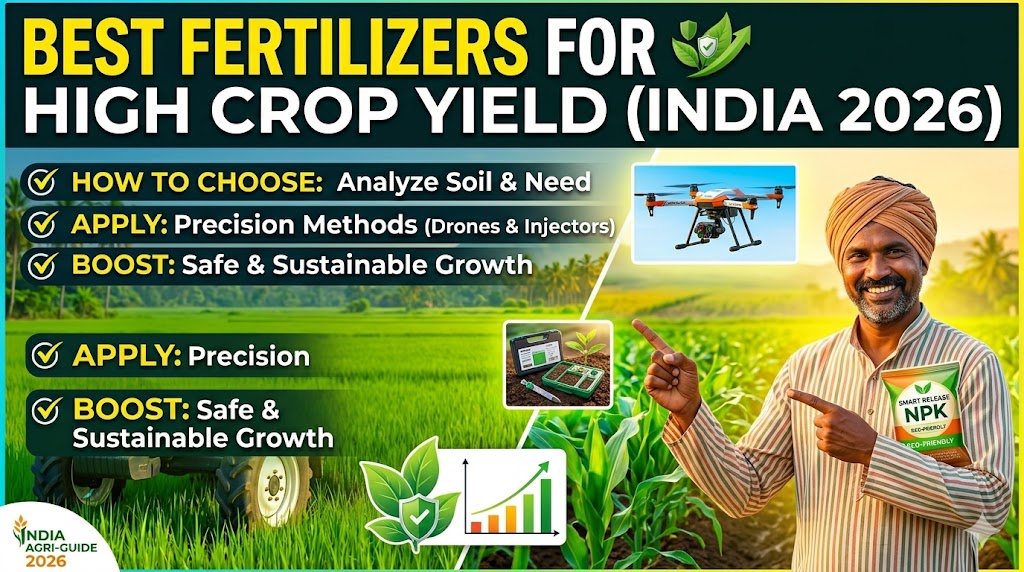
High crop yield is not achieved by buying one “best fertilizer” and applying it blindly. Your yield depends on choosing the right nutrient balance, the right fertilizer type, and applying it at the right stage based on your crop and soil conditions.
This guide helps you understand fertilizers in a practical way: how nutrients affect plant growth, how to choose between organic, chemical, and biofertilizers, and how to apply fertilizers so you increase production while protecting soil health.
1) Why fertilizers matter for yield
Crops require nutrients for leaf growth, root development, flowering/fruiting, and final harvest quality. When nutrients are missing or imbalanced, plants respond with reduced growth and lower yield.
Primary nutrients (N, P, K) — simple explanation
- Nitrogen (N): supports leaf/stem growth and overall vigor.
- Phosphorus (P): supports roots and improves flowering/fruit set.
- Potassium (K): improves fruit/grain quality and helps crops handle stress and pests.
Secondary & micronutrients
- Secondary nutrients: calcium, magnesium, sulfur.
- Micronutrients: zinc, iron, boron, manganese, copper.
2) Organic vs chemical vs biofertilizers (when each one works)
Organic fertilizers
- Improve soil structure and microbial activity.
- Support long-term soil fertility.
- Best used as base nutrition plus soil improvement.
Chemical/inorganic fertilizers
- Provide nutrients quickly and are easier to dose precisely.
- Useful for stage-wise nutrient management.
- Risk if overused: nutrient loss, soil imbalance, and reduced soil health over time.
Biofertilizers
- Work through beneficial microorganisms.
- Help nutrient availability and support sustainable yield.
- Work best when soil conditions and moisture are suitable.
3) How to choose fertilizers for high yield (step-by-step)
- Start with soil testing: pH, organic matter, and nutrient status guide your fertilizer plan.
- Match fertilizer to crop demand: leafy crops need different nutrient balance than fruit crops.
- Plan stage-wise application: apply nitrogen during vegetative stages and adjust based on crop needs.
- Use correct dosing and avoid overapplication: excess fertilizer often reduces efficiency.
- Maintain moisture: fertilizer uptake depends on root moisture conditions.
- Keep records: note what you applied and how yield performed.
4) Application strategy that increases yield without waste
A yield increase strategy usually includes: (1) basal nutrition, (2) stage-wise feeding, and (3) targeted correction of deficiencies.
Here is a practical approach:
Base phase (before active growth)
- Use organic matter + phosphorus support for root establishment.
- Ensure soil is prepared for good root contact and airflow.
Vegetative phase (leaf/stem growth)
- Provide nitrogen in split doses to support steady growth.
- Avoid too much nitrogen that can increase disease susceptibility.
Flowering/fruiting phase (yield formation)
- Shift to balanced nutrition with stronger potassium and phosphorus support.
- Correct deficiencies based on symptoms and tests.
Post-harvest phase (soil rebuilding)
- Use organic inputs and soil amendments to improve next-season performance.
5) Common mistakes that reduce fertilizer efficiency
- Applying fertilizer without soil test: leads to wrong nutrient balance.
- Applying during dry conditions: reduces uptake.
- Overusing nitrogen: causes excess vegetative growth and may reduce fruit/grain quality.
- Ignoring micronutrients: plants may show deficiency symptoms even when NPK is applied.
- Not maintaining uniform distribution: creates patchy growth and uneven yield.
6) Fertilizer planning checklist (use this every season)
- Soil test done? (pH + nutrients)
- Crop stage plan made? (basal + vegetative + flowering/fruiting)
- Fertilizer amounts confirmed by lab/recommendation?
- Irrigation schedule aligned with application?
- Any deficiency symptoms observed previously?
- Record keeping updated for next season decisions?
FAQ
Q1: What is the best fertilizer for high yield in wheat?
A: Typically urea and DAP/appropriate P sources are used, but the best choice depends on your soil test and local recommendations.
Q2: Should I use organic fertilizers or chemical fertilizers?
A: Many high-yield farms use a mix: organic inputs for soil health + chemical fertilizers for stage-wise nutrient precision.
Q3: How can I prevent fertilizer waste?
A: Follow soil-test-guided dosing, apply at correct growth stages, ensure proper distribution, and irrigate appropriately after application.
Conclusion
The “best fertilizer” is the one that matches your crop and soil and is applied at the right stage.
When you use soil testing, stage-wise feeding, balanced NPK, and targeted micronutrient correction, you get higher yields with better soil health and safer long-term farming.