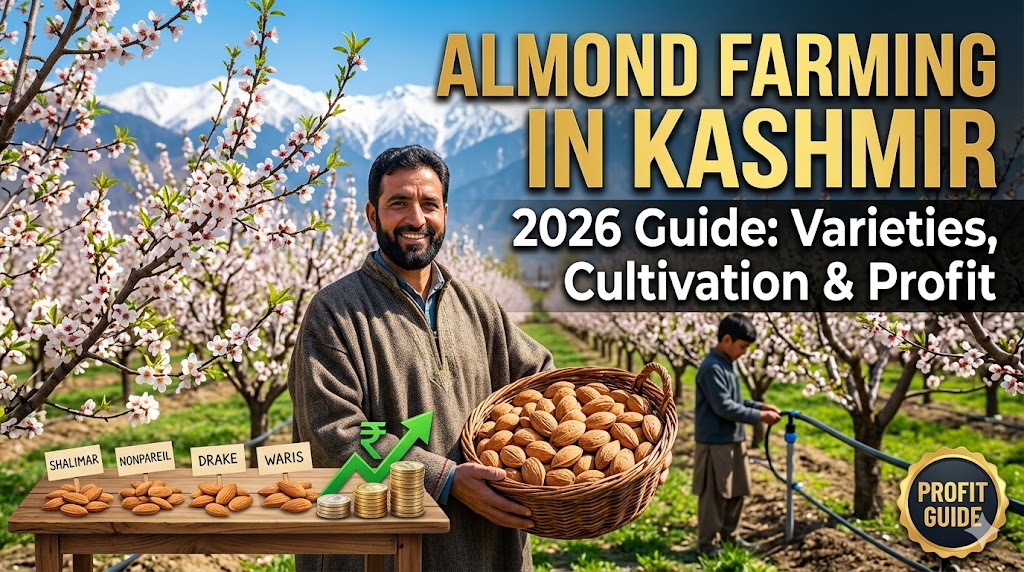
Almonds have long been a part of Kashmir’s traditional orchard culture, but in 2026, this dry fruit crop is gaining fresh attention as farmers look beyond apples for diversification. With rising market demand, relatively lower water requirements compared to apple, and strong returns per kanal, almond farming in Kashmir is emerging as a smart choice for both new and experienced growers. This guide covers everything from climate suitability to varieties, planting techniques, disease management, harvesting, and government schemes supporting almond cultivation.
Why Almond Farming Suits Kashmir’s Climate
Kashmir’s temperate climate, with cold winters providing the necessary chilling hours and warm, dry summers for nut maturation, makes it naturally suited for almond cultivation. Almonds require around 200-500 chilling hours below 7°C during dormancy, which most mid-altitude areas of the valley easily provide. Districts like Kupwara, Baramulla, Anantnag, Budgam, and parts of Pulwama have shown promising results with almond orchards, especially on hill slopes and karewa (loess) soil formations where drainage is excellent.
Unlike apple, which demands intensive irrigation, pesticide schedules, and storage infrastructure, almonds are comparatively low-maintenance once established. This makes them attractive for farmers with limited land near water sources, or those wanting to utilize marginal hill land that isn’t ideal for other fruit crops.
Best Almond Varieties for Kashmir
Choosing the right variety is the foundation of a successful almond orchard. The following varieties have performed well in Kashmir’s agro-climatic zones:
1. Waris (Local Kashmiri Variety)
A traditional soft-shell variety known for its excellent kernel quality and sweet taste. Waris almonds are highly preferred in local markets and command premium prices, though yields are moderate compared to improved varieties.
2. Pranyaj
Developed for higher productivity, Pranyaj is a self-pollinating variety that reduces dependency on pollinator trees, making it suitable for smaller orchards where space is limited.
3. Makhdoom
Known for its early bearing capacity and good kernel filling, Makhdoom is increasingly recommended by horticulture extension officers for new plantations due to its disease tolerance.
4. Non-Pareil (Introduced Variety)
Widely grown internationally, this variety has been trialed in parts of Kashmir with encouraging results, particularly for its thin shell and high kernel-to-shell ratio, which is attractive for processing units.
5. IXL and Merced
These varieties are often planted alongside Non-Pareil as pollinizers since almonds generally require cross-pollination between compatible varieties flowering at the same time.
For best results, orchardists are advised to plant at least two compatible varieties together in a ratio that ensures adequate pollination, typically one pollinizer row for every 3-4 rows of the main variety.
Site Selection and Soil Preparation
Almond trees prefer well-drained, sandy loam to loamy soil with a pH range of 6.0 to 7.5. Waterlogged conditions are particularly harmful, as almond roots are highly sensitive to root asphyxiation and root rot. South-facing slopes are often preferred in Kashmir because they receive more sunlight and warm up faster in spring, reducing frost damage risk to early blossoms.
Before planting, soil testing is highly recommended to understand nutrient status and pH levels. Pits of approximately 1m x 1m x 1m should be dug at least a month before planting, filled with a mixture of topsoil, well-rotted farmyard manure (15-20 kg per pit), and a small quantity of single super phosphate to encourage root establishment.
Planting Time and Spacing
The ideal planting window in Kashmir is during late autumn (October-November) or early spring (February-March), before bud break. Autumn planting often gives roots time to establish before the growing season begins.
Recommended spacing depends on the rootstock and variety vigor:
- Standard spacing: 6m x 6m (approximately 110 plants per hectare)
- High-density planting (with dwarfing rootstocks): 4m x 5m (around 500 plants per hectare)
High-density systems are gaining popularity as they allow earlier returns and better land utilization, similar to trends seen in modern apple orcharding across the valley.
Irrigation Requirements
While almonds are more drought-tolerant than apples, young trees need regular watering during the first two to three years for establishment. Drip irrigation is highly recommended, not only for water efficiency but also for delivering fertigation directly to the root zone. Mature trees typically need irrigation during critical stages: flowering, fruit set, kernel development, and pre-harvest, with reduced watering during winter dormancy.
Fertilizer and Nutrient Management
A balanced nutrition program is essential for healthy growth and consistent yields. General recommendations include:
- Young trees (1-3 years): 50-100g Nitrogen, 25-50g Phosphorus, 25-50g Potassium per tree annually, split into two doses
- Bearing trees (4+ years): 400-600g Nitrogen, 200-300g Phosphorus, 200-300g Potassium per tree, applied in split doses before flowering and after harvest
Farmyard manure application of 20-25 kg per tree annually helps maintain soil organic matter and improves moisture retention, particularly important in Kashmir’s slope-based orchards where erosion can deplete topsoil nutrients over time.
Pollination Management
Almond trees are largely self-incompatible, meaning they require cross-pollination from a different compatible variety to set fruit. Bee activity is crucial during the bloom period, which typically occurs in March in Kashmir, often overlapping with unpredictable late frosts. Farmers are encouraged to:
- Place beehives in the orchard during flowering (2-4 hives per hectare)
- Avoid pesticide spraying during bloom to protect pollinators
- Plant pollinizer rows strategically for maximum cross-pollination coverage
Common Diseases and Pest Management
Almond orchards in Kashmir face several disease and pest challenges that require proactive management:
Shot Hole Disease
Caused by a fungal pathogen, this disease creates small holes in leaves and can affect twigs and fruit. Management includes timely fungicidal sprays during dormancy and after leaf fall.
Brown Rot (Blossom Blight)
This affects flowers and young fruit, particularly during wet spring conditions. Pre-bloom and bloom-period fungicide applications help control its spread.
Aphids and Scale Insects
These pests affect new growth and can weaken trees over time. Dormant oil sprays during late winter help reduce overwintering pest populations before bud break.
Root Rot
Similar to issues seen in apple orchards, poor drainage can lead to root rot in almond trees. Ensuring proper site selection and avoiding overwatering are the primary preventive measures.
Regular orchard sanitation, including removal of fallen leaves and pruned material, significantly reduces disease carryover between seasons.
Pruning and Training
Young almond trees are typically trained to an open-center or modified central leader system, allowing good light penetration, which is essential for nut development and reducing disease pressure in the canopy. Annual pruning after harvest helps:
- Remove dead or diseased wood
- Maintain tree shape and manageable height
- Encourage new fruiting wood for the following season
Harvesting and Post-Harvest Handling
Almonds in Kashmir typically reach harvest maturity in late August to September, depending on variety and altitude. Harvesting is done once the hull splits open, revealing the shell inside. Traditional methods involve manual shaking of branches with poles, though mechanical shakers are increasingly used in larger commercial orchards elsewhere in India.
After harvest, almonds need to be:
- Hulled (removing the outer fleshy covering)
- Dried in the sun for several days to reduce moisture content to safe storage levels
- Sorted by size and quality
- Stored in cool, dry conditions to prevent mold development
Proper drying is critical, as improperly dried almonds are prone to aflatoxin contamination, which can render them unsellable in quality-conscious markets.
Market Potential and Profitability
Kashmiri almonds, particularly the Waris variety, enjoy strong demand in local and national markets due to their distinct taste and quality reputation. Dry fruit traders in Srinagar’s wholesale markets often pay premium rates for locally grown almonds compared to almonds imported from outside the region.
A mature almond orchard, once established (typically by year 5-6), can yield approximately 2-4 kg of kernel per tree depending on variety and management practices. With current market rates for Kashmiri almond kernels often ranging significantly higher than apple returns per unit area, almond farming presents an attractive long-term investment, especially for marginal land that may not support intensive apple cultivation.
Government Support for Almond Growers
The Department of Horticulture, Jammu & Kashmir, has periodically included almond and other dry fruit crops under various horticulture development schemes aimed at diversification. Farmers interested in almond cultivation should connect with their local horticulture extension office to inquire about:
- Planting material subsidies for certified saplings
- Drip irrigation subsidy schemes
- Training programs on modern orchard management practices
Staying connected with district horticulture offices ensures farmers don’t miss out on seasonal scheme announcements and certified planting material availability.
Final Thoughts
Almond farming in Kashmir 2026 offers a compelling diversification opportunity for farmers looking to optimize marginal land, reduce water dependency compared to apple, and tap into a high-value dry fruit market with strong local demand. With careful variety selection, proper site preparation, and consistent orchard management, almonds can become a profitable addition to Kashmir’s horticultural landscape, complementing existing apple, walnut, and pear orchards across the valley.
For more horticulture guides tailored to Kashmir farmers, including apple, walnut, pear, and saffron cultivation, explore other articles on JY Farm.