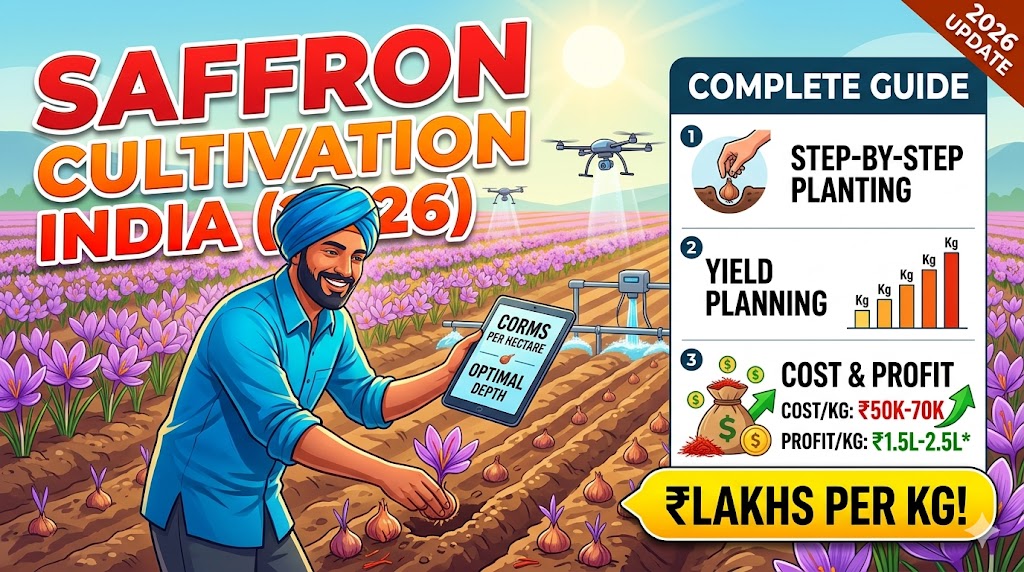
Saffron is known as the “Golden Spice” because it is expensive and high-value.But saffron cultivation is not based on luck—its success depends on a specific formula: right climate fit, excellent soil drainage, correct corm planting practices, disciplined harvesting, and proper drying/storage.
This guide is written for Indian growers. It explains how saffron is planted step-by-step, how to manage irrigation and soil, how to estimate yield, and how to plan profit per kg based on real input and labor requirements (saffron threads are labor-intensive).
Quick Saffron Facts (why it needs precision)
| Topic | What to remember |
|---|---|
| Plant | Crocus sativus grown from corms |
| Harvest | Threads collected manually during short flowering windows |
| Core risk | Corm rot from poor drainage and overwatering |
| Quality control | Drying and storage determine final market quality and price |
1) Climate & soil requirements for saffron in India
Saffron needs a cool temperate climate with distinct seasonal changes.
It performs best when winters allow dormancy and flowering conditions support healthy stigmas.
Soil must be well-drained. Saffron corms are vulnerable to rot if soil stays wet for long periods.
If your land holds water after rains, saffron is a high-risk crop unless you build drainage/raised ridges.
- Climate fit: cool winter + manageable growth conditions
- Drainage: essential for corm survival
- Soil pH: test and follow lab guidance for best nutrient availability
2) Step-by-step saffron cultivation process
Step 1: land preparation
- Remove stones and weeds.
- Prepare soil for aeration and drainage.
- Incorporate well-decomposed organic matter (as per soil test needs).
Step 2: corm selection
- Buy disease-free corms from reliable suppliers.
- Choose healthy, correctly sized corms for uniform emergence.
Step 3: planting time and spacing
- Plant during the recommended window for your region.
- Maintain correct planting depth and spacing to support healthy growth.
Step 4: irrigation management
Overwatering is one of the biggest saffron failures. You need enough moisture for growth,
but never allow stagnant water around corms.
- Use light irrigation only when necessary.
- Ensure water does not accumulate in planting ridges.
Step 5: weed and soil management
- Remove weeds early to reduce competition.
- Maintain soil aeration without disturbing corm zones.
Step 6: flowering and harvesting saffron threads
Harvesting saffron threads requires careful, timely labor.
Flowers open briefly, often during early morning. Collect threads manually within the short window.
- Harvest flowers frequently during the flowering period.
- Use clean tools and careful handling to avoid contamination.
Step 7: drying, grading and storage (quality decides price)
Drying determines color, aroma, and shelf stability.
Improper drying leads to moisture retention and reduced quality.
- Dry threads under controlled conditions (avoid direct high heat).
- Grading should be based on quality parameters used by buyers.
- Store in airtight containers away from sunlight and humidity.
3) Yield planning: how to estimate output
Yield depends on:
corm quality, soil drainage, irrigation discipline, disease pressure, and harvesting discipline.
For profit planning, you should estimate yield based on your planting material and past local yields.
Yield planning method
- Estimate number of plants/corms per unit area
- Estimate flowering density and thread recovery
- Account for losses during drying and grading
- Use conservative yield assumptions for safer ROI planning
4) Cost and profit planning (profit per kg)
Saffron costs include corm purchase, land preparation, labor, and drying/processing.
Profit depends on yield × market price × recovery percentage after drying.
Cost heads to include
- Land preparation and manure
- Corm purchase cost
- Irrigation setup and maintenance
- Labor for planting + harvesting + thread separation
- Drying equipment/material
- Storage containers and packaging
Profit calculation checklist
- Gross revenue = dry saffron yield (kg) × sale price per kg
- Subtract labor + inputs + drying/storage costs
- Use recovery rate assumptions (fresh → dry yield)
- Include risk buffer for rot losses due to poor drainage
5) Common challenges and troubleshooting
Challenge #1: corm rot and weak emergence
Most commonly due to waterlogging, poor drainage, or contaminated planting material.
Fix drainage early and use disease-free corms.
Challenge #2: short flowering window → labor pressure
Saffron threads are collected in a short window.
Prepare labor planning in advance and maintain organization in harvesting.
Challenge #3: poor drying quality → low market acceptance
Control drying conditions and avoid humidity after drying.
Store correctly and grade accurately.
6) FAQ (saffron cultivation)
Q1: How long does saffron take to flower after planting corms?
A: Typically flowers appear after a few months, depending on climate and corm health.
Q2: How many flowers are needed for 1 kg saffron?
A: It varies by thread recovery and flower quality. Many growers estimate high flower counts because each flower produces a small amount of threads.
Q3: Can saffron be grown outside Kashmir?
A: Sometimes possible in other cool regions or controlled conditions if drainage and climate fit are correct, but results vary.
Conclusion
Saffron cultivation becomes profitable when growers treat it as a precision crop: drainage-first land prep, disease-free corm selection, disciplined irrigation, careful harvesting, and controlled drying/storage. If these are managed well, saffron can deliver strong returns per kg in suitable Indian conditions.