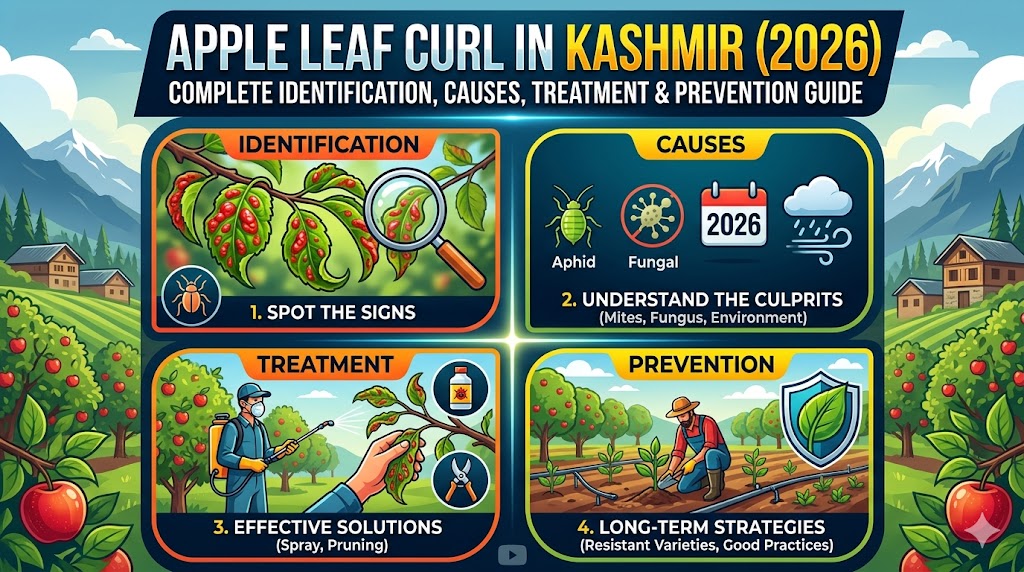
Apple leaf curl is a common problem in temperate apple orchards, and in Kashmir it can become more serious because the valley’s weather patterns often support repeated infection cycles. When leaves curl, twist, or become deformed, the orchard doesn’t just lose “beauty”—it loses productivity. Reduced leaf function means weaker shoots, poor flowering, and smaller fruit size in the next crop window.
This guide focuses on what you need to do on the ground:
how to identify apple leaf curl correctly, how to narrow down the likely cause, what actions to take immediately,
and how to prevent the problem from returning year after year.
It is written for Indian growers with a practical emphasis on disease diagnosis and prevention timing.
Quick Leaf Curl Checklist (use this during scouting)
| Scouting point | What you should observe | Why it matters |
|---|---|---|
| Timing | When did curl first appear? (early spring or later) | Different causes peak at different times. |
| Leaf texture | Are leaves thickened, blistered, sticky, or powdery? | Texture often indicates fungal vs insect vs nutrient issues. |
| New shoot condition | Are new shoots weak or deformed? | Severe shoot damage affects next season yield. |
| Presence of pests | Look for aphids, colonies, or sticky honeydew. | Insect feeding can trigger leaf curl. |
| Orchard microclimate | Dense canopy? Low airflow pockets? | Humidity increases disease and prevents spray penetration. |
1) What “apple leaf curl” really means
Leaf curl is a symptom, not a single disease.
In apple orchards, leaf curl can be triggered by multiple causes such as:
fungal infections (especially during wet, cool conditions),
insect feeding (notably aphids),
and sometimes nutrient and stress factors that weaken tender growth.
Because it’s a symptom, the safest orchard approach is not “spray first.” Instead, identify the cause category:
fungal pattern, insect pattern, or non-infectious stress pattern.
The correct action depends on this category.
2) Identification: symptoms you can see in Kashmir orchards
2.1 Curl with blistering/thickened leaves (fungal suspicion)
In many orchards, fungal-related leaf problems show as thickened leaves, blister-like swelling, or leaf surfaces that look deformed rather than simply folded.
In humid periods, curled leaves may also show spotting or discoloration depending on the pathogen.
2.2 Curl with sticky leaves and visible aphid colonies (insect suspicion)
Aphids often cause leaf curl by feeding on tender growth.
You may notice sticky honeydew on leaves, clusters of small insects, or black sooty mold that grows on honeydew.
Curl in this scenario often starts on new shoot tips and spreads gradually along weak shoots.
2.3 Curl without pests and without fungal spotting (stress/nutrient suspicion)
Sometimes leaves curl due to pruning shock, root stress, drought stress, winter damage, herbicide drift, or nutrient imbalance.
In these cases, you typically don’t see consistent pest colonies or clear fungal patterns.
The curl may appear patchy and follow specific orchard areas (for example, edge rows, compaction spots, or irrigation differences).
3) Common causes of apple leaf curl in Kashmir
Kashmir’s orchards can face repeated rain, fog, and cool spring conditions.
These conditions increase both fungal pressure and the survival of certain insects.
3.1 Fungal leaf infections (wet period risk)
Cool, humid weather supports fungal growth.
When leaves are young and tender in spring, they are more vulnerable.
Dense canopies slow airflow and keep leaves wet longer, creating ideal infection conditions.
3.2 Aphids and other sap-sucking pests (feeding pattern)
Aphids are among the most practical orchard issues because they are visible and act quickly.
Their feeding triggers leaf distortion and also weakens young shoots.
Additionally, aphids can spread virus-like symptoms indirectly by stressing plants and encouraging secondary issues.
3.3 Nutrient imbalance and orchard stress
Leaf curl can be intensified when the orchard is weak.
For example, if nutrition is unbalanced, shoots may become softer and more susceptible to both insects and fungal infections.
That is why leaf curl should be linked to orchard nutrition management rather than treated only as an isolated problem.
4) Field diagnosis: a step-by-step decision method
Before deciding treatment, do this diagnosis sequence.
It saves money and reduces the chance of applying the wrong action at the wrong time.
- Step 1: Identify the first affected leaves
Check whether symptoms began at the shoot tips, mid-leaves, or older leaves. - Step 2: Look for insect signs
Search for aphids on the underside of the curled area.
Check for sticky honeydew and sooty mold. - Step 3: Look for fungal signs
Observe whether leaves show blistering, spots, or a uniform pattern after rainy weather. - Step 4: Check canopy density
In dense canopy pockets, leaf wetness stays longer; fungal patterns become more common. - Step 5: Decide corrective focus
If insect signs are strong, focus on pest control + sanitation.
If fungal patterns dominate, focus on preventive/curative fungal program timed to orchard weather risk.
5) Treatment and orchard actions (safe, practical guidance)
Because leaf curl can have multiple causes, the treatment approach must match the cause category.
Below is a practical “cause-first” treatment logic.
5.1 If aphids are present: reduce the pest population quickly
- Remove heavily infested shoot tips if infestation is limited to small areas.
- Use an IPM approach: target colonies early rather than waiting until the whole orchard collapses.
- Encourage beneficial insects and avoid excessive broad-spectrum spraying that kills predators.
- Monitor weekly after treatment to confirm suppression.
5.2 If fungal infection is likely: act around weather risk windows
- Improve airflow via pruning and thinning.
- Remove and destroy visibly infected curled leaves where feasible (especially if early stage).
- Plan protective/curative sprays based on local disease timing and infection windows.
- Ensure good spray coverage: leaf curl problems often persist when sprays don’t reach the underside.
5.3 If stress/nutrient imbalance is suspected
- Review irrigation schedule and fix water stress or waterlogging pockets.
- Use soil/leaf testing to confirm deficiency or imbalance before applying fertilizers.
- Avoid heavy pruning or fertilizer shock during vulnerable growth weeks.
6) Spray timing guidance (how to think without guesswork)
In orchard work, timing matters more than the name of the product.
For leaf curl problems, sprays should align with:
new flush emergence,
rain/fog risk periods,
and the growth stage vulnerability window.
If you treat too early, you lose protection before infection.
If you treat too late, curled leaves may already be damaged and the orchard’s future yield potential can be reduced.
| Orchard stage | Risk signals | Action focus |
|---|---|---|
| Early spring new flush | Soft growth + humidity/fog | Prevent early infection; scout for aphids |
| After rainy periods | More leaf wetness + spread risk | Protect new leaves; remove infected pockets |
| Later spring/early summer | If curls persist or spread | Repeat targeted IPM based on monitoring |
7) Prevention: how to stop leaf curl from returning
7.1 Canopy and orchard hygiene
- Prune to reduce dense humid pockets.
- Remove infected leaf material during early outbreaks.
- Keep orchard floor management clean to reduce pest survival.
- Sanitize tools to avoid spreading infections between blocks.
7.2 Nutrition management (support healthy shoots)
- Use soil and leaf tests to guide nutrition corrections.
- Avoid excessive nitrogen that creates too-soft growth for aphids.
- Maintain balanced potassium and micronutrients to support plant resistance.
7.3 Monitoring routine (simple weekly system)
The best prevention is repeated scouting.
Walk the orchard once a week during spring flush.
Check new shoots and the underside of leaves.
Record where symptoms start and spread.
8) Frequently Asked Questions (FAQ)
Q1: Is apple leaf curl always a disease?
A: No. Leaf curl can result from fungal infections, aphids/insects, or stress/nutrient imbalance. Correct diagnosis decides the right action.
Q2: Why does leaf curl spread in some blocks faster?
A: Dense canopy and humid pockets increase leaf wetness duration. Poor airflow and inconsistent irrigation also increase plant stress.
Q3: Can I prevent leaf curl without many sprays?
A: You can reduce sprays by focusing on prevention timing, pruning airflow, sanitation, and early monitoring. Sprays become targeted rather than repeated blindly.
Conclusion
Apple leaf curl in Kashmir is a symptom that can have multiple causes. The orchard solution is not a single product—it is a cause-first diagnostic routine followed by the correct actions: improve airflow through pruning, scout weekly for aphids or fungal patterns, correct irrigation/nutrition based on evidence, and treat during the right weather risk windows. If you follow this system, leaf curl becomes manageable—and your apple orchard stays productive and healthy throughout the season.