Root rot is one of those orchard problems that growers often notice too late. By the time the leaves start yellowing or the tree wilts despite adequate water, the damage underground has already been going on for weeks or months. In my years working with apple orchards in Anantnag, root rot has been one of the most consistently destructive problems I have encountered — and one of the most preventable, when you know what to look for.
This guide covers root rot in detail: what causes it, how to identify it at different stages, what treatments work, and most importantly, how to stop it from becoming a recurring problem in your orchard.
What is root rot?
Root rot is a condition where the root system of a plant begins to decay, cutting off its ability to absorb water and nutrients from the soil. It is not caused by a single pathogen. In Indian horticultural conditions, root rot is most commonly caused by water mould fungi — particularly species of Phytophthora and Pythium — as well as Fusarium and Armillaria (honey fungus) in some cases.
These pathogens thrive in wet, poorly drained, and compacted soils. They infect feeder roots first — the small, hair-like roots that do the actual work of absorbing water — and then progress upward along larger roots toward the crown and base of the trunk.
In apple orchards, Phytophthora cactorum and Phytophthora cinnamomi are the most frequently identified species. In vegetable crops, Pythium is more commonly responsible. In older orchards, Armillaria root rot — identifiable by white fungal threads (mycelium) under the bark at the base of the tree — can cause the loss of entire trees.
Which crops are most affected?
Root rot affects a wide range of horticultural crops, but the economic impact is greatest in perennial trees and high-value vegetables:
- Apple trees (particularly young plantations and high-density orchards on dwarfing rootstocks)
- Pear and plum
- Strawberry — one of the most vulnerable crops, with Phytophthora root rot causing total crop failure in some seasons
- Tomato, capsicum, and brinjal
- Rose and carnation in flower farming operations
In Kashmir, apple orchards on M9 and M26 dwarfing rootstocks are particularly vulnerable because these rootstocks have shallow root systems that are more susceptible to waterlogging and soil-borne pathogens than vigorous seedling rootstocks.
Early warning signs — what to look for above ground
The challenge with root rot is that symptoms appear above ground long after the underground damage has begun. By the time you see visible signs on leaves and branches, a significant portion of the root system may already be compromised.
That said, knowing what to watch for gives you the best chance of catching it early enough to save affected trees.
Unexplained wilting. If a tree or plant wilts despite adequate irrigation or recent rainfall, root rot should be your first suspicion. The roots can no longer deliver water effectively, so the plant wilts as if it were dry — even when the surrounding soil is moist.
Yellowing leaves from the base up. Root rot restricts nutrient uptake. You will often see leaves turn pale yellow or show interveinal chlorosis — yellowing between the leaf veins — starting on lower or older leaves first.
Stunted new growth. A healthy apple tree in spring should put out vigorous new shoots of 15–30 cm or more. A tree with root rot will produce weak, short, thin new growth even in a good spring season.
Early defoliation. Affected trees drop their leaves earlier than healthy neighbours. If one tree in a row loses its leaves two or three weeks before the others, dig around its base.
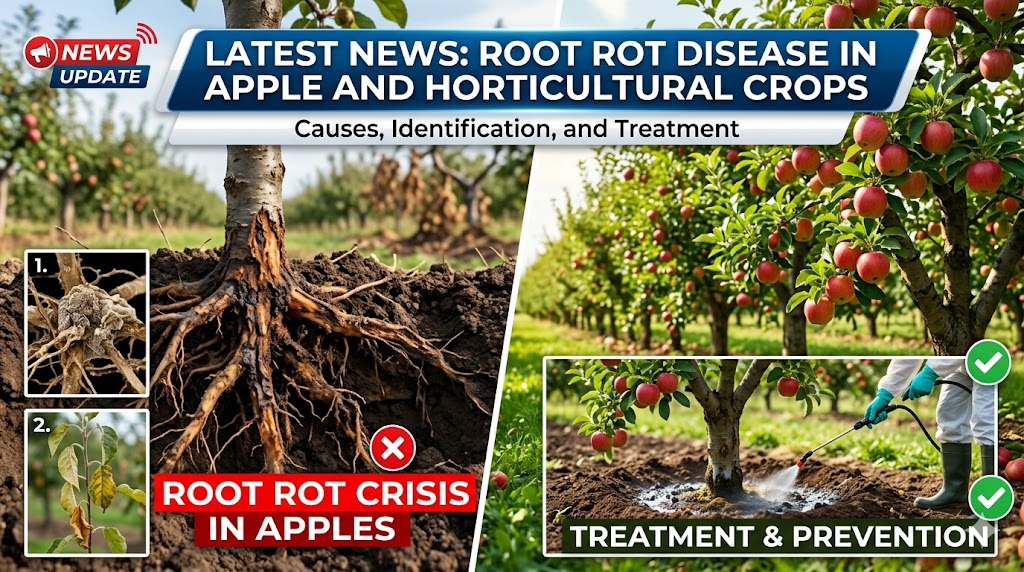
Collar rot symptoms. In Phytophthora infections on apple, look at the base of the trunk just above soil level. Infected bark often shows a brownish, water-soaked discolouration that is clearly different from healthy bark. If you peel back a small section, you may see the boundary between orange-brown diseased wood and healthy white wood.
Confirming the diagnosis underground
If you suspect root rot based on above-ground symptoms, dig carefully around the drip line of the tree — not right at the base — and examine the feeder roots. Healthy roots are white or cream-coloured, firm, and slightly flexible. Roots affected by root rot are brown or black, soft, and may smell faintly of decay. They often slip away from the outer root tissue if pulled gently, leaving behind a bare thread.
In cases where you need certainty before treating, soil and root samples can be sent to the J&K Horticulture Department testing laboratory or SKUAST-K (Sher-e-Kashmir University of Agricultural Sciences and Technology) for pathogen identification. This is particularly worthwhile in high-density orchards where treatment decisions involve significant investment.
Treatment options
Treatment for root rot depends on the severity of infection and the pathogen involved. There is no single solution that works in every case, and in severe infections, the tree or plant may not be recoverable. Early intervention gives the best results.
Improve drainage immediately. This is always the first step, regardless of which pathogen is involved. Root rot cannot persist or spread in well-drained soil the way it can in waterlogged conditions. If the affected area holds water after rain, create drainage channels, raise planting beds, or install subsurface drainage before any chemical treatment.
Remove and destroy severely affected plants. Trees with collar rot extending more than halfway around the circumference of the trunk base, or trees that have lost more than 60–70% of their root system, are unlikely to recover. Remove them along with as much surrounding soil as possible and do not replant susceptible species in that spot for at least two years.
Copper-based fungicides for Phytophthora. Copper oxychloride applied as a soil drench around the base of affected trees is one of the most effective and accessible treatments for Phytophthora root rot. Use at a rate of 3 grams per litre of water, drenching the soil out to the drip line of the tree. Repeat after 30 days.
Metalaxyl or mefenoxam. These systemic fungicides are specifically active against water moulds (Oomycetes), which include Phytophthora and Pythium. They are available under several trade names in India and should be used strictly according to label rates. They are most effective as a preventive or very early curative treatment, not on advanced infections.
Biological control with Trichoderma. Trichoderma harzianum and Trichoderma viride are beneficial fungi that suppress Phytophthora, Pythium, and Fusarium. Applied as a soil drench or incorporated into compost, they establish in the root zone and compete with pathogens. They are not a replacement for chemical treatment in active infections but are an excellent preventive measure and a long-term soil health strategy.
Biochar and organic matter. Improving soil organic matter content through compost application improves drainage, stimulates beneficial microbial communities, and suppresses root rot pathogens over time. This is a medium to long-term strategy, not an immediate cure.
Prevention — the most cost-effective approach
Like most plant diseases, preventing root rot is far more cost-effective than treating it. The following practices, applied consistently, dramatically reduce root rot incidence in apple orchards and other horticultural crops.
Choose rootstocks carefully. In new apple plantations, rootstock selection should account for local drainage conditions. M9 and M26 give excellent productivity in well-drained soils but are poorly suited to heavy, waterlogged sites. In areas with known drainage issues, MM106 or seedling rootstocks offer more resistance.
Plant on raised beds or mounds. Planting trees on a slight mound — even 15–20 cm of raised soil — dramatically reduces the time their crown and upper root system spend in contact with saturated soil after heavy rain.
Avoid overwatering. In drip-irrigated orchards, programme irrigation based on actual soil moisture, not on a fixed schedule. Soil moisture sensors are inexpensive and remove the guesswork from irrigation decisions.
Sanitise tools and equipment. Phytophthora spores can be moved from infected to healthy areas on pruning tools, boots, and tractor tyres. Clean tools with a diluted copper sulphate solution between trees when working in areas with known root rot history.
Apply preventive Trichoderma treatments. At planting and at the start of each growing season, a Trichoderma drench around the root zone of young trees costs very little and provides meaningful protection against soil-borne pathogens.
Root rot in strawberry — a special case
Strawberry is more vulnerable to root rot than apple and requires particularly careful management. The main pathogen in strawberry root rot is Phytophthora fragariae, which causes a condition known as red stele disease — named for the characteristic red or pink discolouration of the stele (central vascular tissue) in affected roots.
Infected strawberry plants show stunted growth, blue-green leaf colour (different from the normal green), and roots with red-pink internal colouring when cut lengthwise. There is no effective cure once plants are infected. Prevention through resistant varieties, raised beds, and strict hygiene between planting seasons is the only reliable management strategy.
In J&K, strawberry cultivation in areas like Gulmarg and parts of Anantnag district has faced significant root rot pressure. Growers should avoid replanting strawberry in any field where root rot has previously occurred for a minimum of three years, and should use certified, disease-free planting material exclusively.
Summary
Root rot is a serious threat in Kashmiri horticulture, particularly in apple orchards on dwarfing rootstocks and in strawberry cultivation. The keys to managing it are early recognition — watching for above-ground symptoms and confirming with root examination — followed by rapid drainage improvement, targeted fungicide treatment, and biological preventive measures. Long-term, the most effective approach is building well-drained, biologically active soils that resist pathogen establishment in the first place.
FAQ
Q: Can a tree recover from root rot? Yes, if caught early and drainage is improved promptly. Trees with less than 50% root damage and no collar rot circling the trunk have a reasonable chance of recovery with treatment.
Q: Is root rot contagious? The pathogens that cause root rot can spread through water movement, contaminated soil, and infected tools. Good drainage and sanitation prevent spread.
Q: What is the best fungicide for root rot in apple orchards in Kashmir? Copper oxychloride as a soil drench is the most widely available and effective option for Phytophthora root rot. Metalaxyl-based products are more targeted but should be used with care to avoid resistance buildup.
Q: Can I replant in a spot where root rot occurred? Not immediately. Wait at least two years and improve drainage before replanting. Consider a resistant rootstock or a different crop in that location.