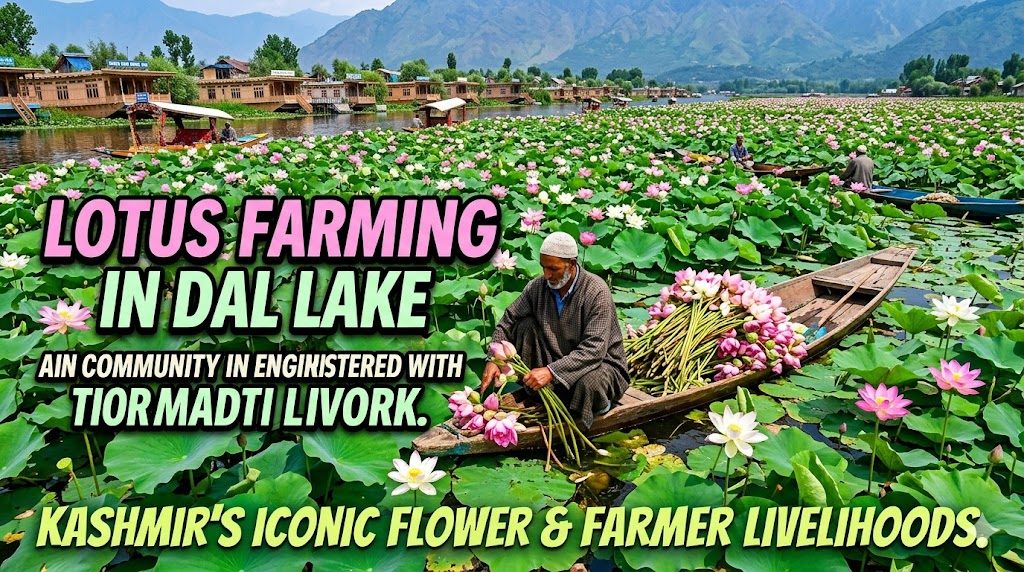
Dal Lake is one of the most recognisable images of Kashmir — the shikaras, the houseboats, the backdrop of the Zabarwan mountains. What many visitors do not realise is that Dal Lake is also a working agricultural landscape, and lotus farming is one of its most important traditional crops.
The lotus (Nelumbo nucifera) has been cultivated in Dal Lake and other water bodies of the Kashmir valley for centuries. Its roots, seeds, and flowers are all commercially valuable, and its cultivation forms a significant part of the income of families who have lived on and around the lake for generations.
The geography and ecology of Dal Lake lotus cultivation
Dal Lake covers approximately 18 square kilometres in the heart of Srinagar, though its effective surface area has shrunk significantly over recent decades due to encroachment, siltation, and weed proliferation. Within the lake, there are areas of open water, floating gardens (called dembs or radhs), and shallower zones that are ideal for lotus cultivation.
Lotus grows in water depths of 60 to 150 cm, rooting in the rich organic sediment at the lake bottom. The lake’s sediment — built up over centuries of organic input from aquatic plants, fish, and waterfowl — provides naturally fertile growing conditions that require minimal external fertiliser inputs.
The main lotus-growing areas within Dal Lake are concentrated in the northeast and southeast portions of the lake, and in connected water bodies like Nagin Lake and Anchar Lake.
The economics of Dal Lake lotus farming
Lotus farming at Dal Lake is a multi-product enterprise. Different parts of the plant are harvested and sold through different market channels:
Lotus stems (nadru): Nadru is the underground stem (rhizome) of the lotus plant. It is the highest-value lotus product from Dal Lake and an important ingredient in Kashmiri cuisine, particularly in the traditional preparation of nadru yakhni. A kilogram of fresh nadru sells for ₹60 to ₹120 in Srinagar markets depending on season and quality. Premium, well-cleaned nadru sold to restaurants and hotels commands even higher prices.
Nadru harvest runs primarily from October through December and into January. Farmers — typically working from small wooden boats — use long poles to dislodge rhizomes from the lake sediment, then hand-select and clean them before bringing them to market.
Lotus flowers: Cut lotus flowers are sold to temples, mosques, and flower markets. They are also increasingly sold through tourist-oriented flower markets on Dal Lake’s ghats. A bundle of cut lotus flowers typically sells for ₹50 to ₹150 depending on season and flower quality.
Lotus seeds: Dried lotus seeds are sold as a snack and used in Ayurvedic preparations. They have growing demand in health food markets in metro cities. Lotus seeds from Dal Lake are collected from dried seed pods after the flowering season.
Cultivation practices
Unlike most agricultural crops, lotus in Dal Lake does not involve conventional field preparation, planting in rows, or soil cultivation. The lake’s natural conditions — water depth, sediment fertility, and seasonal temperature cycles — govern the growing cycle.
Farmers maintain their lotus areas by managing competing aquatic weeds, ensuring adequate water depth, and periodically removing dead plant material. In areas where lotus cultivation has declined, restoration involves reintroducing rhizome sections and protecting the growing area from boat traffic and weed competition.
The growing season begins in spring as water temperatures rise above 10°C, typically in April. Lotus leaves emerge in May and June, flowers peak in July and August, and rhizomes are harvested from October onwards.
Challenges facing Dal Lake lotus farmers
Dal Lake’s lotus farming faces several serious challenges that have reduced both the cultivated area and the income of farming families over recent years.
Lake degradation and shrinkage. Decades of encroachment, runoff from urban development, and reduced water inflow have degraded significant areas of Dal Lake. Shallower areas have become choked with invasive aquatic weeds — particularly water hyacinth — which compete with lotus and reduce the lake’s productivity.
Invasive weed competition. Water hyacinth and other floating weeds spread rapidly and can cover large areas of lotus growing zones in a single season. Removal is labour-intensive and must be done repeatedly.
Market access and price volatility. Nadru prices fluctuate significantly through the season, and farmers with limited storage capacity often have no choice but to sell at whatever price is available at harvest time. Improved storage infrastructure and better market information would allow farmers to hold product for better prices.
Declining farmer numbers. Younger members of Dal Lake farming families are increasingly moving toward urban employment rather than continuing traditional lotus cultivation. This is a pattern seen across traditional agricultural communities in Kashmir and globally.
Tourism and lotus farming — a growing opportunity
Dal Lake’s lotus fields are one of the valley’s most photographed landscapes. The flowering season in July and August attracts significant visitor attention, and there is a real opportunity to develop agro-tourism experiences around lotus farming — boat tours through flowering lotus fields, nadru cooking demonstrations, and direct purchase of lotus products from farmers.
Several houseboats and Srinagar tourism operators have begun incorporating Dal Lake agricultural experiences into their offerings, and this is an area with significant potential for income diversification among lake farming families.
Conservation and the future of Dal Lake lotus farming
The health of Dal Lake’s lotus farming is directly tied to the health of the lake ecosystem itself. Restoration initiatives by the J&K government, including the Dal Lake Conservation and Management Authority, address some of the weed and encroachment problems, but the lake’s ecological condition remains a concern.
For lotus farming families, the most important actions are participating in community-level weed management, adopting improved nadru cleaning and packaging practices to command better prices, and exploring value-added products — dried lotus seeds, lotus flower extracts, and processed nadru — that carry higher margins than fresh commodity sales.
Summary
Lotus farming in Dal Lake is not a relic of the past — it is an active agricultural system that feeds real families and produces products with genuine market demand, particularly nadru, which is an irreplaceable ingredient in Kashmiri cuisine. Its future depends on lake ecosystem health, better market access for farmers, and the development of value-added product opportunities that make lotus farming economically competitive with the alternatives available to younger Kashmiri rural workers.
FAQ
Q: What is nadru and why is it valuable? Nadru is the underground stem (rhizome) of the lotus plant, a staple ingredient in Kashmiri cuisine. Its unique texture and flavour, combined with limited production from Dal Lake, give it significant market value — ₹60 to ₹120 per kg at retail.
Q: Can lotus be farmed outside of Dal Lake in Kashmir? Yes. Lotus can be cultivated in any water body with suitable depth (60–150 cm) and organic sediment. Some farmers in the Wular Lake and Manasbal Lake areas also practice lotus cultivation.
Q: What is the main threat to Dal Lake lotus farming? Invasive aquatic weeds, particularly water hyacinth, are the most immediate farming challenge. Longer term, lake shrinkage and ecosystem degradation from urban runoff threaten the entire lake agricultural system.