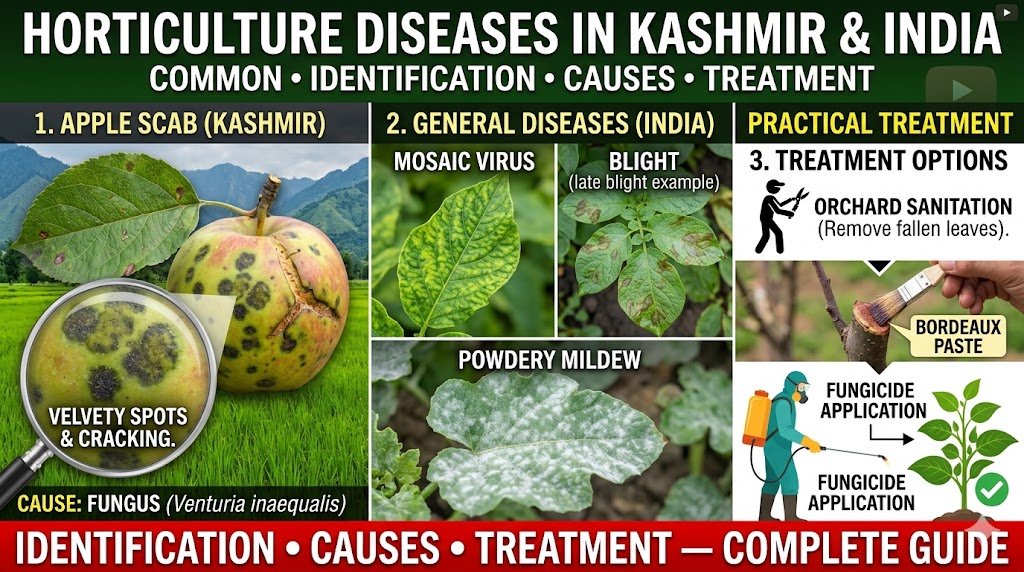
Horticulture diseases are one of the most consistent threats to farm income. A disease that goes undetected for even two or three weeks can reduce a season’s yield by 30 to 50 percent, and in severe cases, it can destroy an entire crop. In my experience working with apple orchards and observing other horticultural operations across the Kashmir valley, the single most effective way to reduce disease losses is to know what you are looking for — and to look regularly.
This guide covers the most important diseases affecting horticultural crops in Kashmir and across India, with practical identification details and treatment strategies that work under real field conditions.
Powdery mildew
Powdery mildew is one of the most widespread fungal diseases in horticulture, affecting apples, cucurbits (cucumber, squash, melon), roses, grapes, and many vegetable crops. It is caused by various species of Erysiphe and related fungi, each specialising in specific host plants.
How to identify it: Powdery mildew is one of the easiest diseases to spot. It forms a white or grey powdery coating on the upper surface of leaves, young shoots, and sometimes fruit. Unlike most fungal diseases, it does not need wet conditions to establish — in fact, it thrives in warm, dry days combined with cool nights and high relative humidity, conditions that are common in Kashmir’s apple-growing areas.
In apple orchards, powdery mildew — caused by Podosphaera leucotricha — infects young shoots in spring and early summer, causing them to appear silvery-white and stunted. Infected shoots often remain upright when healthy shoots have begun to arch naturally.
Treatment: Sulphur-based fungicides are the standard treatment for powdery mildew in most crops. Wettable sulphur applied every 10–14 days during the active growing season provides good control. Neem oil (at 2–3 ml per litre) is an effective organic alternative. For apple powdery mildew, systemic fungicides like myclobutanil or tebuconazole provide curative action on established infections.
Avoid overhead irrigation, which creates the humidity that encourages the disease. Prune out heavily infected shoots in apple orchards before the season’s first spray.
Scab (apple scab in Kashmir)
Apple scab, caused by Venturia inaequalis, is arguably the most economically important disease of apple orchards in Kashmir. It affects leaves, shoots, and fruit, causing characteristic olive-green to black, velvety spots that reduce fruit marketability even when infections are not severe.
How to identify it: On leaves, scab appears as olive-coloured, circular to irregular spots with feathery margins. On fruit, it produces dark, scabby lesions that crack as the fruit enlarges. Severely infected fruit becomes misshapen and unmarketable.
Scab is a monocyclic disease early in the season and polycyclic thereafter — meaning the first infection cycle comes from fungal spores overwintering in fallen leaves, and subsequent cycles come from spores produced on the new season’s infections. Managing the first infection cycle in spring is critical to keeping the disease under control for the entire season.
Treatment: Timing is everything with scab. Protective fungicide applications — with copper-based products, mancozeb, or captan — must be applied before or immediately after infection events (rain periods when temperatures are between 6–24°C). Once symptoms are visible, curative fungicides (trifloxystrobin, kresoxim-methyl) can slow further spread but cannot reverse existing damage. Collect and burn fallen leaves in autumn to reduce the primary inoculum for the following season.
Bacterial wilt
Bacterial wilt, caused by Ralstonia solanacearum, affects solanaceous crops — tomato, brinjal, capsicum — and can devastate crops where it establishes in the soil. It is a soil-borne disease that enters plants through wounds or natural openings in roots.
How to identify it: The classic symptom is sudden, rapid wilting of the entire plant — often appearing healthy in the morning and completely wilted by afternoon. If you cut the stem near the base and hold it in a glass of water, you will see milky, bacterial threads oozing from the cut end. This oozing test is the most reliable field diagnostic for bacterial wilt.
The disease spreads through contaminated soil, irrigation water, and farm tools. Once established in a field, it persists in the soil for many years even without a host plant present.
Treatment: There is no effective curative treatment for plants already infected. Remove and destroy infected plants immediately, away from the field. Do not compost infected material. For the soil itself, solarisation — covering moist soil with clear polythene film during the hottest weeks of summer — reduces Ralstonia populations significantly. Crop rotation with non-host crops (cereals, onion) for at least 3–4 years is the most reliable long-term management. Resistant tomato varieties are now available and should be used in fields with a history of bacterial wilt.
Anthracnose
Anthracnose is a group of fungal diseases caused primarily by Colletotrichum species. It affects a wide range of crops including mango, chilli, beans, cucurbits, and strawberry. In Kashmir, anthracnose is particularly common in apple orchards (caused by Colletotrichum acutatum) and in vegetable crops grown in the valley.
How to identify it: Anthracnose on fruit appears as dark, sunken, circular lesions that expand and may develop pink or orange spore masses in wet conditions. On leaves, it causes irregular dark brown spots with yellow margins. On stems and twigs, it creates elongated, sunken cankers.
The disease spreads rapidly in warm, wet conditions. In apple orchards, rain during harvest season creates major anthracnose risk, particularly on varieties like Golden Delicious.
Treatment: Mancozeb or copper oxychloride applied preventively before and during wet periods provides good protection. Post-harvest anthracnose can be managed by keeping harvested fruit cool and dry and packing promptly. In chilli, removing infected fruit from the plant prevents secondary spread.
Damping off
Damping off is a seedling disease caused by several water mould and fungal pathogens including Pythium, Rhizoctonia, and Fusarium. It kills seedlings either before they emerge (pre-emergence damping off) or just after, causing them to collapse at the soil surface (post-emergence damping off).
How to identify it: Seeds fail to germinate, or seedlings emerge and then suddenly collapse at soil level, as if the stem has been pinched. The collapsed area is often dark and water-soaked. In nurseries, damping off can spread in a circular pattern from an initial focus point.
Treatment: Prevention is far more effective than cure. Use sterilised seedling mix, avoid overwatering, ensure good drainage in seedbeds, and sow at recommended densities to allow air circulation. Seed treatment with Thiram or Captan before sowing reduces damping off significantly. Biological seed treatment with Trichoderma is an effective organic alternative.
Mosaic virus diseases
Several important horticultural crops are affected by mosaic viruses — cucumber mosaic virus (CMV), tomato mosaic virus (ToMV), and bean mosaic virus are among the most common. These are transmitted by aphids and cannot be cured once established.
How to identify it: Mosaic viruses produce a characteristic mottled pattern on leaves — alternating light green or yellow patches with normal dark green areas. Affected leaves are often distorted, cupped, or smaller than normal. Fruit on infected plants is often discoloured and reduced in size.
Management: Remove and destroy infected plants promptly. Control aphid populations with insecticides or reflective mulches that deter landing aphids. Plant resistant varieties wherever available. There is no chemical cure for virus infections.
An integrated approach to disease management
The most effective way to manage horticulture diseases is through an integrated approach that combines several strategies rather than relying on any single treatment:
Observation and monitoring. Walk your orchard or field at least once a week during the active growing season. Most diseases are far easier to manage when caught early. Look at leaves (top and bottom), stems, and fruit at each visit.
Cultural practices. Crop rotation, proper plant spacing, pruning for air circulation, and removing infected plant material all reduce disease pressure without chemical inputs.
Preventive spraying schedule. A well-timed preventive spray programme, based on local weather conditions and disease risk calendars from the J&K Horticulture Department, prevents most major infections before they establish.
Resistant varieties. Where available, disease-resistant varieties dramatically reduce management costs and chemical use.
Soil health. Healthy, biologically active soil with good drainage suppresses many soil-borne pathogens naturally. Compost, cover crops, and Trichoderma applications all contribute to a healthier root environment.
Summary
Disease management in horticulture is ultimately about consistency — consistent observation, consistent preventive care, and consistent response when problems appear. No single spray or treatment replaces the value of walking your fields regularly and knowing what healthy crops look like so that early symptoms stand out.
FAQ
Q: What is the most common disease in Kashmiri apple orchards? Apple scab (Venturia inaequalis) is the most economically important disease, followed by powdery mildew. Both are manageable with a well-timed preventive spray programme.
Q: Can I use neem oil for all horticulture diseases? Neem oil is effective against powdery mildew and some insect pests but has limited activity against bacterial diseases and most other fungal infections. It works best as part of an organic prevention programme rather than as a curative treatment.
Q: How do I prevent disease from spreading between plants? Disinfect tools with copper sulphate or 70% alcohol between plants when working in areas with known disease. Remove and destroy infected material rather than leaving it in the field.