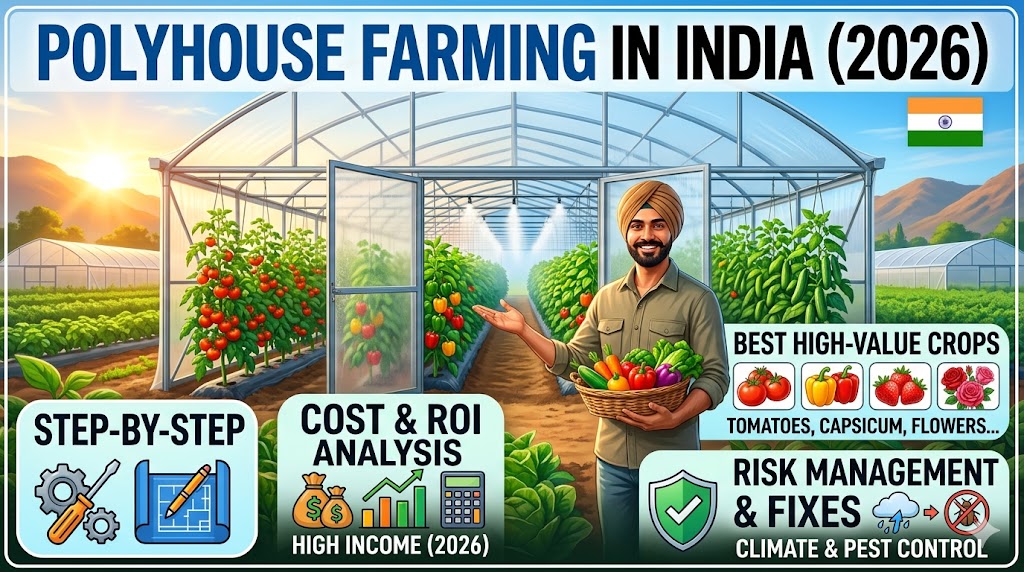
Polyhouse farming is one of the most practical “controlled agriculture” options for Indian growers who want better crop quality and more stable income. A polyhouse can reduce weather risk, improve uniformity, and allow year-round production—especially for vegetables, flowers, and high-value crops.
However, polyhouse profitability depends on one thing above all:
planning the business like a system—structure + irrigation/fertigation + crop calendar + pest/disease prevention + marketing.
In this guide, you’ll learn how to set up a polyhouse step-by-step, how to estimate real investment and operating costs, which crops suit different polyhouse types, and what mistakes commonly destroy ROI. This is built for AdSense-friendly quality: clear sections, action checklists, and crop-risk details.
Polyhouse farming: quick facts before you invest
| Planning area | What to decide |
|---|---|
| Polyhouse type | Naturally ventilated vs climate-controlled (based on your region and crops) |
| Crop choice | Select crops based on market demand and your ability to manage pests/disease |
| Irrigation system | Drip/fertigation for uniform watering and nutrient efficiency |
| ROI driver | Buyer price + crop cycles + disease losses + operating cost control |
1) What is a polyhouse and how it works
A polyhouse is a protected cultivation structure covered with polyethylene film (UV-stabilized).
The film moderates temperature, protects plants from rain impact, improves humidity stability, and reduces some disease vectors.
But it doesn’t automatically create good yields. You still must manage:
ventilation, irrigation, soil/fertility, sanitation, and pest/disease prevention.
2) Types of polyhouses (choose the right one for your budget)
Polyhouse designs in India are often categorized by ventilation capability and automation.
The right choice depends on whether your region already has suitable temperatures for crops, or whether you need stronger climate control.
- Naturally ventilated polyhouse: best for regions where moderate weather control is enough. Lower capital cost.
- Climate-controlled polyhouse: includes fans, cooling pads, sensors, and stronger ventilation control. Higher cost, better stability for sensitive crops.
- Low-cost/temporary poly structures: useful for experimenting, but ROI improves when crop and buyer plan is stable.
3) Step-by-step guide to start polyhouse farming
Step 1: Site selection (don’t skip this)
- Choose land with good drainage and sunlight access.
- Confirm water availability (quality and quantity) and electricity reliability.
- Plan access roads for input delivery and produce transport.
Step 2: Polyhouse design and orientation
- Use experienced fabricators; wrong structure design causes leaks and weak airflow.
- Plan gutters and drainage lines so water doesn’t collect inside.
- Structure height and ventilation windows should match crop needs.
Step 3: Irrigation and fertigation setup
Most polyhouse ROI problems happen because irrigation and fertigation were not planned properly.
Drip irrigation provides uniform moisture. Fertigation allows stage-wise nutrient delivery, improving efficiency and reducing fertilizer waste.
- Install filters (sand/mesh filters) to reduce emitter clogging.
- Provide dosing tanks for fertilizer mixing with safe handling.
- Plan flushing valves and maintenance access.
Step 4: Soil beds / grow media planning
You may use soil beds or raised beds with soil mixes.
Alternatively, some high-value greenhouse crops use grow bags or coco peat systems.
Choose based on crop biology, irrigation plan, and maintenance skill.
- Use well-prepared beds with proper drainage slope.
- Maintain sanitation around beds, walkways, and drip lines.
Step 5: Crop planning and calendar
Create a crop schedule for the year that includes planting dates, expected harvest windows, and disease-risk seasons.
A polyhouse can run multiple cycles, but only when you plan for soil health, pest cycles, and buyer demand.
Step 6: Plant health and nursery selection
- Use healthy seedlings or transplants from trusted nurseries.
- Reject plants with visible pests/disease symptoms.
- Quarantine new plant batches if possible.
Step 7: Routine monitoring (the ROI habit)
- Weekly scouting: leaves, flowers, fruits/branches, drip lines, and pests.
- Record findings by block/row so you can act faster next time.
- Maintain sanitation: remove diseased plant parts early.
4) Investment details: how to estimate cost correctly
Polyhouse investment varies widely in India based on structure quality, automation, crop selection, irrigation system, and scale.
Instead of copying random cost numbers, use this cost-head approach to build your own budget.
| Cost head | What’s included | Why it matters for ROI |
|---|---|---|
| Structure & covering | GI/pipe frame, polythene film, cladding, gutters | Durability and light transmission impact yield |
| Drip & fertigation | Pumps, filters, lines, injectors, tanks | Uniform moisture reduces losses and improves quality |
| Climate control (if needed) | Fans, cooling pads, sensors, shading | Stability protects yield in extreme weather |
| Planting material & inputs | Seeds/transplants, fertilizers, bioagents, mulch | Direct effect on crop cycle success |
| Labor & maintenance | Pruning/training, scouting, sanitation, spares | Good routine reduces disease outbreaks and downtime |
5) Best crops for polyhouse farming (with crop risk logic)
Choose crops based on two factors:
buyer demand and your ability to manage pests/disease under controlled conditions.
Some crops give high margins but need stronger pest prevention routines.
| Crop type | Best for | Main management focus |
|---|---|---|
| Capsicum | Premium vegetable markets | Climate stability and early pest control |
| Tomato | Multiple harvest cycles | Sanitation, pruning airflow, disease scouting |
| Cucumber | Stable demand | Moisture balance and trellis management |
| Gerbera/flowers | Direct premium buyers | Pest prevention and careful grading |
6) ROI planning: how to calculate returns safely
ROI does not come from construction alone. ROI comes from:
harvest volume + quality grading + buyer price – operating costs – disease losses.
ROI worksheet (simple)
- Total Investment: structure + drip/fertigation + climate equipment + installation
- Annual Revenue: expected yield per cycle × number of cycles × expected selling price
- Operating Costs: labor + inputs + plant protection + utilities + packing
- Net Profit: revenue − operating costs
- ROI: net profit ÷ total investment × 100
Always add a loss factor for:
pest outbreaks, rejected produce, price drops, and replacement of damaged equipment.
This makes your ROI plan realistic.
7) Common polyhouse challenges (and fixes)
Challenge #1: ventilation problems → fungal disease
When humidity stays high inside the polyhouse, fungal diseases increase.
Fix: correct ventilation system and prune for airflow; remove diseased plant parts early.
Challenge #2: irrigation imbalance → plant stress
Overwatering causes root stress. Underwatering reduces yield and quality.
Fix: monitor soil moisture and adjust irrigation frequency; keep emitters clean.
Challenge #3: pest introduction through new seedlings
Many outbreaks start when infected seedlings enter.
Fix: buy from trusted nurseries and quarantine new batches if possible.
Challenge #4: market mismatch → low price
Polyhouse farming creates quality, but buyers must pay for it.
Fix: secure buyers and quality standards before full production cycles begin.
8) FAQ (polyhouse farming)
Q1: What is the lifespan of a polyhouse?
A: With proper maintenance, the structure can last many years. Poly film typically needs replacement based on sunlight exposure and damage.
Q2: Is polyhouse farming suitable for small farms?
A: Yes, small farms can start with half-acre or smaller structures if crop choice and buyer planning are strong.
Q3: Which crops give better returns in polyhouses?
A: Capsicum, premium vegetables, and flowers can give strong margins when pests are controlled early and grading/marketing is organized.
Conclusion
Polyhouse farming becomes profitable when you build a full business system: proper structure + drip/fertigation + crop calendar + disease prevention + buyer plan.Use the step-by-step workflow in this guide to estimate costs, plan ROI, and avoid the most common ROI-killing mistakes.